
Kuranda Scenic Railway and its hand-built rainforest route
Published on 09/23/2026 at 06:03 | Editorial responsibility: Rafael Müller, Editor-in-Chief AD HOC NEWS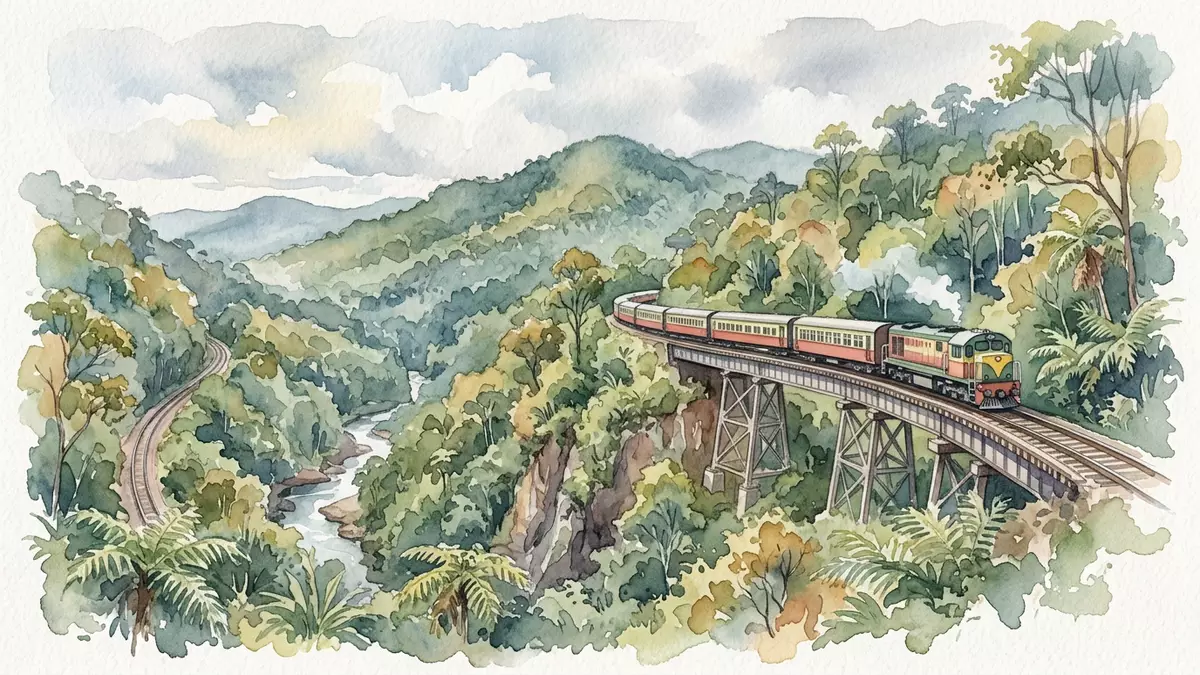
Kuranda Scenic Railway climbs from the coast near Cairns to Kuranda through rainforest, ravines, tunnels and bridges. The heritage line opened to passenger travel on 25 June 1891, and its route remains a visible record of nineteenth-century railway construction in Queensland.
Kuranda Scenic Railway climbs through Barron Gorge
The railway links Cairns with Kuranda on the Atherton Tableland, crossing the coastal range through the Barron Valley. From the lowlands, the line rises towards Kuranda and reaches an elevation of about 328 m (1,076 ft) near Barron Falls.
The journey passes through the Macalister Range, Stoney Creek Gorge and Barron Gorge. Rainforest borders sections of the track, while steep rock faces, waterfalls and narrow valleys appear between the railway structures. The route is a moving sequence of bridges, cuttings and dense tropical vegetation.
The railway’s physical scale is easy to read from its route. The line includes hand-built tunnels and numerous bridges, with the track repeatedly crossing difficult ground above creeks and ravines. The result is a railway landscape in which engineering and rainforest occupy the same view.
Construction between 1886 and 1891
Construction began in 1886 after the Barron Valley gorge route had been selected for a railway linking the coast with the inland tablelands. Sir Samuel Griffith turned the first sod on 10 May 1886, marking the beginning of a project carried out with hand tools, dynamite and manual labour.
John Robb held the contract for the difficult range section. Workers cut into steep slopes, formed embankments and excavated more than two million cubic metres of earth. The work included fifteen tunnels, many curves and bridges above waterfalls and ravines.
The line was constructed in an era before modern earth-moving machinery. Camps appeared beside tunnels and cuttings, and workers came from different parts of Europe and Australia. The physical record remains in the masonry, tunnel mouths, retaining walls and bridgework along the range.
Goods traffic reached the Kuranda line on 15 June 1891. Passenger services followed ten days later. Kuranda railway station in its present form dates from 1915 and has Federation-style details, landscaped gardens and rainforest planting.
Stations, bridges and the rainforest village
The railway journey connects Cairns, Freshwater and Kuranda, with the route passing through the foothills before entering the range. Freshwater station lies inland from Cairns, while Kuranda station stands beside the Barron River near the village.
Stoney Creek Bridge is among the route’s recognisable structures. Its track crosses a steep gorge beside falling water, joining the railway’s metalwork to the surrounding forest. The bridge belongs to the same wider engineering landscape as the tunnels and rock cuttings.
Barron Falls railway station provides a viewpoint towards Barron Falls and the gorge. The waterfall, railway line and rainforest occupy connected parts of the same landscape, with the track continuing through the range towards Kuranda.
Kuranda railway station has a distinctive timber character, Federation-style detailing and extensive fern planting. The station is closely associated with the rainforest village, where the railway arrives among vegetation rather than in an open urban setting.
The line’s heritage identity comes from the combination of its date, construction methods and setting. Queensland heritage railway records describe the section through the coastal range, Stoney Creek Gorge and Barron Gorge.
The route also preserves a direct connection with Queensland’s nineteenth-century railway expansion. The railway history records the 1886 construction start, the 1891 passenger opening and the hand-built work across the range.
The railway’s route has a length, elevation and character that can be understood without separating it from the terrain. The Cairns–Kuranda route describes the connection between Cairns, Freshwater and Kuranda through the rainforest.
Visiting Kuranda Scenic Railway: what travellers from Western Europe should know
- The railway runs from Cairns through Freshwater to Kuranda in Queensland, Australia. Kuranda station is beside the Barron River and near the village.
- The route climbs from the coastal lowlands to about 328 m (1,076 ft), passing through steep rainforest country, gorges, tunnels and bridges.
- Barron Falls railway station lies beside the gorge and provides views towards Barron Falls. Stoney Creek Bridge is another named structure along the range section.
- The official language is English and the currency is the Australian dollar.
- Entry requirements depend on your nationality; UK travellers can check the FCDO travel advice at gov.uk/foreign-travel-advice, Irish travellers the Department of Foreign Affairs at ireland.ie.
Searching for Kuranda Scenic Railway on social platforms
These links open searches for Kuranda Scenic Railway on each platform.
Frequently asked questions about Kuranda Scenic Railway
Where is Kuranda Scenic Railway?
The railway runs between Cairns and Kuranda in Queensland, Australia. It crosses the coastal range through Stoney Creek Gorge and Barron Gorge.
What can travellers expect on the route?
The route includes rainforest, steep valleys, tunnels, bridges, waterfalls and named railway stations. The line rises towards Kuranda and reaches about 328 m (1,076 ft) near Barron Falls.
What makes the railway distinctive?
Its identity comes from the combination of a passenger railway opened in 1891, hand-built range engineering and a rainforest setting. Kuranda station adds a Federation-style railway building beside the Barron River.


