
La Seu Vella and Lleida’s open stone cloister
Published on 09/23/2026 at 00:52 | Editorial responsibility: Rafael Müller, Editor-in-Chief AD HOC NEWS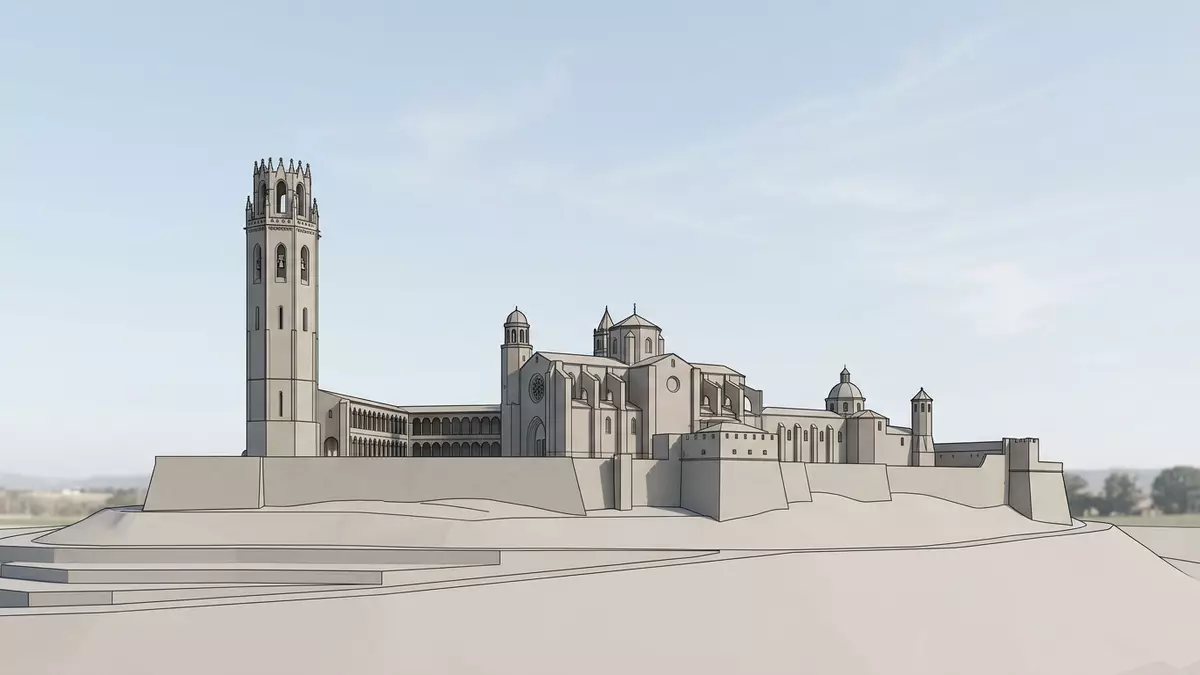
La Seu Vella rises above Lleida as a medieval cathedral whose cloister opens towards the city and the surrounding plain. Romanesque portals, Gothic chapels and a bell tower completed in 1431 form a complex built across several centuries.
La Seu Vella on Lleida Hill
The cathedral stands on the Turó de Lleida, the hill that dominates Lleida and the Segrià plain. Its elevated position places the church, cloister, Canonja and nearby Castle of the King within a single monumental precinct.
The present cathedral began in 1203 under Pere de Coma, its first recorded master builder. The church was consecrated in 1278 and dedicated to the Virgin Mary. Construction began in 1203 during a period when Romanesque forms were meeting newer Gothic practice.
Romanesque portals and Gothic stonework
La Seu Vella combines Romanesque and Gothic architecture rather than presenting a single uniform style. The Romanesque portals carry carved decoration, while the later Gothic work appears in the chapels, vaulting and cloister.
The building’s sculptural language is associated with the School of Lleida. The Anunciata, Fillols, Sant Berenguer and Apostles’ doorways belong to different stages of the medieval complex. Their carved figures, foliage and geometric details show how the cathedral’s decoration developed between the twelfth and fifteenth centuries.
The church follows a Latin-cross plan with a nave and two aisles. Stonework fills the interior, alongside surviving Gothic mural paintings. The cathedral’s major medieval elements include the chapels, the cloister, the bell tower and the Portal of the Apostles. Romanesque and Gothic elements remain visible across the ensemble.
The cloister that opens towards the plain
The cloister is positioned directly before the cathedral’s main façade, an arrangement that distinguishes La Seu Vella from many Christian cathedral complexes. Its galleries contain pointed arches, tracery windows and carved capitals.
The open cloister forms the most recognisable spatial feature of the monument. Its arcades frame Lleida, the lower city and the agricultural plain beyond. The capitals provide a close view of medieval sculpture, while the galleries connect the cathedral façade with the rest of the hilltop complex.
Work on the cloister continued into the fourteenth century, and the bell tower remained under construction until 1431. The tower gives the cathedral a vertical counterpoint to the broad cloister galleries. The bell tower was completed in 1431.
La Seu Vella served as the cathedral church of the Diocese of Lleida from 1278 until 1707. In the early eighteenth century, its religious function ended and the hilltop complex became a military stronghold. The nearby Castle of the King, also known as La Suda, adds a second historical layer to the site.
Visiting La Seu Vella: what travellers from Western Europe should know
- La Seu Vella stands on the Turó de Lleida above the city. Lleida railway station connects the city with regional and long-distance rail services, while the hill is reached from the urban area by road and on foot.
- The site occupies a hilltop precinct with sloping approaches, stone surfaces and steps between its buildings. The cathedral, cloister, Canonja and Castle of the King are arranged across the elevated complex.
- The official language is Catalan and Spanish, and the currency is the euro.
Searching for La Seu Vella on social platforms
These links open searches for La Seu Vella on each platform.
Frequently asked questions about La Seu Vella
Where is La Seu Vella?
La Seu Vella stands on the Turó de Lleida, the hill above Lleida in Catalonia, Spain. The complex overlooks the city and the surrounding Segrià plain.
What can visitors see at La Seu Vella?
The complex contains the cathedral, Romanesque portals, Gothic chapels, the open cloister, the Canonja and the bell tower. The nearby Castle of the King forms part of the hilltop monumental setting.
What makes La Seu Vella distinctive?
Its cloister stands directly before the cathedral façade and opens towards views of Lleida. Romanesque sculpture, Gothic additions and the military history of the hill appear together in one complex.


