
La Seu Vella, Lleida’s hilltop cathedral-fortress
Published on 08/24/2026 at 17:46 | Editorial responsibility: Rafael Müller, Editor-in-Chief AD HOC NEWS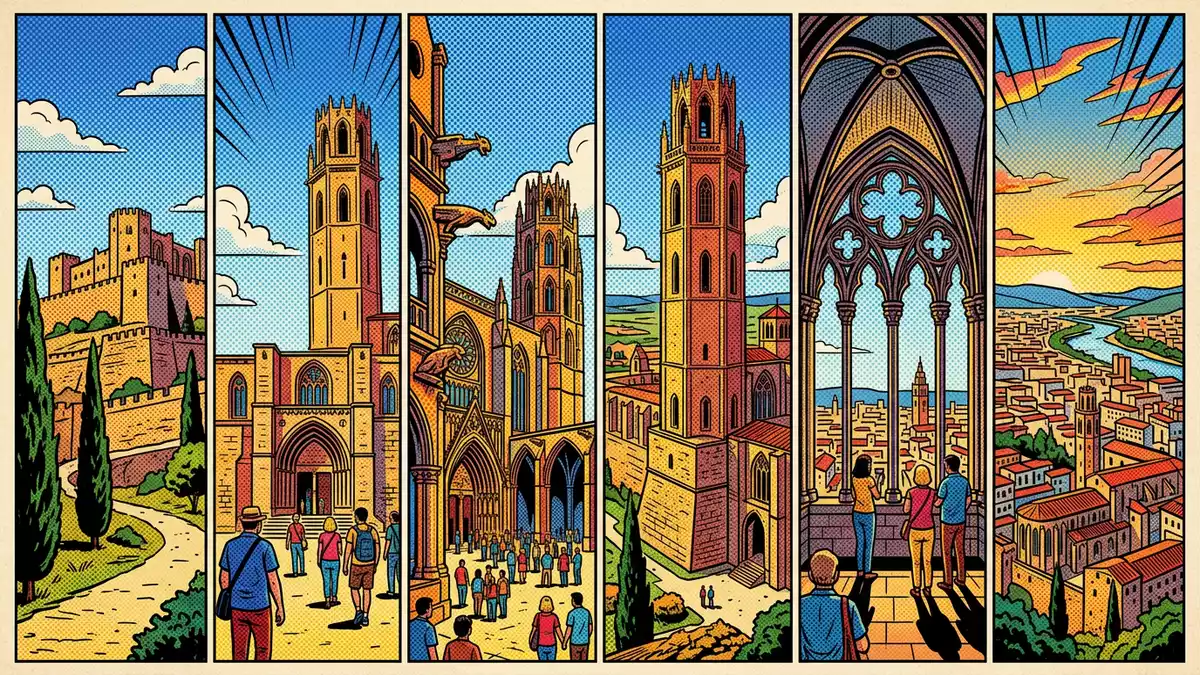
La Seu Vella is the former cathedral that crowns the hill above Lleida in Catalonia, its sandstone mass and slender bell tower forming a landmark visible across the Segrià plain. Built in the thirteenth century on the Turó de la Seu Vella, it later became a military fortress, and the combination of church, cloister and defences gives the site its distinctive character.
A cathedral on the Turó de la Seu Vella
La Seu Vella stands on the Turó de Lleida, the hill that dominates the city and the surrounding plain, with the cathedral complex occupying the highest point.Turó de Lleida From the terrace beside the church the view stretches over the compact urban fabric of Lleida and out towards irrigated fields and distant ranges, giving a clear sense of how the hill has long controlled approaches to the city.
The building known as La Seu Vella is the old Cathedral of Saint Mary, a Romanesque structure with Gothic vaulting, begun in 1203 under the master builder Pere de Coma and consecrated in 1278.begun in 1203 Its plan has three naves, a marked transept with a dome above, and a sanctuary with multiple apses, all executed in warm local stone that has weathered into a muted, textured surface.
Romanesque, Gothic and a vast open cloister
One of the most striking features of La Seu Vella is the way late Romanesque forms and Gothic elements sit together in a single complex, the heavy walls and carved portals contrasted with pointed vaults and slender supports.combination of late Romanesque and Gothic Capitals and door surrounds carry sculpted foliage, human figures and geometric patterns, while the interior space of the nave rises in a sequence of bays under ribbed stone ceilings.
Beside the church lies an extensive cloister, an open courtyard framed by arcaded galleries whose arches look out towards the city and the plain.arcaded galleries of the cloister The sandstone columns, traceried openings and carved details turn the cloister into a kind of stone balcony over Lleida, and its scale underlines that La Seu Vella was once a major medieval cathedral precinct rather than a small parish church.
From cathedral to fortress on Lleida’s skyline
In the eighteenth century, after the War of the Spanish Succession, La Seu Vella ceased to serve as Lleida’s main cathedral, and the hilltop complex was converted into a military fortress with barracks and defensive works.converted into a military fortress Fortification walls encircle the Turó de la Seu Vella, and the presence of the nearby Castell del Rei, or La Suda, reinforces the impression of a combined religious and military acropolis above the city.
The building’s status as an old cathedral and national monument has been formally recognised, and twentieth-century restoration campaigns have focused on recovering its architectural character after the long period of military use.Old Cathedral of Lleida monument Today La Seu Vella reads simultaneously as a church without its original furnishings, a cloister open to the elements and a fortified ensemble, with the tall bell tower rising above walls that recall its centuries as a citadel.
Visiting La Seu Vella: what travellers from Western Europe should know
- La Seu Vella stands on the Turó de la Seu Vella hill above Lleida in western Catalonia, with road access from the lower city and signposted approaches on foot.
- The cathedral complex sits on elevated ground with terraces, internal staircases and stone surfaces, so visiting involves walking on gradients and tackling steps within the cloister and tower areas.
- Castell del Rei, also known as La Suda, lies close to the cathedral on the same hill, forming part of the wider historic ensemble above Lleida.
- The official language is Catalan and the currency is the euro.
Searching for La Seu Vella on social platforms
These links open searches for La Seu Vella on each platform.
Frequently asked questions about La Seu Vella
Where is La Seu Vella located?
La Seu Vella stands on the Turó de la Seu Vella hill above the city of Lleida in western Catalonia, Spain, overlooking the Segrià plain.
What can visitors expect at La Seu Vella?
Visitors encounter a former cathedral with Romanesque and Gothic architecture, a large open cloister, surrounding fortification walls and extensive views over Lleida and its hinterland.
What makes La Seu Vella distinctive among Iberian cathedrals?
Its combination of medieval cathedral church, vast cloister and later fortress works on a commanding hilltop gives La Seu Vella a dual religious and military character unusual for such a site.


