
Lago di Como between lake shore villas and mountain walls
Published on 08/24/2026 at 07:48 | Editorial responsibility: Rafael Müller, Editor-in-Chief AD HOC NEWS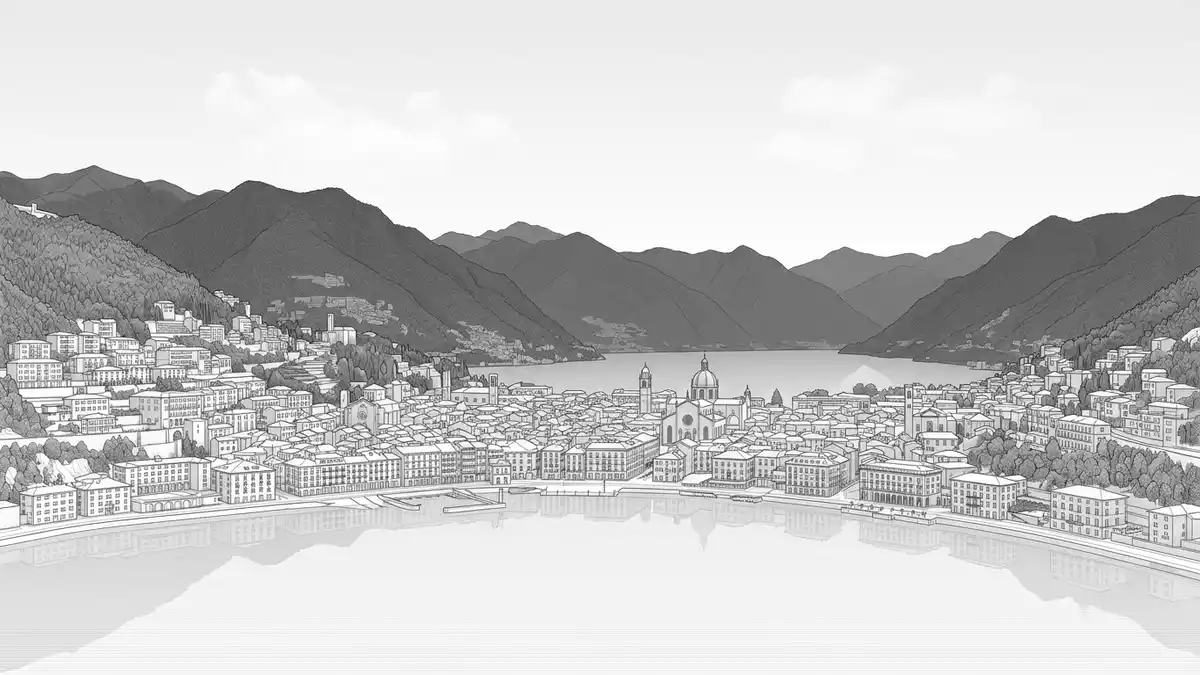
Lago di Como, also called Lake Como, is a glacial lake in Lombardy, northern Italy, with a surface area of 146 km² and an inverted Y shape. Como sits at the south-western end, where the lake meets the city and the hills begin.
Lake water, steep shores and a divided outline
The lake reaches a maximum depth of 425 m (1,394 ft) and stretches for about 46 km (29 miles). Its three branches frame different shorelines, from town fronts to slopes and wooded edges.
Britannica places Como at the extreme south-west end of the lake, north of Milan, and describes the surrounding mountains as limestone and granite. The basin belongs to the southern side of the Alps, with water and rock sharing the same narrow setting.Como at the extreme south-west
The lake is also known in Italian as Lago di Como and in Latin as Larius. That older name survives in the local habit of treating the water, the shore towns and the wider district as one connected landscape.
Historic houses on the shore
Villa Carlotta stands in Tremezzina on the western shore. It was built around 1690 for Giorgio Clerici, the Milanese president of the Senate, and later took its present name from Princess Charlotte of Prussia.built around 1690
The villa combines a house, art collection and botanical garden. Its long history includes aristocratic ownership, later public stewardship and a setting that opens towards the water and the opposite shore.botanical garden
Villa del Balbianello, on the Dosso d’Avedo peninsula near Lenno, belongs to the same shoreline world. Cardinal Angelo Maria Durini acquired the site in the late eighteenth century, and the house later passed through the hands of Guido Monzino, whose collection remains part of its identity.Cardinal Angelo Maria Durini
These villas are not isolated monuments. They sit in a chain of terraces, landing places and lakefront gardens that make the shore read as a continuous cultural edge rather than a series of separate stops.
Como, Pliny and the lake’s cultural memory
The city of Como adds an older civic layer to the lakeside scene. The Roman town of Comum was the birthplace of Pliny the Elder and Pliny the Younger, figures whose names remain tied to the city’s classical reputation.Pliny the Elder
That heritage appears in the Duomo of Como as well, where the facade carries statues of the two Plinys. The cathedral gives the lakeside city a stone centre, while the water remains only a short walk away.Duomo of Como
Lake Como is therefore not just a sheet of water. It is a historic setting of Roman memory, villa architecture and mountain-backed shoreline, all compressed into a single basin.
Visiting Lago di Como: what travellers from Western Europe should know
- The lake lies in Lombardy, north of Milan, with Como at its south-western end. Ferries and lakeside roads connect the shore towns, and the city of Como serves as the main urban gateway.
- Shore walks can involve steps, gradients and repeated changes in level. The villas on the western shore also sit on terraces above the water.
- Villa Carlotta stands in Tremezzina on the western shore, facing the Bellagio side across the lake. Villa del Balbianello occupies a peninsula near Lenno.
- The basin’s three branches meet at a broad central point near Bellagio. The lake’s form is easy to read from the shore, with the water narrowing into long arms.
Searching for Lago di Como on social platforms
These links open searches for Lago di Como on each platform.
Frequently asked questions about Lago di Como
Where is Lago di Como?
Lago di Como lies in Lombardy, in northern Italy. Como sits at its south-western end, north of Milan.
What does a visit to Lago di Como involve?
The lake is a landscape of water, shore towns and steep sides. Ferries, roads and villa gardens link its main settlements.
What makes Lago di Como distinctive?
Its long, inverted Y shape is the defining image. The basin also joins Roman Como, grand villas and alpine rock in one setting.


