
Lago Titicaca and the high-water world of Copacabana
Published on 09/23/2026 at 03:03 | Editorial responsibility: Rafael Müller, Editor-in-Chief AD HOC NEWS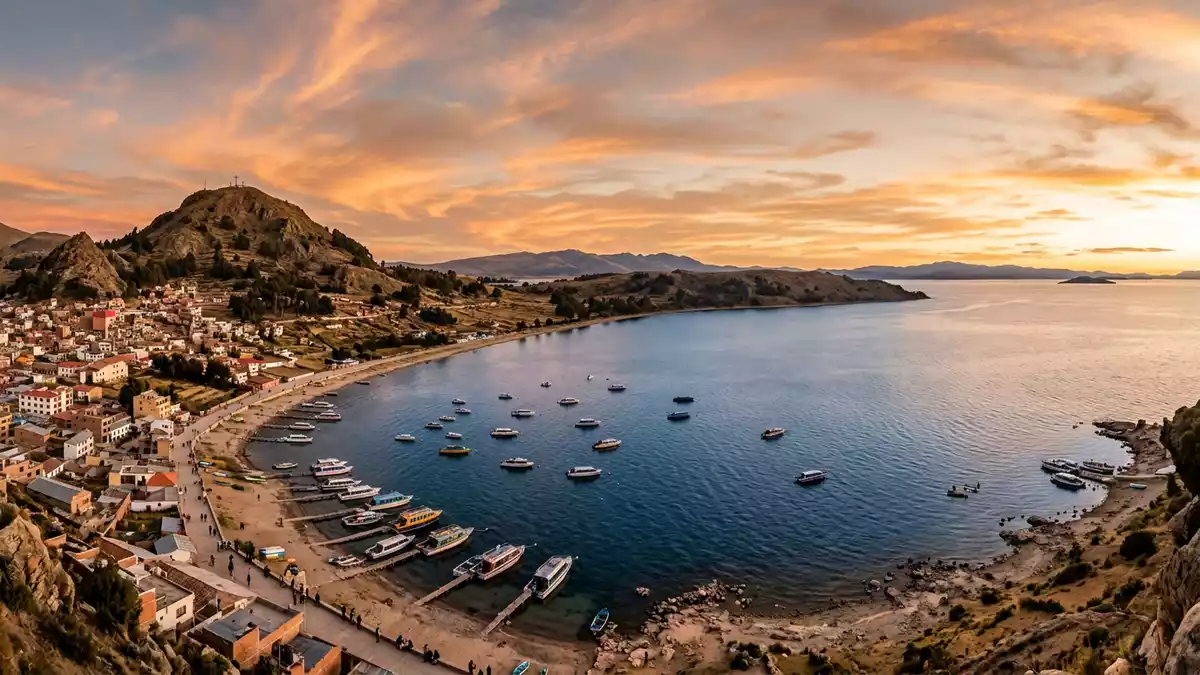
Lago Titicaca is a vast high-Andean lake shared by Bolivia and Peru. Its water lies at about 3,810 m (12,500 ft) above sea level, while Copacabana occupies a sheltered Bolivian shore beside the lake’s southern basin. The combination of open water, mountain light, islands and archaeological remains gives the landscape its distinctive character.
Lago Titicaca: water above the Altiplano
The lake stretches across the Altiplano, the elevated plateau of the central Andes. Its surface covers approximately 8,300 square kilometres, and its basin includes open water, reed wetlands, islands, cultivated slopes and settlements. The shore belongs to both Peru and Bolivia, with Puno on the western side and Copacabana in Bolivia’s La Paz Department.
At this elevation, the lake is part of a high mountain environment rather than a lowland waterscape. Grasses, reeds and sparse shrubs appear across the surrounding terrain, while the water opens between ridges and distant peaks. Lago Titicaca is navigable by large vessels and is recognised as the highest navigable lake of its kind.
Copacabana and the Bolivian shore
Copacabana sits on a peninsula between sections of Lago Titicaca, with the town facing a bay and the lake extending towards the islands beyond. Its urban centre includes the Basilica of Our Lady of Copacabana, a major religious building associated with the Virgin of Copacabana. The town’s streets, shoreline and hills form the principal mainland setting for exploring the Bolivian side.
From Copacabana, the view reaches towards Isla del Sol, or the Island of the Sun, in the southern part of the lake. The island belongs to Bolivia and contains villages, terraces, paths, carved stones and archaeological remains. Its terrain rises and falls across a long island ridge, so the landscape is encountered through shorelines, slopes and high viewpoints rather than a single enclosed site.
Isla del Sol, Tiwanaku and Inca memory
Isla del Sol carries archaeological evidence of human occupation dating to at least the third millennium BC. Tiwanaku culture flourished around the southern Lake Titicaca region before the Inca period, leaving the lake within a long sequence of Andean cultural history.
Many visible remains on the island belong to the Inca period, particularly the fifteenth century. The Sacred Rock, the Chincana ruins, the Inca Stairway, terraces and stone structures form a dispersed archaeological landscape. The island also remains connected with Aymara communities and living agricultural traditions, so ancient masonry and inhabited settlements occupy the same high terrain.
Lago Titicaca’s cultural importance reaches beyond individual ruins. The lake appears in origin traditions associated with Andean peoples, including Inca accounts linking the waters and islands with the beginnings of the sun and the first Inca ancestors. Archaeology and oral tradition therefore meet across a landscape defined by water, rock, cultivation and altitude.
Visiting Lago Titicaca: what travellers from Western Europe should know
- Copacabana lies on the Bolivian shore in La Paz Department. The town is reached by road from La Paz, while boats connect its lakeside harbour with Isla del Sol.
- The lake and surrounding settlements sit at roughly 3,810 m (12,500 ft). Walks on Isla del Sol include steep paths, stone steps, terraces and uneven ground.
- The principal languages in Bolivia include Spanish, Quechua and Aymara. The national currency is the Bolivian boliviano.
- Conditions on the mountain change with the seasons; the local cable-car operators and alpine clubs provide information.
- Entry requirements depend on your nationality; UK travellers can check the FCDO travel advice at gov.uk/foreign-travel-advice, Irish travellers the Department of Foreign Affairs at ireland.ie.
Searching for Lago Titicaca on social platforms
These links open searches for Lago Titicaca on each platform.
Frequently asked questions about Lago Titicaca
Where is Lago Titicaca?
Lago Titicaca lies in the Andes between Peru and Bolivia. Copacabana is a Bolivian lakeside town on the southern part of the basin.
What can travellers expect around Copacabana?
The area combines a high-altitude shoreline with boat routes, island paths, cultivated terraces, villages and archaeological remains. Isla del Sol is the principal island landscape associated with the Bolivian side.
What makes Lago Titicaca distinctive?
The lake combines an elevation of about 3,810 m (12,500 ft) with a large navigable water surface and a cultural history reaching from early settlement through Tiwanaku and Inca periods.


