
Lake Manyara National Park between lake and Rift Valley wall
Published on 09/08/2026 at 07:21 | Editorial responsibility: Rafael Müller, Editor-in-Chief AD HOC NEWS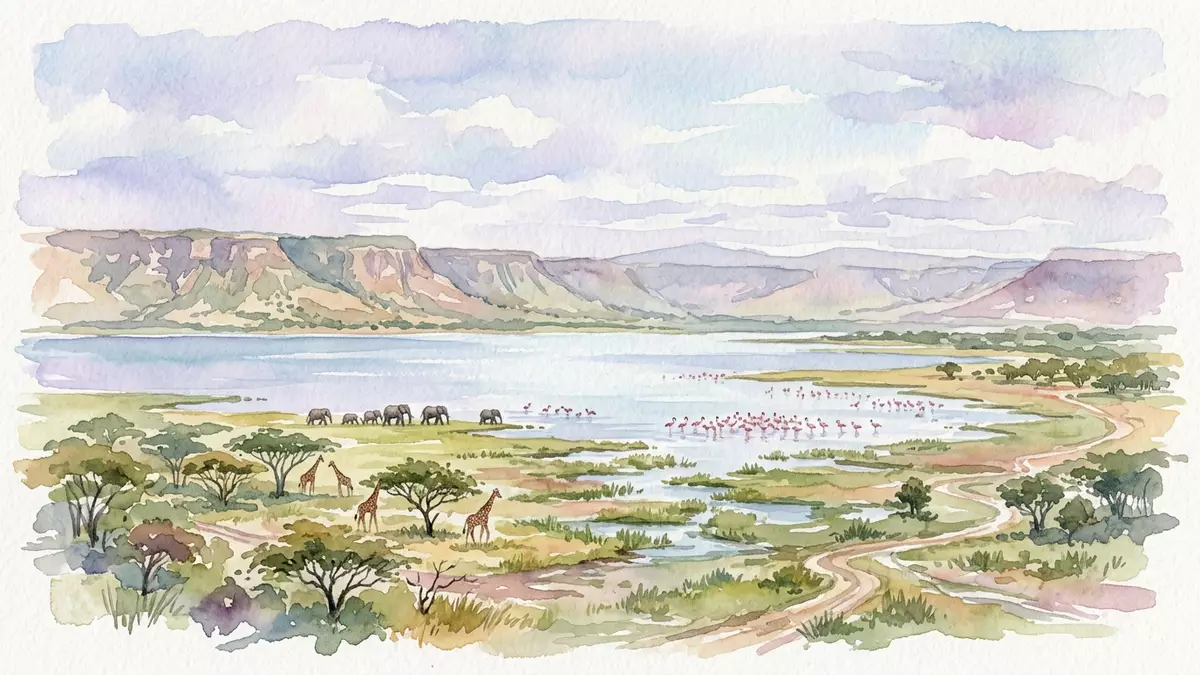
Lake Manyara National Park sits between the shimmering surface of Lake Manyara and the abrupt wall of the Great Rift Valley, creating a narrow wildlife corridor that feels like a cross?section of northern Tanzania in miniature. Established as a national park in 1960, it links the market town of Mto wa Mbu with one of East Africa’s most distinctive combinations of lake, forest and cliff.
Lake, escarpment and a compact safari landscape
The park occupies a strip of land along the floor of the Rift Valley, with Lake Manyara on one side and the rising escarpment on the other. The protected area covers in the region of 330 km², and a substantial part of that fluctuates with the level of the shallow alkaline lake.Within just 330 km² Lake Manyara National Park contains groundwater forest, acacia woodland, open floodplain and lakeshore.
Lake Manyara itself is a soda lake, with water that can be highly alkaline and with depths that remain low even in the rainy season.Water levels rise and fall seasonally, exposing salt flats along parts of the shoreline when the lake retreats. The contrast between bright salt crust, pale water and the dark green of forest at the lake’s edge is one of the most characteristic sights on a drive through the park.
Habitats, wildlife and UNESCO biosphere status
Although Lake Manyara National Park is relatively compact compared with some other Tanzanian reserves, it is known for an unusually dense mix of habitats and species. Groundwater forest near the park’s northern gate gives way to acacia woodlands and grassy floodplains closer to the lake. The alkaline shallows attract flamingos and other water birds, while elephants, hippos and a variety of antelope use the forest and riverine areas on the drier ground.Flamingos, elephants, hippos and over 400 bird species have been recorded around the lake and its surrounding vegetation.
The national park forms the core of the Lake Manyara Biosphere Reserve, recognised under UNESCO’s Man and the Biosphere Programme.It forms part of a UNESCO Biosphere Reserve that extends beyond the park boundary to include the wider lake basin. This status reflects the way different ecological zones fit together: lake and wetland in the basin itself, forest and woodland on the valley floor, and higher ground rising towards the Ngorongoro Highlands. For travellers, it translates into short drives between contrasting scenes, with wildlife ranging from large mammals to dense bird life.
Names, history and the link to Mto wa Mbu
Lake Manyara National Park takes its name from both the lake and from a local plant. The name “Manyara” is linked to Euphorbia tirucalli, a species known as emanyara in Maasai, whose hedges traditionally mark homestead boundaries in the area.The park derives its name from a plant called Euphorbia tirucalli and from the lake that runs along its eastern edge. The area was first protected as a game reserve in the late 1950s before becoming a national park in 1960, a period when Tanzania’s northern wildlife areas were being formally set aside for conservation and tourism.It became a game reserve in 1957 and a national park in 1960.
Mto wa Mbu stands immediately north of the park entrance, at the point where the tarmac road from Arusha meets the Rift Valley wall. It has grown as a trading centre, drawing people from many parts of Tanzania, and is often used as a base or stopover for visits to the park. The main gate of Lake Manyara National Park lies close to the town, at the foot of the escarpment where forest begins.The park’s main gate is close to Mto wa Mbu, creating a direct link between local markets and the start of the protected area.
Visiting Lake Manyara National Park: what travellers from Western Europe should know
- Lake Manyara National Park lies in northern Tanzania, along the Northern Safari Circuit between Tarangire National Park and the Ngorongoro Conservation Area, with the main gate reached by road from Arusha near Mto wa Mbu.
- The terrain combines a flat valley floor with sections of forest and floodplain; game drives follow established tracks, some of which run close to the lakeshore, where surfaces can vary with the season.
- The official language is Swahili and the currency is the Tanzanian shilling.
- Entry requirements depend on your nationality; UK travellers can check the FCDO travel advice at gov.uk/foreign-travel-advice, Irish travellers the Department of Foreign Affairs at ireland.ie.
Searching for Lake Manyara National Park on social platforms
These links open searches for Lake Manyara National Park on each platform.Frequently asked questions about Lake Manyara National Park
Where is Lake Manyara National Park?
Lake Manyara National Park lies in northern Tanzania, between Lake Manyara and the Great Rift Valley escarpment, with its main gate close to Mto wa Mbu and reached by road from Arusha.
What can travellers expect on a visit?
A visit typically involves game drives through forest, woodland and floodplain, with views of the alkaline lake, sightings of large mammals and dense bird life in a compact setting.
What makes Lake Manyara National Park distinctive?
The park’s character comes from the way a shallow soda lake, varied habitats and the steep Rift Valley wall are compressed into a relatively small area that carries UNESCO biosphere status.


