
Lamu Old Town, a living Swahili city of coral stone and carved doors
Published on 09/09/2026 at 08:36 | Editorial responsibility: Rafael Müller, Editor-in-Chief AD HOC NEWS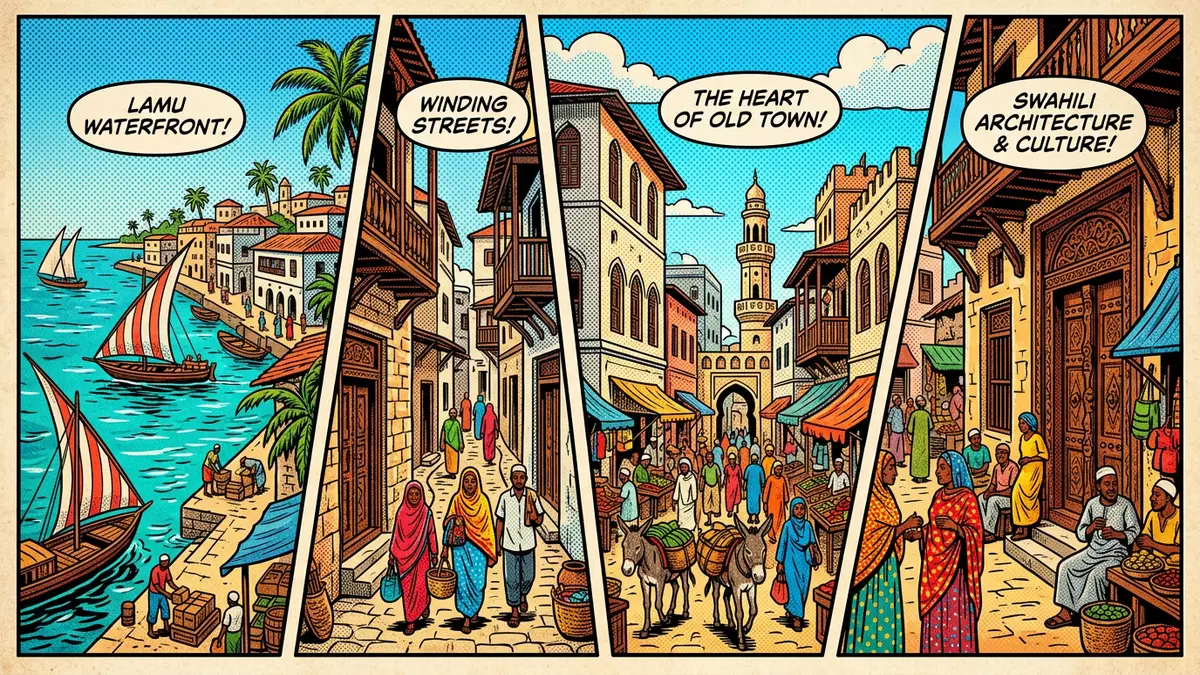
Lamu Old Town on Kenya’s Lamu Island is a historic Swahili settlement where coral stone houses, mangrove timber beams and intricately carved wooden doors line a maze of narrow lanes. Dating back to the twelfth century and inscribed as a UNESCO World Heritage Site in 2001, it is a living town whose architecture, street layout and harbourfront reflect centuries of trade and cultural exchange across the Indian Ocean.
A Swahili town shaped by centuries of Indian Ocean trade
Lamu Old Town stands on the waterfront of Lamu Island, part of the Lamu Archipelago off the northern coast of Kenya in the Indian Ocean. The town developed as a Swahili port within a broader chain of coastal settlements that linked East Africa with Arabia, Persia, India and later Europe, using the seasonal monsoon winds to move people and goods along maritime routes.Lamu Old Town on the coast of East Africa Over more than 700 years of continuous settlement, merchants, religious scholars and craftsmen created a town where everyday life, trade and faith are closely intertwined.
The historical record links Lamu’s emergence as a major centre to the period between the twelfth and fourteenth centuries, when Swahili towns flourished as intermediaries between African hinterlands and overseas markets.Lamu as an important trading centre in Islamic coastal East Africa Over time, Lamu experienced Portuguese rule, Omani Arab control and later incorporation into British colonial administration before becoming part of independent Kenya in 1963.Periods of Portuguese and Omani influence These political shifts left traces in the town’s institutions and built fabric, yet the Swahili character remained dominant.
Coral stone houses, courtyards and carved doors
Lamu Old Town is built primarily from coral stone blocks and mangrove timber, materials drawn from the coastal environment and used across the Swahili coast. Houses rise in compact plots along narrow streets, creating continuous walls punctuated by entrances and occasional projecting verandahs facing the lanes.Coral stone and mangrove timber construction Many buildings are organised around inner courtyards that bring light and air into the heart of the home while preserving privacy behind street-facing walls.
One of the most striking features of Lamu’s architecture is the profusion of elaborately carved wooden doors, often framed by carved lintels and side panels, which mark the threshold between street and interior. These doors combine geometric patterns, floral motifs and calligraphic inscriptions, reflecting both Swahili craft traditions and influences from Arab and Indian design.Elaborately carved wooden doors Many townhouses also include shaded verandahs or arcades at first-floor level along the seafront or main streets, creating transitional spaces between the private domain and public life.
A World Heritage harbour town that remains lived-in
Lamu Old Town was inscribed on the UNESCO World Heritage List in December 2001 as a cultural property under criteria (ii), (iv) and (vi, recognising its architecture, its role in regional history and its association with Islamic and Swahili traditions.UNESCO inscription of Lamu Old Town in 2001 The designated area covers a compact urban core of around 15 to 16 hectares, surrounded by a buffer zone that includes parts of the adjacent Indian Ocean waters and the skyline of nearby Manda Island.Old Town extent and buffer zone
Unlike many historic ports that have turned into museums, Lamu Old Town remains a living settlement, with residential houses, mosques, small shops, guesthouses and civic buildings such as the Lamu Fort and the Lamu Museum occupying structures that retain traditional forms.Historic sites including Lamu Fort and Lamu Museum The town’s lanes are narrow and follow an irregular pattern shaped by plot boundaries and building alignments, and the seafront still frames views of dhows and other small vessels moored along the harbour.
Visiting Lamu Old Town: what travellers from Western Europe should know
- Lamu Old Town lies on Lamu Island off Kenya’s northern coast in the Indian Ocean, reached by crossing the channel from the mainland at Mokowe to the island port of Lamu.
- The town’s streets are narrow and largely laid out for walking; many routes involve uneven ground, stepped thresholds and alleyways where pedestrians, handcarts and animals share limited space.
- The surrounding area forms part of the Lamu Archipelago, with views across the water towards Manda Island and other low-lying islands close to the harbour.
- The official language is Swahili alongside English, and the currency is the Kenyan shilling.
- Entry requirements depend on your nationality; UK travellers can check the FCDO travel advice at gov.uk/foreign-travel-advice, Irish travellers the Department of Foreign Affairs at ireland.ie.
Searching for Lamu Old Town on social platforms
These links open searches for Lamu Old Town on each platform.
Frequently asked questions about Lamu Old Town
Where is Lamu Old Town located?
Lamu Old Town is on Lamu Island in the Lamu Archipelago off the northern coast of Kenya in the Indian Ocean, reached from the mainland at Mokowe.
What can visitors expect when walking through Lamu Old Town?
Visitors encounter narrow lanes lined with coral stone houses, mangrove timber beams, inner courtyards and ornate carved doors, together with harbourfront views and active residential neighbourhoods.
What makes Lamu Old Town distinctive among coastal towns?
Lamu Old Town is recognised as the oldest and best-preserved Swahili settlement in East Africa, with continuous habitation, a compact historic core and a streetscape shaped by centuries of Indian Ocean trade.


