
Lamu Old Town and the living fabric of Swahili architecture
Published on 08/23/2026 at 13:02 | Editorial responsibility: Rafael Müller, Editor-in-Chief AD HOC NEWS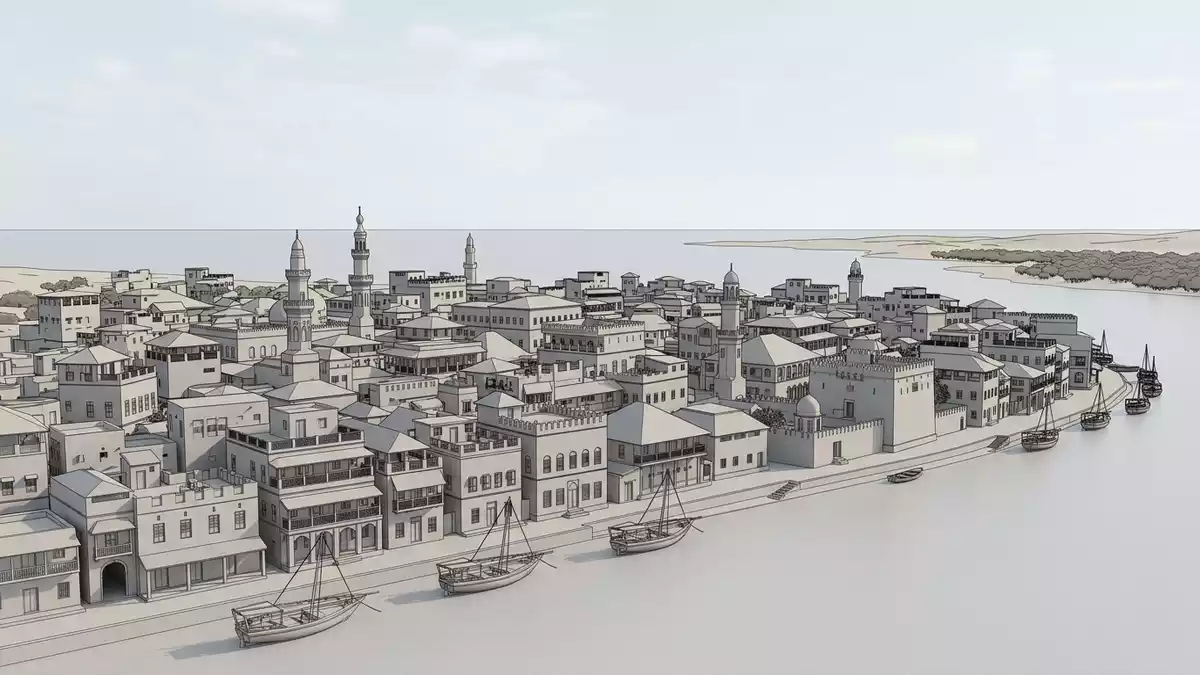
Lamu Old Town on Lamu Island, off Kenya’s northern coast, is a living Swahili town where coral-stone streets, carved timber doors and Islamic learning have shaped daily life for centuries.
A medieval Swahili town on the Indian Ocean
Lamu Old Town lies on Lamu Island, part of the Lamu Archipelago on the Indian Ocean coast of Kenya, north-east of Mombasa and close to the border with Somalia.Lamu Old Town on Lamu Island The settlement forms a compact urban area backed by low hills and facing a sheltered channel towards Manda Island, where the waterfront opens to dhows and small boats crossing the shallow waters.
The town is widely recognised as the oldest continuously inhabited Swahili settlement on the East African coast, with origins in the medieval period and a documented history extending over more than 700 years.more than 700 years of settlement Its position along Indian Ocean trade routes brought merchants, scholars and sailors from Arabia, Persia, India and later Europe, shaping an urban culture that blends African and Indian Ocean influences in stone and timber.cultural influences from Arabia, India and Europe
Coral stone, mangrove timber and carved doors
The defining material palette of Lamu Old Town is coral stone and mangrove timber, a construction tradition that gives the streets their pale, textured walls and dark timber details.built in coral stone and mangrove timber Many houses rise over several storeys, with façades that are almost blank at ground level save for heavy wooden entrance doors, while upper levels carry small windows and projecting verandas looking onto the lanes below.
Behind these walls, the domestic architecture often revolves around inner courtyards, shaded by galleries and sometimes trees, which organise rooms for family life and offer privacy from the street.inner courtyards and verandas The most celebrated feature of many houses is the elaborately carved wooden door, framed by inscriptions or vegetal motifs and studded with brass, reflecting Swahili craftsmanship with motifs drawn from Arab and Indian traditions.
Street layout, waterfront and religious life
The plan of Lamu Old Town is a fine-grained network of narrow streets and pathways running inland from the seafront, with lanes that curve gently and intersections that reveal short vistas of walls, galleries and small squares.street pattern with narrow lanes Many of these passages are too constricted for vehicles, which has preserved a pedestrian scale where people, donkeys and handcarts navigate the uneven ground between houses and mosques.
Along the waterfront, a linear public space separates the built-up old town from the water, edged by simple stone structures, steps and landing places for dhows and smaller craft that maintain the connection with other islands and the mainland.waterfront facing the channel Lamu has long held an important religious role, hosting major Muslim celebrations since the nineteenth century and serving as a regional centre of Islamic scholarship and Swahili poetry, which is reflected in the number of mosques and religious schools dispersed through the old town.religious celebrations and Islamic learning
World Heritage status and Swahili cultural continuity
In 2001 Lamu Old Town was inscribed on the UNESCO World Heritage List as a cultural site, under criteria (ii), (iv) and (vi), recognising both its architecture and its role in Islamic and Swahili culture.inscribed on the World Heritage List in 2001 The designation acknowledges the town as an outstanding example of a Swahili coastal settlement that has retained its traditional functions, with houses still inhabited and religious and educational institutions active.
The urban fabric reflects centuries of contact between Bantu-speaking communities, Arabs, Persians, Indians and Europeans, expressed in a distinct Swahili culture visible in building forms, carved woodwork and public spaces.interaction between Bantu, Arabs, Persians, Indians and Europeans Conservation efforts, including management plans for the sixteen-hectare core of the old town and its buffer zone over the waters towards Manda Island, aim to keep this historic settlement functioning while safeguarding its material character.management of the old town and buffer zone
Visiting Lamu Old Town: what travellers from Western Europe should know
- Lamu Old Town stands on Lamu Island off Kenya’s northern coast, reached by boat across the channel from jetties on the mainland and by small craft linking the islands.
- The old town’s streets are narrow, irregular and largely built for pedestrians and donkeys, with uneven ground surfaces and occasional steps between levels in the built fabric.
- Lamu lies in equatorial East Africa on the Indian Ocean; the climate brings strong sunlight and high temperatures, and the seafront offers views over the channel towards Manda Island.
- The official language is Swahili and the currency is the Kenyan shilling.
- Entry requirements depend on your nationality; UK travellers can check the FCDO travel advice at gov.uk/foreign-travel-advice, Irish travellers the Department of Foreign Affairs at ireland.ie.
Searching for Lamu Old Town on social platforms
These links open searches for Lamu Old Town on each platform.
Frequently asked questions about Lamu Old Town
Where is Lamu Old Town located?
Lamu Old Town is on Lamu Island off Kenya’s northern Indian Ocean coast, facing a sheltered channel and forming part of the Lamu Archipelago.
What should visitors expect when walking through Lamu Old Town?
Visitors encounter narrow pedestrian lanes in coral stone, houses with carved wooden doors and inner courtyards, and a waterfront lined with landing places for dhows.
What makes Lamu Old Town distinctive among coastal settlements?
Lamu Old Town combines centuries of Swahili culture, coral-stone and mangrove architecture, Islamic scholarship and a continuous urban life recognised through UNESCO World Heritage status.


