
Leshan Da Fo and the colossal Buddha carved into rock
Published on 09/22/2026 at 22:40 | Editorial responsibility: Rafael Müller, Editor-in-Chief AD HOC NEWS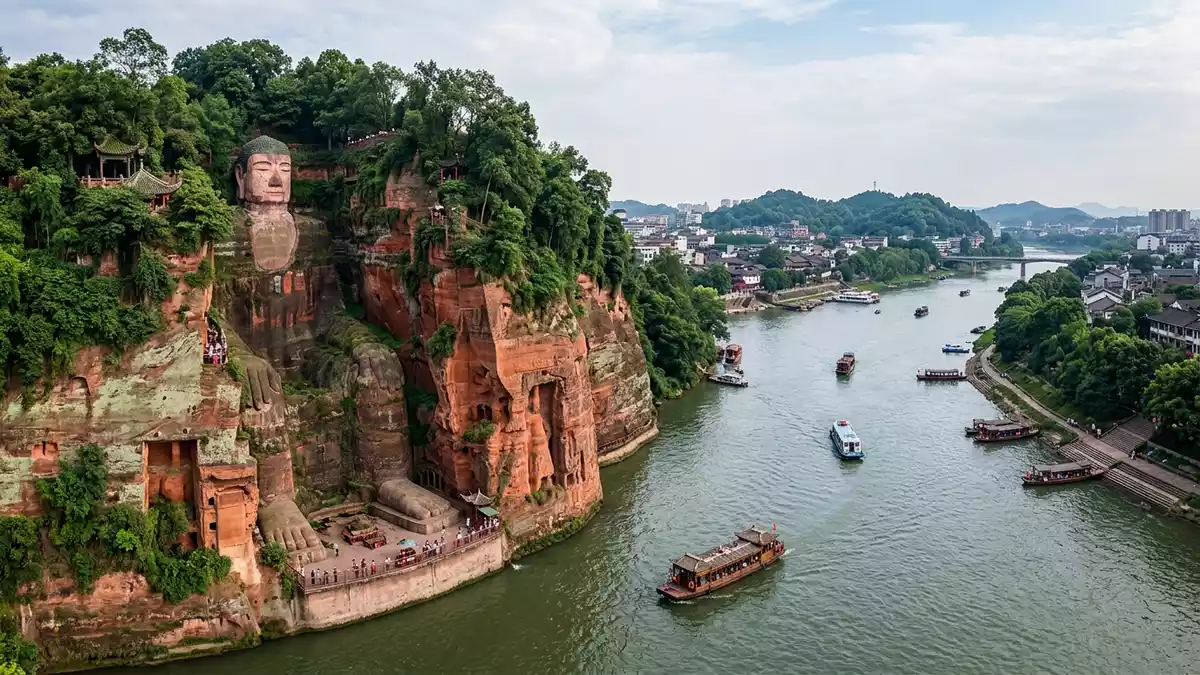
Leshan Da Fo is a seated Buddha carved into the cliff of Lingyun Mountain at Leshan, Sichuan. The red-sandstone figure rises 71 metres above the meeting of the Min, Dadu and Qingyi rivers, turning an entire mountainside into a Buddhist image.
Leshan Da Fo: a Buddha shaped from the cliff
The statue represents Maitreya, the Buddha associated with the future, and sits with both hands resting on its knees. Its head, shoulders, hands and feet are cut directly into the rock, while the surrounding cliff remains part of the composition.
The scale is easiest to understand through individual features. The shoulders measure 28 metres across, the fingers extend 8.3 metres, and the ears reach about 7 metres. The head carries a pattern of carved curls, giving the broad face a precise surface that contrasts with the rough mountain around it.
A Tang dynasty project completed in 803
Work began in 713 during the Tang dynasty, when the Buddhist monk Hai Tong led the project. The carving reached completion in 803, after roughly 90 years of work by successive generations of craftsmen.
The statue belongs to the religious and artistic world of Tang China, when Buddhist sculpture occupied an important place in temples, caves and mountain landscapes. Hai Tong is linked to the project’s beginning, while later support carried the carving through its long construction period. The Tang-era carving history places the monument within a clearly dated period of Chinese history.
Three rivers beneath a carved mountain
Leshan Da Fo faces the confluence of the Min, Dadu and Qingyi rivers. The waterway, the cliff and the seated figure form a single landscape, with the Buddha occupying the rock above the river junction.
The monument forms part of the Mount Emei Scenic Area, including Leshan Giant Buddha Scenic Area, which entered the UNESCO World Heritage List in 1996. The designation combines cultural and natural value across the mountain and river setting. The 1996 heritage inscription records the place within that wider protected landscape.
Visiting Leshan Da Fo: what travellers from Western Europe should know
- Leshan Da Fo is in Leshan, in Sichuan province in south-western China. The site lies at Lingyun Mountain beside the junction of the Min, Dadu and Qingyi rivers.
- The approach includes steep paths and stairways cut into the hillside. The cliff setting involves uneven stone surfaces and substantial changes in level.
- The official language is Mandarin Chinese and the currency is the renminbi.
- Entry requirements depend on your nationality; UK travellers can check the FCDO travel advice at gov.uk/foreign-travel-advice, Irish travellers the Department of Foreign Affairs at ireland.ie.
Searching for Leshan Da Fo on social platforms
These links open searches for Leshan Da Fo on each platform.Frequently asked questions about Leshan Da Fo
Where is Leshan Da Fo?
Leshan Da Fo is carved into Lingyun Mountain in Leshan, Sichuan province, above the meeting of the Min, Dadu and Qingyi rivers.
What can visitors expect at the site?
The site combines cliffside paths, stone steps, river views and the monument’s carved details. The approach includes steep sections and uneven ground.
What makes Leshan Da Fo distinctive?
Its 71-metre height, Tang-dynasty date and direct connection with the mountain make it a vast seated sculpture within a river landscape.


