
Lineas de Nazca: vast desert drawings of southern Peru
Published on 09/07/2026 at 20:37 | Editorial responsibility: Rafael Müller, Editor-in-Chief AD HOC NEWS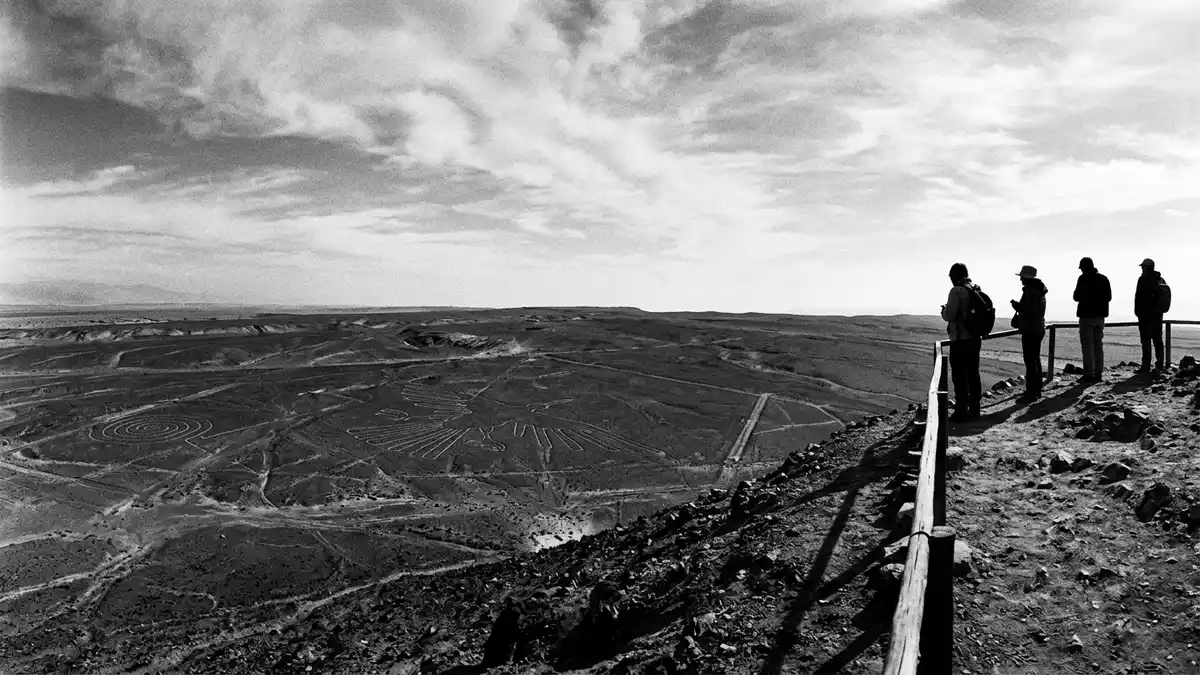
Lineas de Nazca, better known internationally as the Nazca Lines, form a vast field of ancient geoglyphs cut into the desert plateau near the town of Nazca in southern Peru. The figures stretch across the arid coastal plain in the Ica region and belong to a wider ensemble recognised as the Lines and Geoglyphs of Nasca and Palpa, inscribed on the UNESCO World Heritage List in 1994. The setting is a dry pampa between the Andes foothills and the Pacific, where hundreds of lines and figures define an open-air canvas on a monumental scale.
A desert plain turned into a giant drawing surface
The core of Lineas de Nazca lies on the Nazca Desert, on pampas such as Jumana and Ingenio between Nazca and Palpa in the Department of Ica. Here the desert’s pale surface carries long straight lines, geometric shapes and stylised figures created by removing the darker top layer of stones to reveal the lighter ground beneath.Nazca Desert geoglyphs The geoglyphs occupy a broad plateau of coastal plain and low foothills, over an area measured in hundreds of square kilometres, so that many designs only appear in full when seen from elevated points.
The World Heritage listing describes the Lines and Geoglyphs of Nasca and Palpa as one of the most outstanding concentrations of geoglyphs anywhere, occupying a zone roughly 400 km south of Lima and encompassing the provinces of Nazca and Palpa.Lines and Geoglyphs of Nasca and Palpa Within this landscape, the figures extend across desert plains and low slopes, forming a continuous cultural field rather than a single compact site. From ground level many lines resemble tracks crossing the pampa, but viewed from above they resolve into deliberate designs laid out with considerable precision.
Ancient designs and the Nazca culture
The geoglyph tradition at Lineas de Nazca belongs to the cultural sequence of the south Peruvian coast between the eighth century BC and the eighth century AD, with many designs associated with the Nazca culture of the first millennium AD.ancient Pre-Hispanic societies Over centuries, people created straight lines running for kilometres, geometric forms and figures representing animals, plants and human shapes, engraving them into the desert surface. The result is an accumulated field of images that overlap, intersect and coexist in the same terrain.
Sources describing the Nazca Lines count hundreds of straight lines and geometric forms and dozens of animal figures, including creatures such as a hummingbird, a monkey, a spider and other stylised fauna figures.animal, plant and human designs The figures vary greatly in size, from smaller motifs to designs extending over large segments of desert. Some creatures stand alone on relatively level ground; others form part of clusters of lines and symbols, drawing on the open nature of the pampa as a drawing surface.
From early study to World Heritage status
Although Lineas de Nazca are ancient, their full extent became widely known only in the twentieth century. In 1927 Peruvian archaeologist Toribio Mejía Xesspe observed the lines while walking the desert, noting patterns that are difficult to see from the ground.Toribio Mejía Xesspe’s early observations A few years later, the advent of aerial photography revealed the larger figures and the coherence of the designs, transforming an apparently empty plain into a visible system of drawings.
A key figure in the study and protection of the Nazca Lines was the German mathematician Maria Reiche, born in 1903 in Dresden, who dedicated decades of work to documenting the geoglyphs and advocating for their preservation.Maria Reiche’s lifetime of study Her efforts contributed to the recognition of the Lines and Geoglyphs of Nasca and Palpa as a cultural World Heritage Site, formally inscribed by UNESCO in 1994 under criteria that emphasise their outstanding universal value and creative achievement.World Heritage inscription in 1994
Visiting Lineas de Nazca: what travellers from Western Europe should know
- Lineas de Nazca lie near the town of Nazca in the Ica region of southern Peru, on the coastal desert plain several hundred kilometres south of Lima.
- The terrain consists of a dry plateau of gravel and sand, with long, exposed stretches on the pampa and low foothills where sun and dust are constant elements.
- The geoglyph field forms part of a protected cultural landscape; access routes use desert roads and tracks, and some viewpoints are reached by short climbs on uneven surfaces.
- The official language is Spanish and the currency is the Peruvian sol.
- Entry requirements depend on your nationality; UK travellers can check the FCDO travel advice at gov.uk/foreign-travel-advice, Irish travellers the Department of Foreign Affairs at ireland.ie.
Searching for Lineas de Nazca on social platforms
These links open searches for Lineas de Nazca on each platform.
Frequently asked questions about Lineas de Nazca
Where are Lineas de Nazca located?
Lineas de Nazca are situated on the Nazca Desert in the Ica region of southern Peru, on pampas between the towns of Nazca and Palpa.
What should travellers expect on a visit?
A visit centres on expansive desert plains marked by long lines and stylised figures, experienced from viewpoints and access routes arranged across the pampa.
What makes Lineas de Nazca distinctive?
The site combines hundreds of ancient geoglyphs into a continuous desert canvas, recognised by UNESCO as the Lines and Geoglyphs of Nasca and Palpa.


