
Longji Titian and the dragon’s spine above Guilin
Published on 08/23/2026 at 13:27 | Editorial responsibility: Rafael Müller, Editor-in-Chief AD HOC NEWS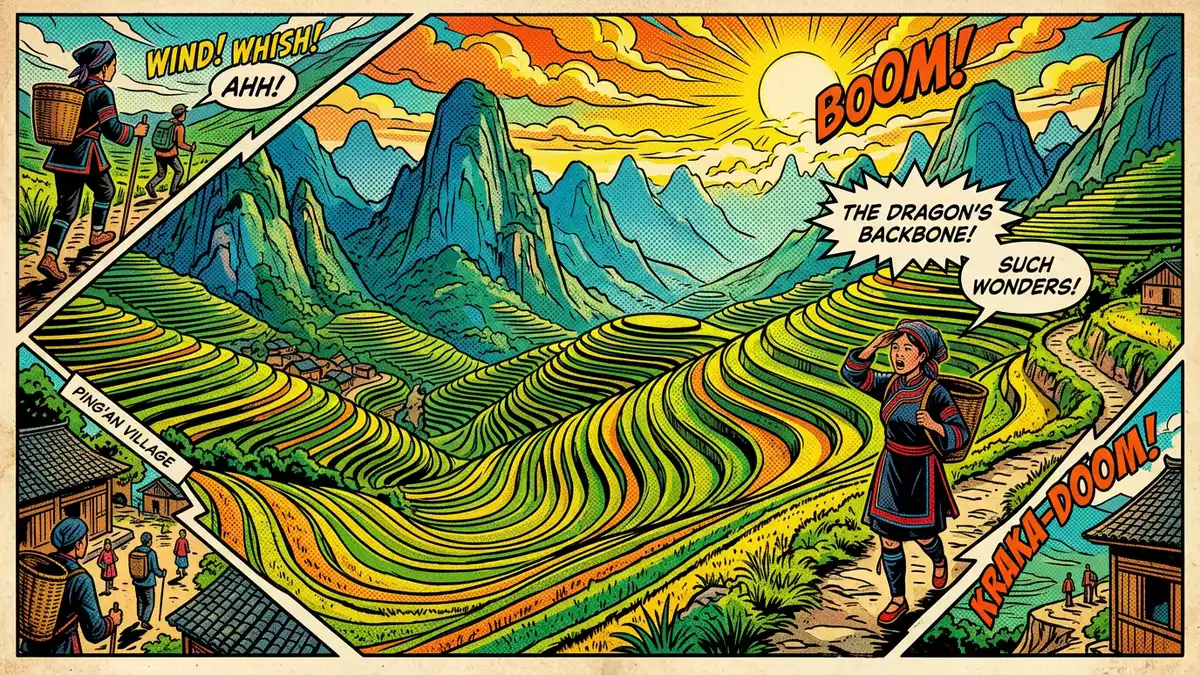
On the mountains north of Guilin in southern China, Longji Titian turns entire hillsides into layered fields that climb like a dragon’s spine across the slopes. Known in English as the Longji or Longsheng Rice Terraces, these stepped paddies in Longsheng County trace an intricate pattern of agriculture that has shaped the landscape since the Yuan and Qing dynasties.
Rice terraces wrapped around Longji Mountain
Longji Titian occupies the flanks of Longji Mountain in Longsheng Various Nationalities Autonomous County, in the Guangxi Zhuang Autonomous Region north of Guilin. The terraces form a continuous system of fields that run from the valley floor up towards the ridges, creating a patchwork of cultivated land across the mountain sides.Longji Rice Terraces The name Longji, which translates as “dragon’s spine”, reflects the way the terraces curve along the contours of the hills, giving the impression of scales on a mythical creature.
The terraces belong to a wider scenic area that includes villages such as Ping’an Zhuang Village, Jinkeng Dazhai and Longji Ancient Zhuang Village, each with its own cluster of fields. Together they form a landscape where cultivated strips of land sit between forested slopes and small settlements, with paths and tracks connecting homes, fields and viewpoints.three main terrace areas
Centuries of terracing by Zhuang and Yao communities
The terraced fields of Longji Titian are rooted in a long history of agriculture in the mountains north of Guilin. Construction of the terraces is linked to the Yuan dynasty, which ruled from 1271 to 1368, and they reached their present extent in the Ming and early Qing periods between the fourteenth and early twentieth centuries.built in the Yuan Dynasty and completed in the Qing Dynasty Over that span, generations of farmers carved narrow ledges into steep hillsides, building up embankments to hold soil and water.
The terraces are closely associated with the Zhuang and Yao ethnic groups, whose villages dot the slopes and valleys of Longsheng County.home to the Zhuang and Yao ethnic groups Their farming practices created a system in which water, earth and crop cycles are managed across entire hillsides, from lower paddies near streams to higher fields close to the ridgeline. The terraces are recognised as a heritage landscape of irrigation, reflecting long-standing techniques for channeling water and maintaining the structures that support the fields.
Patterns of water, light and seasonal colour
Seen from viewpoints above Ping’an or Jinkeng, Longji Titian presents repeating arcs and bands that follow the muscle of the mountain. The elevation of the terraces ranges from around 300 m (984 ft) above sea level to more than 800 m (2,625 ft), so the fields step up in long sweeps across slopes that would otherwise be difficult to cultivate.elevation range of the terraces Paths and simple stairways run between the levels, sometimes crossing small channels that carry water from higher to lower plots.
The terraces change appearance with the agricultural cycle. When the paddies are flooded, the water reflects the sky and the curved bunds emphasise the underlying form of the slopes. When rice grows tall, the terraces become bands of green that later take on warmer tones as harvest approaches. In some parts of the scenic area, wooden houses of the villages stand within sight of the fields, so that balconies and lanes look directly onto the pattern of cultivation.
Visiting Longji Titian: what travellers from Western Europe should know
- Longji Titian lies in Longsheng County north of Guilin in Guangxi, and the scenic area is reached by road via Longji Town, which serves as the access point for the terraces.
- The terrain consists of stepped fields on steep hillsides, and visiting viewpoints or villages involves walking on paths and stairways between terraces at elevations rising above 300 m (984 ft).
- The Longji terraces are in a mountainous rural area with villages such as Ping’an and Dazhai, where accommodation and basic services cluster close to the paths leading into the fields.
- The official language is Chinese and the currency is the Chinese yuan.
- Entry requirements depend on your nationality; UK travellers can check the FCDO travel advice at gov.uk/foreign-travel-advice, Irish travellers the Department of Foreign Affairs at ireland.ie.
Searching for Longji Titian on social platforms
These links open searches for Longji Titian on each platform.
Frequently asked questions about Longji Titian
Where is Longji Titian located?
Longji Titian is in Longji Town in Longsheng County north of Guilin, in the Guangxi Zhuang Autonomous Region of southern China.
What should visitors expect at Longji Titian?
Visitors encounter terraced rice fields stepping up steep hillsides around villages such as Ping’an and Jinkeng Dazhai, with walking paths linking viewpoints and settlements.
What makes Longji Titian distinctive among rice landscapes?
Longji Titian combines centuries-old terracing by Zhuang and Yao communities with a large elevation range, creating sweeping patterns of fields that follow the contours of Longji Mountain.


