
Longmen Shiku in Luoyang, a cliff of carved Buddha worlds
Published on 08/23/2026 at 07:57 | Editorial responsibility: Rafael Müller, Editor-in-Chief AD HOC NEWS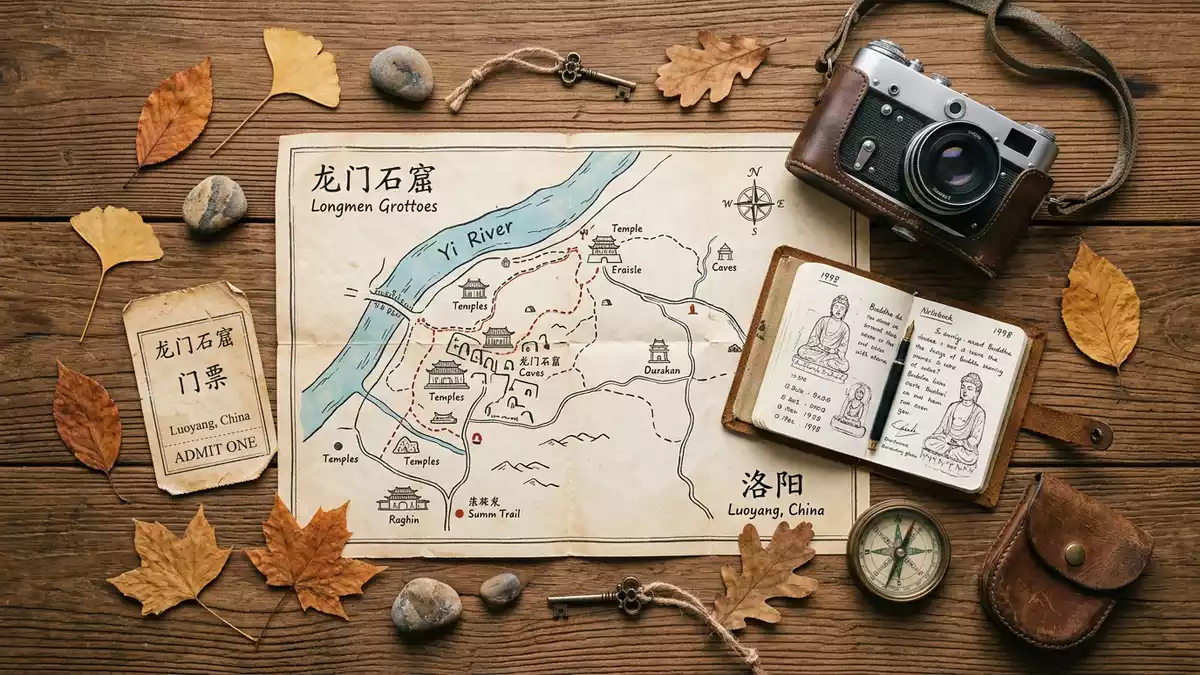
Longmen Shiku, known in English as the Longmen Grottoes, turns a limestone gorge just south of Luoyang in central China into a continuous wall of Buddhist sculpture. Carved mainly during the Northern Wei and Tang dynasties, this cliffside complex preserves one of the densest collections of stone Buddhist art in China and has been inscribed as a UNESCO World Heritage Site since 2000.
A cliff turned into a Buddhist landscape
Longmen Shiku occupies both banks of the Yi River in Henan Province, where limestone cliffs close in on a bend of the waterway and provide a natural rock face for carving.The grottoes line the limestone cliffs for about 1 km, and the result is less a set of isolated caves than a continuous sequence of shrines. The Chinese name “Longmen Shiku” literally means “Longmen stone caves”, a reminder that this is a landscape shaped directly into the rock rather than built from freestanding structures.
On the western bank, the cliff face rises above terraces and paths that follow the river, while the eastern side presents another band of carvings and structures facing back across the water.More than 2,300 caves and niches have been cut into these cliffs, containing an extraordinary range of images from tiny reliefs to monumental figures towering over visitors on the ledges below.
From Northern Wei court project to Tang dynasty masterpiece
The history of Longmen Shiku is written into its stone. Carving began in 493, when Emperor Xiaowen of the Northern Wei dynasty transferred his capital to Luoyang and patronage for Buddhist cave temples followed the court to this new centre.Work continued across several dynasties, with major phases stretching through the sixth and seventh centuries. The grottoes therefore offer an unusually clear timeline of how Chinese Buddhist imagery evolved as political power shifted.
By the Tang dynasty, which began in 618, Longmen Shiku had become a canvas for large-scale imperial commissions as well as donations from aristocrats, monks and lay believers.UNESCO highlights the site as a pinnacle of Chinese stone carving from this period, when sculptors refined earlier Northern Wei styles into fuller, more naturalistic bodies and elaborate drapery. Standing in front of Tang-era caves, it is possible to see rounded faces, detailed jewellery and complex group compositions that differ markedly from the slimmer, more stylised figures of the fifth and sixth centuries.
Caves, statues and inscriptions along the Yi River
The scale of Longmen Shiku is easiest to grasp in numbers. The site contains in the order of 2,300 caves and niches, close to 110,000 Buddhist stone statues and more than 2,800 inscriptions carved on steles or directly into the rock.The World Heritage listing underlines how exceptional this concentration is for a single valley. Statues range from figures only a few centimetres high to seated Buddhas several storeys tall, surrounded by attendant bodhisattvas, guardians and disciples.
Longmen Shiku is not only a collection of images but also a vast archive of inscriptions in stone.Thousands of dedicatory texts record donors’ names, dates, and the dynasties under which specific caves were completed, giving historians rare precision in tracing patronage networks around Luoyang. For visitors, these carved characters punctuate the cliff like a second layer of storytelling beside the figures themselves, reinforcing the impression of walking along a stone library where every niche preserves a specific moment in the spread of Buddhism in East Asia.
Visiting Longmen Shiku: what travellers from Western Europe should know
- Longmen Shiku lies just south of Luoyang in Henan Province, with the grottoes cut into cliffs on both banks of the Yi River in Luolong District.
- The approach inside the scenic area involves walking along riverside paths and climbing stone steps between terraces, as many of the caves open partway up the cliff face.
- The wider scenic area includes the Western Hill Grottoes, Eastern Hill Grottoes, Xiangshan Temple and Bai Garden, linked by marked routes beside the river and up the slopes.
- The official language is Chinese and the currency is the renminbi (yuan).
- Entry requirements depend on your nationality; UK travellers can check the FCDO travel advice at gov.uk/foreign-travel-advice, Irish travellers the Department of Foreign Affairs at ireland.ie.
Searching for Longmen Shiku on social platforms
These links open searches for Longmen Shiku on each platform.
Frequently asked questions about Longmen Shiku
Where is Longmen Shiku located?
Longmen Shiku is located in Luolong District, just south of Luoyang in Henan Province, with grottoes lining both sides of the Yi River.
What can visitors expect to see at Longmen Shiku?
Visitors encounter limestone cliffs carved with thousands of Buddhist caves, statues of many sizes, and numerous inscriptions that trace imperial and private patronage over several centuries.
What makes Longmen Shiku distinctive among Buddhist cave sites?
Longmen Shiku is distinctive for its long sequence of Northern Wei and Tang carvings, its river gorge setting and the exceptional density of statues and inscriptions along a single stretch of cliff.


