
Mandalay Hill rises above a city shaped by royal history
Published on 09/24/2026 at 12:15 | Editorial responsibility: Rafael Müller, Editor-in-Chief AD HOC NEWS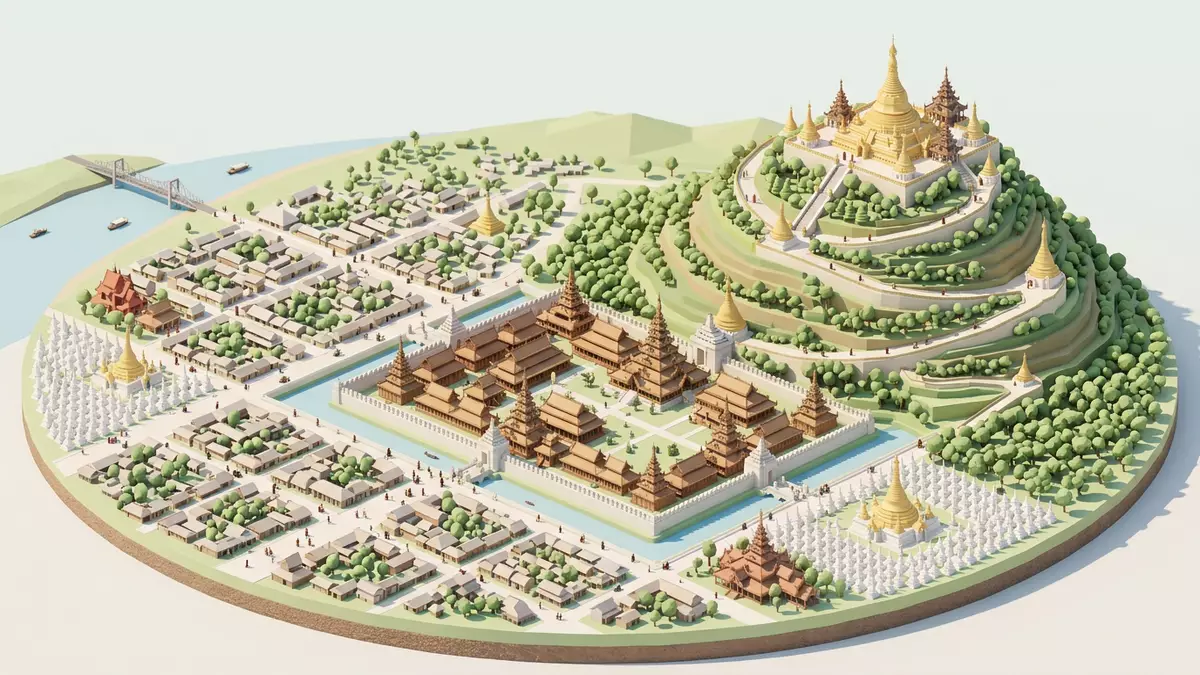
Mandalay Hill rises north-east of Mandalay as a broad, sacred landmark above the city. Its slopes combine Buddhist shrines, monasteries and stairways, while Sutaungpyei Pagoda crowns the summit and the royal history of King Mindon remains closely linked with the hill.
Mandalay Hill and the making of a royal capital
Mandalay Hill stands north of downtown Mandalay in Myanmar, beside the city established by King Mindon of the Konbaung dynasty. Mindon founded Mandalay in 1857, making it the final royal capital of the Burmese kingdom.
The hill reaches about 230 m (755 ft) above the surrounding plain. Mandalay Region tourism information places it north of downtown and records its height as 230 m.
A pilgrimage landscape of pagodas and monasteries
Mandalay Hill is not a bare viewpoint. Pagodas and monasteries occupy its slopes, terraces and approaches, creating a continuous religious landscape above the city.
Burmese Buddhist tradition connects the hill with a prophecy attributed to Gautama Buddha. The story says that a great Buddhist city would rise at the foot of the hill, a tradition associated with Mindon’s foundation of Mandalay in 1857. the hill’s Buddhist legend remains part of its cultural identity.
The stairways pass shrines, images and small religious buildings before reaching the summit. The route is therefore both a climb through a built landscape and a pilgrimage setting, with devotional architecture repeatedly appearing beside the path.
Sutaungpyei Pagoda above the Mandalay plain
At the summit stands Sutaungpyei Pagoda, also known as the Wish-fulfilling Pagoda. Its elevated position places a Buddhist sanctuary above the city grid, palace grounds and the plain extending towards the Ayeyarwady River.
The summit area contains religious images and open terraces alongside the pagoda. the summit Buddha image forms part of the hill’s religious imagery and its association with Mindon.
From the upper slopes, Mandalay appears as a planned city beneath a prominent religious landmark. The view includes the former royal palace compound, urban neighbourhoods, pagodas and the river plain beyond.
Visiting Mandalay Hill: what travellers from Western Europe should know
- Mandalay Hill lies north-east of central Mandalay. The hill can be reached by road to its foot, followed by an ascent on foot or by local transport.
- The approach includes stairways on the slope and a climb towards the summit. Religious buildings occupy the route, so the ascent passes through an active sacred landscape.
- The summit is associated with Sutaungpyei Pagoda and elevated views across Mandalay, the palace compound and the Ayeyarwady plain.
- The official language is Burmese and the currency is the Myanmar kyat.
- Entry requirements depend on your nationality; UK travellers can check the FCDO travel advice at gov.uk/foreign-travel-advice, Irish travellers the Department of Foreign Affairs at ireland.ie.
Searching for Mandalay Hill on social platforms
These links open searches for Mandalay Hill on each platform.
Frequently asked questions about Mandalay Hill
Where is Mandalay Hill?
Mandalay Hill stands north-east of downtown Mandalay in Myanmar. It rises above the city and the plain leading towards the Ayeyarwady River.
What can visitors expect on the ascent?
The route includes stairways, Buddhist images, pagodas and monasteries. The climb ends at Sutaungpyei Pagoda near the summit.
What makes Mandalay Hill distinctive?
Its religious buildings form a pilgrimage landscape above a nineteenth-century royal capital. The hill also connects Mandalay’s Buddhist traditions with King Mindon’s foundation of the city in 1857.


