
Matsumoto-jo and the black keep in central Japan
Published on 08/15/2026 at 14:46 | Editorial responsibility: Rafael Müller, Editor-in-Chief AD HOC NEWS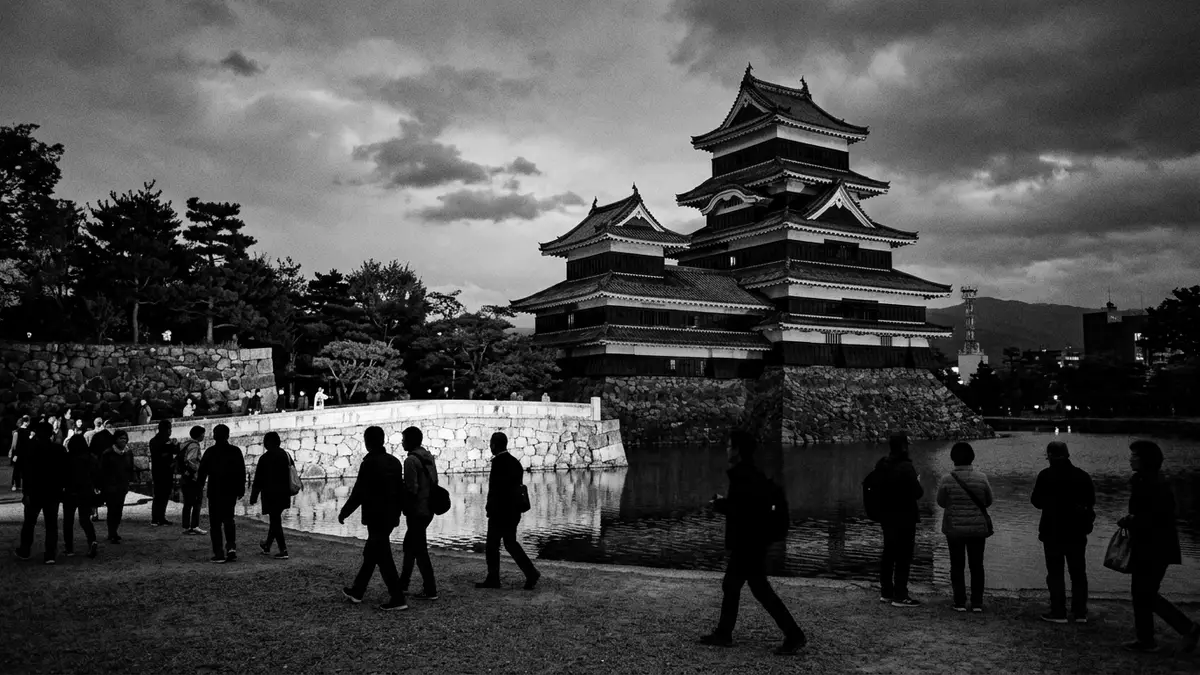
Matsumoto-jo rises in Matsumoto, Nagano Prefecture, as a black timber castle with a keep linked to smaller towers. The castle was completed in 1594 and is a National Treasure.
Matsumoto-jo’s linked keep and tower complex
The castle’s main keep sits with the Inui Keep, Watari Tower, Tatsumitsuke Tower and Tsukimi Tower as a connected group. The result is a compact castle complex with several attached parts and a dark wooden exterior.
The keep is known for its five external storeys and six internal floors. It is also one of the surviving examples of Japan’s castle architecture from the late Sengoku period and early Edo period, with work tied to Ishikawa Kazumasa and his son Yasunaga.
connected towers and the five-structure group are the core of the castle’s form.
The castle in the Sengoku and Edo periods
The present keep dates to the end of the Sengoku period, when castle building in Japan shifted from rough field fortifications to more elaborate defensive and residential forms. Matsumoto-jo belongs to that transition, and its black lacquered timber finish gives the site a severe profile.
The site is closely tied to the Ogasawara clan and to Ishikawa Kazumasa, then to the later work carried out by his son. That sequence places the castle within the political consolidation that followed the Warring States era, when strongholds were adapted into more formal castle compounds.
The castle was designated a National Treasure in 1952, and its earlier historic-site status was already established in 1930. Those designations reflect the survival of the original timber keep and its linked structures.
Black timber, white walls and surviving castle fabric
Matsumoto-jo is often recognised by the contrast between its black exterior and pale wall surfaces. The keep reads as a strong horizontal and vertical composition, with the smaller towers pressed against the main structure.
The castle preserve a broad spread of visible fabric: the main keep, roofed passages, wings and towers. Its surviving plan makes the building legible as a layered castle rather than a single isolated tower.
The black exterior and the six-floor keep give the castle its clearest visible character.
Visiting Matsumoto-jo: what travellers from Western Europe should know
- The castle stands in central Matsumoto, Nagano Prefecture, and JR Matsumoto Station is the main rail reference point.
- The approach includes the castle grounds and the keep’s interior stairs, which run through several levels of timber and tight turns.
- English is not an official language in Japan, and the currency is the Japanese yen.
- Entry requirements depend on your nationality; UK travellers can check the FCDO travel advice at gov.uk/foreign-travel-advice, Irish travellers the Department of Foreign Affairs at ireland.ie.
Searching for Matsumoto-jo on social platforms
These links open searches for Matsumoto-jo on each platform.
Frequently asked questions about Matsumoto-jo
Where is Matsumoto-jo?
It stands in Matsumoto in Nagano Prefecture, in central Japan. JR Matsumoto Station is the nearest major rail reference point.
What does a visit involve?
The castle grounds lead into the timber keep, where the route passes through several floors and linked sections. The interior is a narrow climb through the structure’s surviving wooden frame.
What makes Matsumoto-jo distinctive?
The black exterior, the linked keep complex and the six internal floors of the main keep give it a sharply layered profile. Its National Treasure status places it among Japan’s most important surviving castles.


