
Matterhorn above Zermatt: a pyramidal Alpine giant
Published on 08/17/2026 at 13:10 | Editorial responsibility: Rafael Müller, Editor-in-Chief AD HOC NEWS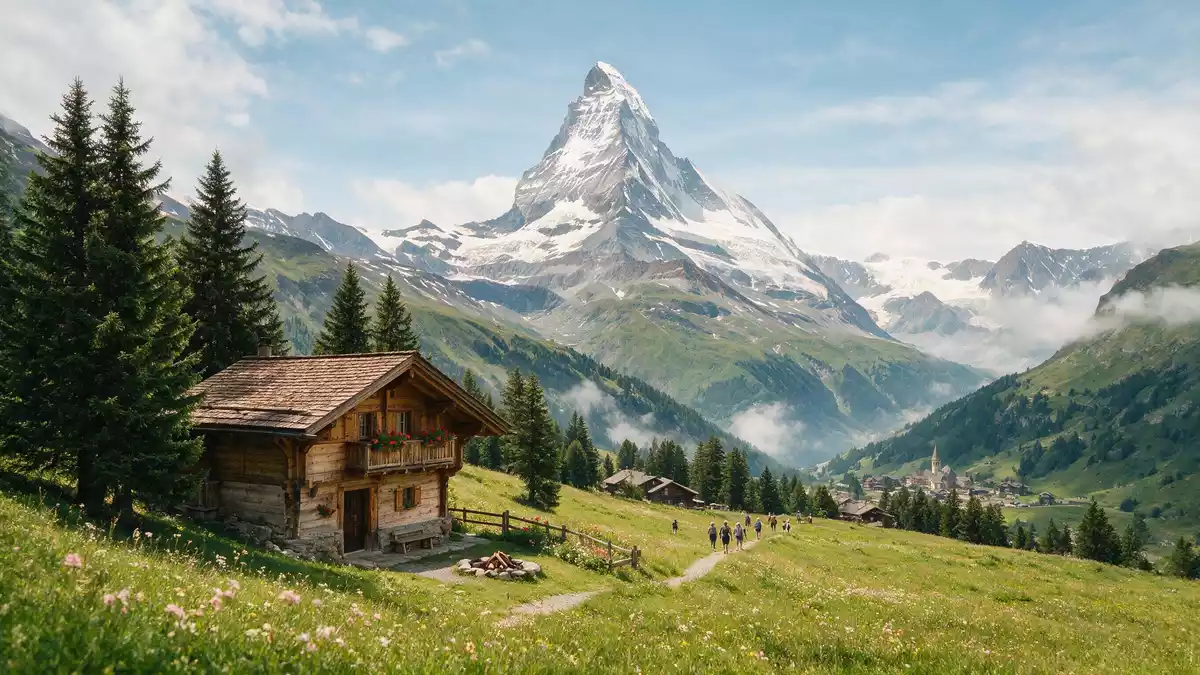
The Matterhorn rises above Zermatt as a sharply defined Alpine pyramid, straddling the border between Switzerland and Italy and dominating the surrounding Valais peaks. Its summit reaches 4,478 m (14,692 ft), and the mountain’s dramatic form and climbing history have made it one of the best known high points in the Alps.
A four-faced pyramid on the Swiss–Italian frontier
The Matterhorn stands in the Pennine Alps at the head of the Matter Valley, overlooking the village of Zermatt on the Swiss side and Breuil-Cervinia in Italy on the opposite slope.Frontier between Switzerland and Italy Its summit lies on the main Alpine watershed, and the mountain forms part of the wider Monte Rosa area of high peaks.Pennine Alps location
The peak has four principal faces aligned broadly with the cardinal directions, giving the mountain the near-symmetric pyramidal outline that features so often in photographs and drawings.Four faces of the mountain The north face drops towards Zermatt and the Matter Valley, while the south face descends into the Italian Aosta Valley. On clear days the peak stands isolated above surrounding ridges, its rock shoulders and snowfields rising steeply from the glaciers at its base.
From untouched peak to classic climb
The Matterhorn remained unclimbed longer than many other major Alpine summits. It was first reached on 14 July 1865 by a party led by the English mountaineer Edward Whymper, who ascended from Zermatt via the Hörnli ridge on the mountain’s north-east side.First ascent in 1865 Whymper’s team included Francis Douglas, Charles Hudson, Douglas Hadow, the French guide Michel-Auguste Croz and the Zermatt guides Peter Taugwalder and his son.Hörnli ridge route
The descent from that first ascent ended in tragedy when a fall on the upper north face cost the lives of Hadow, Hudson, Douglas and Croz, an event that has been retold in Alpine literature ever since.Fatal descent In the years that followed, climbers traced further lines up the mountain, including routes on the Italian side and direct climbs on the great faces, and the Matterhorn became a central objective in the development of guiding and technical mountaineering in the region.
Matterhorn in the Zermatt landscape
The peak rises above alpine meadows, forests and the high glaciers of Valais, forming a backdrop to Zermatt’s streets and the mountain railways that reach neighbouring viewpoints. The Gornergrat railway, for example, climbs from the valley floor to a ridge station from which the Matterhorn stands framed against the icefields and the Monte Rosa group.Matterhorn seen from Gornergrat
Zermatt itself is a car-free village, with electric vehicles and rail connections serving the valley and linking it to the wider Swiss network.Car-free status of Zermatt Around the village and on neighbouring terraces, the Matterhorn appears from differing angles: sometimes as a slender rock tower, sometimes as a broad snow-covered pyramid, depending on the vantage point and the season’s snow line.
Visiting Matterhorn: what travellers from Western Europe should know
- The Matterhorn stands above Zermatt in the canton of Valais in south-west Switzerland, on the border with Italy; the nearest larger Swiss towns lie down the Matter Valley.
- Approaches from Zermatt involve mountain railways and cable cars that lead to high viewpoints and trailheads on surrounding ridges and plateaux.
- The terrain around the mountain includes steep paths, rocky sections and high-altitude viewpoints, with significant elevation differences between the valley floor and the main lookouts.
- Zermatt is in Switzerland, where the official language in the region is German and the currency is the Swiss franc.
- Entry requirements depend on your nationality; UK travellers can check the FCDO travel advice at gov.uk/foreign-travel-advice, Irish travellers the Department of Foreign Affairs at ireland.ie.
Searching for Matterhorn on social platforms
These links open searches for Matterhorn on each platform.
Frequently asked questions about Matterhorn
Where is the Matterhorn?
The Matterhorn is a mountain in the Pennine Alps above Zermatt in the Swiss canton of Valais, on the frontier with Italy.
What should travellers expect when visiting?
Travellers encounter a high Alpine landscape, with steep slopes, glaciers and viewpoints reached by mountain railways, cable cars and marked paths from Zermatt.
What makes the Matterhorn distinctive among Alpine peaks?
Its four-sided pyramidal summit, height of 4,478 m (14,692 ft) and the history of the first ascent in 1865 give the Matterhorn a particular place in Alpine mountaineering.


