
Medina of Essaouira, a planned Atlantic fortress-city
Published on 08/16/2026 at 14:30 | Editorial responsibility: Rafael Müller, Editor-in-Chief AD HOC NEWS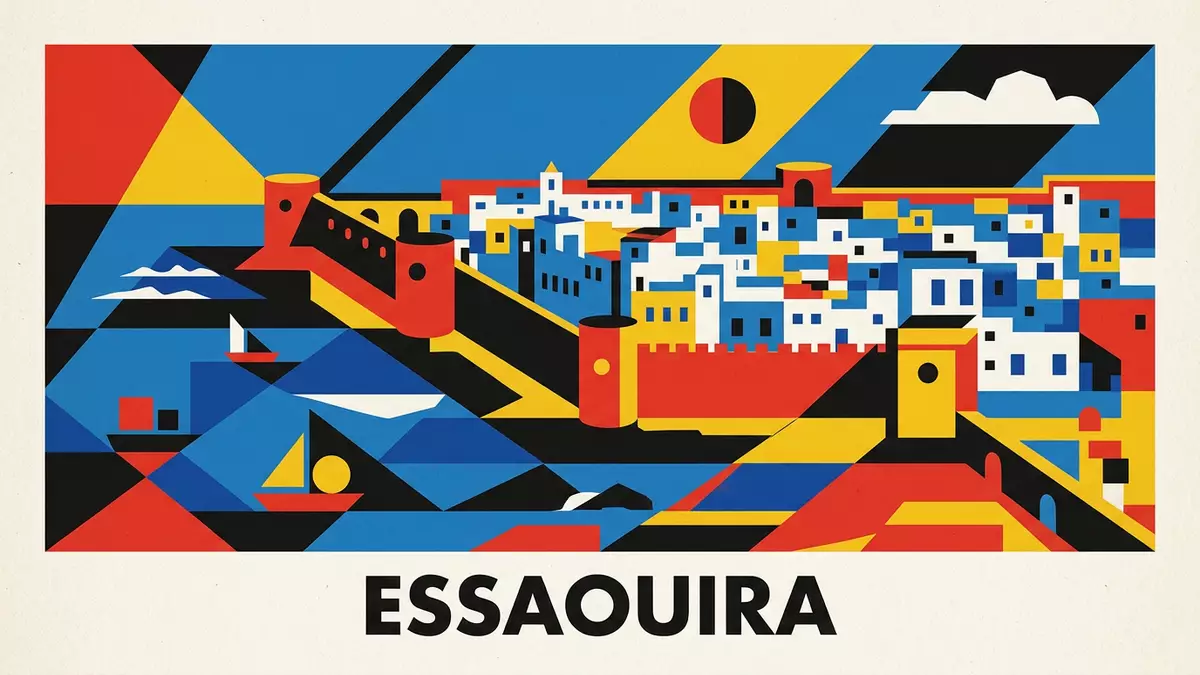
Medina of Essaouira is the walled historic core of Essaouira on Morocco’s Atlantic coast, laid out in the eighteenth century as a planned port city with stone ramparts and a regular street grid.
A planned Atlantic port between walls and waves
The Medina of Essaouira forms a compact fortified town between the Atlantic shoreline and the modern quarters of Essaouira, enclosed by masonry ramparts and bastions that follow European military principles in a North African setting. The current city was established in the 1760s under Sultan Sidi Mohammed ben Abdallah of the Alaouite dynasty, who commissioned the French-trained architect Théodore Cornut to design its fortifications and overall plan. Within these walls the urban fabric was laid out with orthogonal streets rather than winding lanes, creating straight axes that link gates, markets and squares and distinguish Essaouira from many other Moroccan medinas.
From the outset the town functioned as a maritime gateway between Morocco’s interior and overseas ports, connecting caravan routes from the Sahara and Marrakesh with Atlantic trade. The harbour, earthwork platforms and seaward batteries made the medina both commercial and defensive, positioned on a low shoreline with views towards the Mogador archipelago of offshore islands that form part of the wider heritage site. The combination of regular street pattern, stone ramparts and layered trading history gives Medina of Essaouira its character as an Atlantic fortress-city where daily life still unfolds inside the eighteenth-century outline.
Streets, quarters and stone architecture
Architecture inside the Medina of Essaouira is defined by limewashed façades, masonry walls and timber doors and shutters, organised along straight streets that converge on markets and squares. The historic layout included distinct quarters, with a kasbah as an administrative district, the medina as a commercial and residential core and a mellah forming the Jewish quarter, each woven into the overall grid. Buildings tend to rise to several storeys, creating continuous street fronts punctuated by shop units on the ground floor and living spaces above, while gateways and watchtowers articulate the perimeter wall facing both land and sea.
The fortifications draw on the work of French military engineer Sébastien Le Prestre de Vauban, whose ideas were transmitted here through Cornut’s design of bastions and curtain walls. Cannon platforms and seaward defences protect approaches from the Atlantic, and the walls frame views towards the Mogador islands, which now serve as a protected bird sanctuary under the same heritage listing. This mixture of European-influenced military works and local urban building traditions produces a townscape where stone batteries, markets and houses share the same tight footprint, making architectural detail part of everyday circulation through the medina.
World Heritage status and historical names
In 2001 Medina of Essaouira, formerly known as Mogador, was inscribed on the UNESCO World Heritage List as a cultural site, recognised for its exceptional example of a late eighteenth-century fortified town built according to contemporary European military principles in a North African context.UNESCO inscription in 2001World Heritage identification number 753 The listing emphasises the town’s planned character and its testimony to exchanges of human values through Atlantic trade, and classifies it as an historic urban site on Morocco’s Atlantic coast. The name Mogador derives from a Phoenician term “Migdol”, meaning a small fortress, while the Arabic name Essaouira is linked to ideas of a “well-designed” or “well-drawn” town, reflecting the regular plan traced in the eighteenth century.
The World Heritage property extends beyond the built-up medina to include the Mogador archipelago offshore, which has a long history of use and now functions as a protected area for seabirds under Moroccan conservation measures.mapped extent of the heritage property Within the walls, urban fabric and monuments are also protected under national heritage legislation, anchoring Medina of Essaouira within both international and Moroccan frameworks for safeguarding historic towns. Taken together, the coastal setting, layered naming history and formal recognition situate the medina as a coastal stronghold whose identity rests on its planned layout and enduring stone envelope.
Visiting Medina of Essaouira: what travellers from Western Europe should know
- Medina of Essaouira lies on Morocco’s Atlantic coast within the city of Essaouira; it is reached overland by road links from Marrakesh and other regional centres.
- Inside the walls, streets are relatively narrow and laid out in a grid, with sections paved for walking and some passageways bounded by tall buildings that limit direct views.
- The Atlantic shoreline borders the medina, and sections of the ramparts and seaward batteries are exposed to ocean winds and salt air along masonry walks.
- The official language is Arabic and the currency is the Moroccan dirham.
- Entry requirements depend on your nationality; UK travellers can check the FCDO travel advice at gov.uk/foreign-travel-advice, Irish travellers the Department of Foreign Affairs at ireland.ie.
Searching for Medina of Essaouira on social platforms
These links open searches for Medina of Essaouira on each platform.Frequently asked questions about Medina of Essaouira
Where is Medina of Essaouira?
Medina of Essaouira is the historic walled town of Essaouira on Morocco’s Atlantic coast, enclosed by eighteenth-century ramparts beside the ocean.
What can visitors expect inside the medina?
Visitors encounter straight streets laid out on a grid, lined by stone and limewashed buildings, markets, squares and gateways within the surrounding fortifications.
What makes Medina of Essaouira distinctive?
Its planned eighteenth-century layout, European-influenced military architecture and inclusion of the Mogador islands within a single World Heritage property distinguish the medina.


