
Medina of Tripoli and its layered Mediterranean streets
Published on 09/23/2026 at 04:02 | Editorial responsibility: Rafael Müller, Editor-in-Chief AD HOC NEWS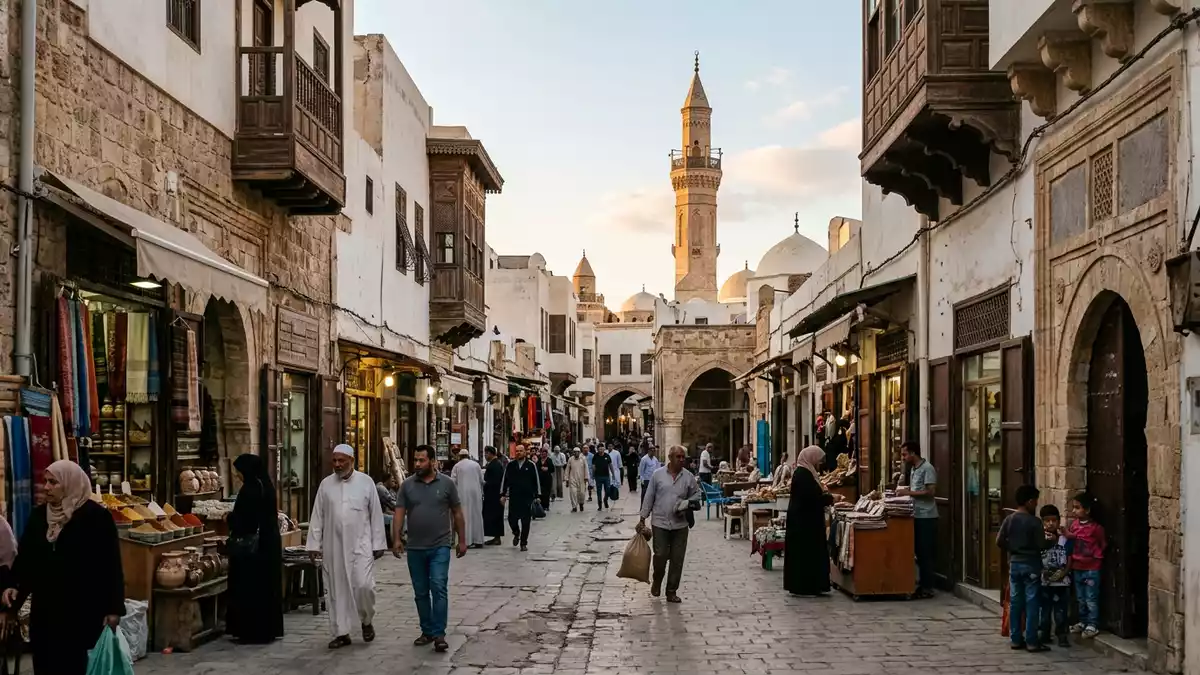
Medina of Tripoli is the walled historic quarter of Tripolis, pressed between the Mediterranean harbour and the newer city. Its streets bring together Roman masonry, Ottoman fortifications, mosques, courtyards and markets within a compact urban fabric.
Medina of Tripoli between harbour and old city
The medina lies along Tripoli’s harbour in north-western Libya. Its walls enclose lanes, small squares, religious buildings, trading spaces and houses arranged around inward-facing courtyards.
The quarter’s overall outline became roughly pentagonal during sixteenth-century fortification works. The harbour edge remains closely connected with the old city, while newer streets begin beyond the masonry boundary.
Oea, Rome and the arch of Marcus Aurelius
Tripoli began as the Phoenician port of Oea, one of the three cities that gave the region its ancient name, Tripolitania. Roman rule followed in 146 BC and continued until about 450 CE.
The marble Arch of Marcus Aurelius dates from 163 CE and remains inside the medina. Its carved reliefs and surviving masonry mark the Roman layer beneath the later Islamic and Ottoman city.
Roman columns, capitals and carved fragments appear in later buildings as reused material. These pieces stand beside plastered walls, tiled interiors, arcades and doorways associated with Arab, Hafsid, Ottoman and Karamanli traditions.
Ottoman walls, mosques and courtyard houses
The Red Castle dominates the harbour side of the old city. Its visible complex includes sixteenth-century Spanish works and later Ottoman additions, reflecting Tripoli’s position within Mediterranean imperial history.
Religious architecture gives the medina much of its vertical and decorative character. The Karamanli Mosque belongs to the eighteenth century, while the Gurgi Mosque was built by Yusuf Gurgi in 1833 and contains Turkish-style tiles, Italian marble columns and carved stucco.
Dar Yusuf al-Karamanli is arranged around a central courtyard. Turkish tile-work, domestic rooms and household objects connect the residence with the Karamanli dynasty, which ruled Tripoli in the eighteenth and nineteenth centuries.
Markets and lanes form the everyday fabric around these monuments. Sharia Jamaa ad-Draghut leads towards the Mosque of Draghut and the Arch of Marcus Aurelius, while souks branch from the principal entrance near Green Square.
Visiting Medina of Tripoli: what travellers from Western Europe should know
- Medina of Tripoli lies beside the harbour in Tripolis. Green Square forms a principal entrance, with the old quarter reached on foot from the surrounding central streets.
- The medina is a pedestrian quarter of narrow lanes, courtyards and uneven historic surfaces. The route between the Red Castle, the souks and the Roman arch involves frequent changes of direction.
- Arabic is Libya’s official language, and the national currency is the Libyan dinar.
- Entry requirements depend on your nationality; UK travellers can check the FCDO travel advice at gov.uk/foreign-travel-advice, Irish travellers the Department of Foreign Affairs at ireland.ie.
Searching for Medina of Tripoli on social platforms
These links open searches for Medina of Tripoli on each platform.
Frequently asked questions about Medina of Tripoli
Where is Medina of Tripoli?
Medina of Tripoli is the historic walled quarter of Tripolis, beside the Mediterranean harbour in north-western Libya.
What can visitors expect inside?
The quarter contains narrow lanes, souks, mosques, courtyard houses, Ottoman structures and Roman remains, including the Arch of Marcus Aurelius.
What makes the medina distinctive?
Its streets combine the ancient city of Oea with sixteenth-century fortifications, Ottoman and Karamanli buildings, and later Mediterranean architectural layers.


