
Meteora’s monasteries rise from sandstone pillars
Published on 09/23/2026 at 08:45 | Editorial responsibility: Rafael Müller, Editor-in-Chief AD HOC NEWS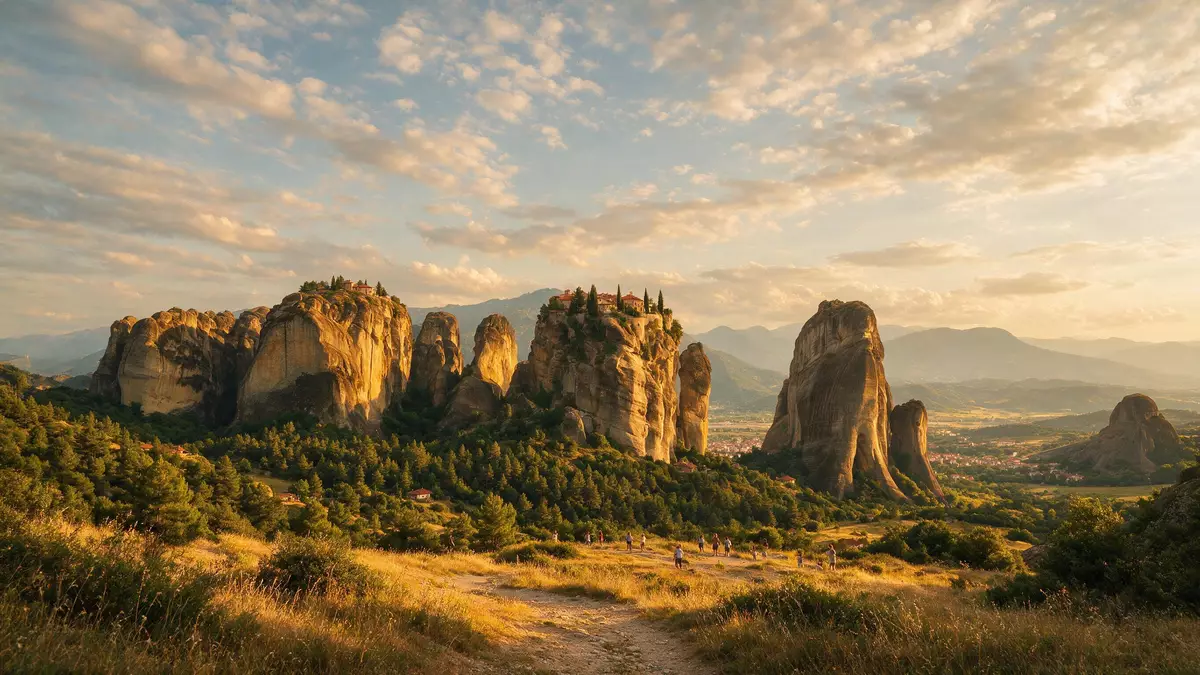
Meteora rises above Kalambaka as a group of sandstone pillars carrying Orthodox monasteries. The buildings sit on abrupt grey-brown rock formations, creating a visible meeting of geology, architecture and religious life.
Sandstone pillars above Kalambaka
Meteora lies in Thessaly, north of Kalambaka and east of the Pindus Mountains, in the upper valley of the Pineiós River. Its pinnacles rise roughly 400 metres above the surrounding plain and form the physical setting for the monasteries.
The rock dates from the Tertiary period and developed from sands associated with an ancient river delta. Geological processes and earthquakes divided the sedimentary mass into the steep formations visible across the landscape. The result is a field of tall, isolated surfaces with narrow ledges, vertical walls and flat summits.
The name Meteora refers to the appearance of something suspended in the sky. The phrase suits a landscape in which monasteries occupy high rock platforms above the town and the plain. Meteora’s sandstone formations are inseparable from the cultural identity of the site.
From hermit shelters to Orthodox monasteries
Organised monasticism at Meteora began in the eleventh century. Hermits settled in caves and on the rock formations, creating a religious landscape that expanded during the medieval period.
The main monastic development belongs to the fourteenth and fifteenth centuries. Athanasios Koinovitis, a monk associated with Mount Athos, established the first structures of the Great Meteoron on the broad rock known as Platy Lithos. The monastery is also called the Monastery of the Transfiguration.
At the height of Meteora’s monastic history, twenty-four monasteries occupied the rocky summits. Six monasteries survive as the principal visible group: Great Meteoron, Varlaam, Rousanou, Saint Nicholas Anapausas, the Holy Trinity and Saint Stephen.
Great Meteoron contains the katholikon, or principal church, dedicated to the Transfiguration. Varlaam, the Holy Trinity and Saint Stephen add further churches, courtyards and monastic buildings to the complex. Frescoes, carved timber, masonry and painted interiors preserve the artistic character of Orthodox religious architecture. Athanasios Koinovitis and Great Meteoron remain central to the site’s documented history.
A mixed heritage of rock, art and faith
Meteora entered the UNESCO World Heritage List in 1988. Its designation combines cultural and natural values, recognising both the monasteries and the geological landscape that supports them.
The monasteries form compact ensembles on the summits, with churches, courtyards, defensive walls, terraces and residential buildings arranged across confined rock surfaces. Their materials include local stone, timber, plaster and painted decoration.
The churches preserve examples of Byzantine and post-Byzantine religious art. Wall paintings depict biblical scenes, saints, martyrs and liturgical subjects, while the buildings retain the spatial character of working Orthodox communities.
The surviving monasteries also show different relationships with the rock. Some occupy broad platforms, while others sit on narrower summits or ledges. The contrast between vertical sandstone and carefully built masonry gives Meteora its defining visual form. Meteora’s monastic tradition belongs to the wider history of Greek Orthodox religious culture.
Visiting Meteora: what travellers from Western Europe should know
- Meteora stands north of Kalambaka in Thessaly. The town provides the main local base, while roads connect the monastery area with Kalambaka and nearby Kastraki.
- The approach combines roads, stairways and uneven mountain terrain. Monastery entrances involve steps, and several buildings stand on exposed rock platforms above the plain.
- The six principal monasteries occupy separate rock formations. Their churches and courtyards contain painted decoration, carved details and active Orthodox religious spaces.
- The official language is Greek and the currency is the euro.
Searching for Meteora on social platforms
These links open searches for Meteora on each platform.
Frequently asked questions about Meteora
Where is Meteora?
Meteora is in Thessaly, central Greece, immediately north of Kalambaka and near the village of Kastraki. The site lies east of the Pindus Mountains in the Pineiós River valley.
What can visitors see at Meteora?
The site contains sandstone pillars, monastery buildings, Orthodox churches, courtyards, frescoes and views across the Thessalian plain. The approach includes roads, stairs and uneven rock terrain.
What makes Meteora distinctive?
Meteora combines a geological landscape of sandstone pinnacles with a medieval Orthodox monastic complex. The monasteries entered the UNESCO World Heritage List in 1988.


