
Mirski zamok and the layered face of Mir
Published on 08/16/2026 at 14:17 | Editorial responsibility: Rafael Müller, Editor-in-Chief AD HOC NEWS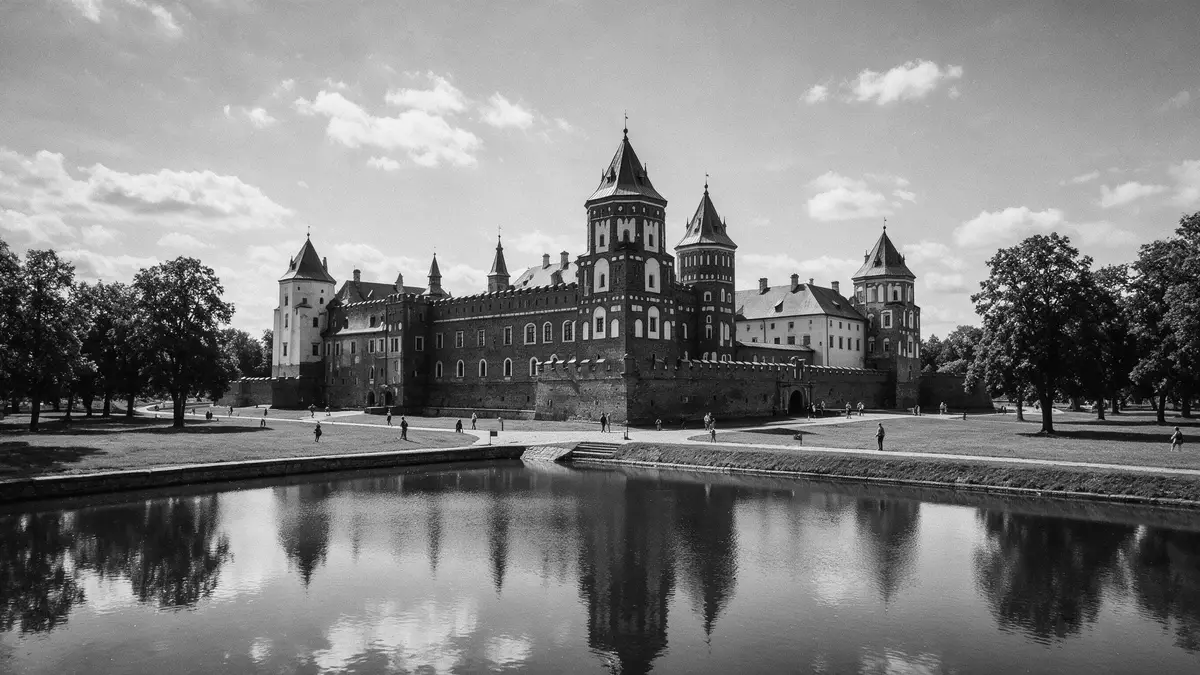
Mirski zamok in Mir is a brick castle complex shaped by the sixteenth century and later additions. Its most striking feature is the mix of Gothic, Renaissance and Baroque forms around one compact enclosure.
Brick walls and shifting styles at Mirski zamok
The castle is linked with the Mir Castle complex and is recognised as a UNESCO World Heritage site. The site’s fabric reflects the work of the Radziwi?? family and earlier owners, with brickwork, towers and later ornamental layers visible in the same ensemble.
The castle belongs to the period when fortified residences in the Grand Duchy of Lithuania combined defence and display. In Mir, that history remains readable in the mass of the walls and the sequence of architectural forms.
Mir, the Miranka and the castle grounds
Mirski zamok stands in the town of Mir in the Grodno Region of Belarus, close to the Miranka river. The setting includes earthworks, parkland and the main castle precinct, all gathered around the same historical core.
The complex has been associated with the early sixteenth century, and the site is tied to the name of Juri Iljinitsch. The wider complex also carries traces of later phases under the Radziwi??s and subsequent restoration work.
The castle as a layered historical residence
What gives Mirski zamok its force is not one style alone but the way several periods sit side by side. Brick Gothic details appear beside later decorative elements, and the whole complex keeps the outline of a fortified residence.
The castle was entered in the World Heritage List in 2000, which places it among Belarus’s most significant historic ensembles. Its architecture also carries the memory of the Ilyinich, Radziwi?? and ?wiatope?k-Mirski names, all connected with the site’s long ownership history.
These layers make the complex easy to read from different angles. One side presents brick fortification, another later decoration, and the overall effect is a castle that records changing tastes in a single place.
Visiting Mirski zamok: what travellers from Western Europe should know
- Mirski zamok is in Mir, in the Grodno Region of Belarus. Road access runs through the district roads around the town, and the complex is reached on foot within Mir itself.
- The castle stands within walls, earthworks and parkland. Visitors move through a historic ensemble rather than a single building.
- The official language is Belarusian and Russian, and the currency is the Belarusian rouble.
- Entry requirements depend on your nationality; UK travellers can check the FCDO travel advice at gov.uk/foreign-travel-advice, Irish travellers the Department of Foreign Affairs at ireland.ie.
- Conditions on the mountain change with the seasons; the local cable-car operators and alpine clubs provide information.
Searching for Mirski zamok on social platforms
These links open searches for Mirski zamok on each platform.
Frequently asked questions about Mirski zamok
Where is Mirski zamok?
It stands in Mir, in the Grodno Region of Belarus. The castle complex sits within the town rather than apart from it.
What does a visit involve?
The place is a castle ensemble with walls, towers, earthworks and parkland. It reads as a historic precinct with several connected parts.
What makes it distinctive?
Its mix of Gothic, Renaissance and Baroque elements gives it a layered appearance. The name of the Ilyinich and Radziwi?? families remains tied to that history.


