
Mogao Ku, the desert cliff of painted Buddhas at Dunhuang
Published on 09/10/2026 at 07:12 | Editorial responsibility: Rafael Müller, Editor-in-Chief AD HOC NEWS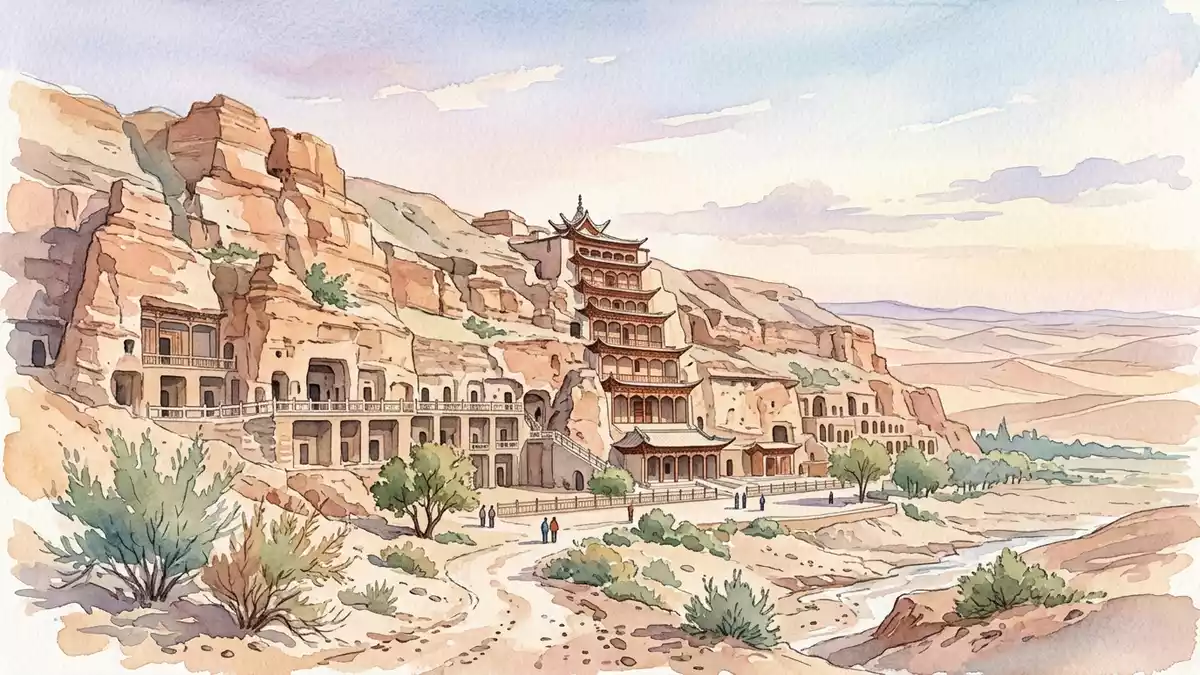
Mogao Ku, better known internationally as the Mogao Caves or Thousand Buddha Grottoes, is a vast complex of Buddhist cave temples carved into a desert cliff south-east of Dunhuang in north-western China. Created along a key branch of the Silk Road and first established in the fourth century AD, the site brings together murals and sculptures that chart around a thousand years of Buddhist art and daily life in Central Asia and China.
A Silk Road cliff turned into a painted sanctuary
Mogao Ku occupies a sandstone cliff above the Dachuan River on the eastern side of the Echoing-Sand Mountain, with rows of cave entrances cut into the rock face.Carved into the cliffs above the Dachuan River the complex lies south-east of the Dunhuang oasis in Gansu Province, where desert, river and trade routes meet.Location 25 km from downtown Dunhuang The caves stretch for well over a kilometre along the cliff, forming tiers of openings reached by walkways and staircases.
The first caves were cut in 366 AD, in the era known as the Five Hus and Sixteen States, and new grottoes continued to be added through successive dynasties up to the fourteenth century.Built in the year of 366 Around 735 caves were created in total, of which about 492 carry interior decoration that survives, making Mogao Ku one of the richest continuous records of Buddhist visual culture in East and Central Asia.492 cells and cave sanctuaries
Murals and sculptures across a thousand years
Inside the decorated caves, walls and ceilings are covered with murals showing Buddhas, bodhisattvas, donors, heavenly guardians and narrative scenes. The painted surfaces extend over tens of thousands of square metres, reflecting changing styles between the fourth and fourteenth centuries as different dynasties and regional influences left their mark on Mogao Ku.About 45,000 square meters of murals In some caves the paintings are organised in horizontal bands, while others concentrate imagery around a central figure of the Buddha or depict elaborate pure lands.
Alongside the murals stand painted sculptures in clay, ranging from small devotional figures to monumental images several storeys high. More than 2,000 of these statues are preserved, their forms echoing artistic trends from periods such as the Tang dynasty, when Dunhuang was an important frontier city.Tang dynasty paintings on cave walls Together, the sculpture and painting at Mogao Ku have led many specialists to describe the site as one of the greatest repositories of Buddhist art in the world.Greatest treasures of Buddhist art
Mogao Ku as a World Heritage desert complex
The significance of Mogao Ku was recognised internationally when the cave-temple complex was inscribed on the UNESCO World Heritage List in 1987 as a cultural property.World Heritage inscription in 1987 The listing highlights the way the caves reflect the movement of ideas, goods and artistic motifs along the Silk Route, with paintings that combine Chinese, Central Asian and Indian elements in a single desert sanctuary.
Visitors encounter not only the cliff of grottoes themselves but also the wider landscape: the dry river valley, the nearby dunes of Echoing-Sand Mountain and the oasis town of Dunhuang to the north-west.Cliff overlooking the Daquan River The caves sit around 25 km south-east of the town, forming a complex where monastic life, artistic production and trade intersected for centuries.About 15 miles south-east of Dunhuang
Visiting Mogao Ku: what travellers from Western Europe should know
- Mogao Ku lies about 25 km south-east of Dunhuang in Gansu Province, reached by road from the town and its railway station.
- The cliffside complex involves walking along exterior paths and using stairways to reach selected cave entrances.
- The surrounding terrain is desert, with sand and exposed rock near the caves and oasis vegetation closer to Dunhuang.
- The official language is Chinese and the currency is the yuan (CNY).
- Entry requirements depend on your nationality; UK travellers can check the FCDO travel advice at gov.uk/foreign-travel-advice, Irish travellers the Department of Foreign Affairs at ireland.ie.
Searching for Mogao Ku on social platforms
These links open searches for Mogao Ku on each platform.
Frequently asked questions about Mogao Ku
Where is Mogao Ku located?
Mogao Ku is on a desert cliff about 25 km south-east of Dunhuang, in Gansu Province in north-western China.
What can visitors expect inside the caves?
Selected caves contain extensive Buddhist murals and painted clay sculptures, with imagery created between the fourth and fourteenth centuries.
What makes Mogao Ku distinctive among historic sites?
The combination of hundreds of decorated caves, vast mural surfaces and its recognised role on the Silk Road give Mogao Ku its particular character.


