
Monasterio de Piedra, where medieval stone meets cascading water
Published on 09/07/2026 at 06:11 | Editorial responsibility: Rafael Müller, Editor-in-Chief AD HOC NEWS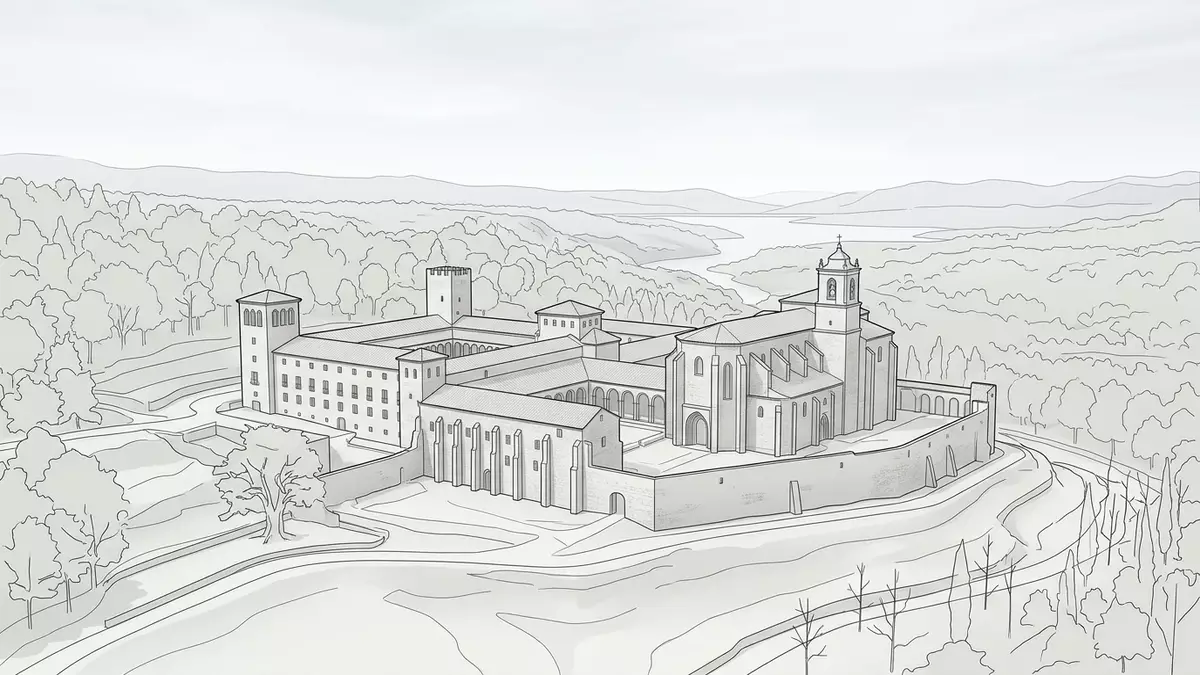
Monasterio de Piedra in Nuevalos in north?east Spain brings together a medieval Cistercian monastery and a river landscape reshaped into lakes, caves and waterfalls within a single enclosed park. Founded in 1194 under Alfonso II of Aragon beside the Piedra River, it developed over centuries into a complex where stone cloisters and wooded ravines sit side by side.
From royal foundation to Cistercian stone monastery
The story of Monasterio de Piedra begins in 1194, when King Alfonso II of Aragon and his wife Sancha donated an old castle beside the Piedra River to monks from Poblet so that a new monastery could be established there.donated a former Arabic castle The community followed the Cistercian order, whose approach to architecture emphasised simplicity and functional layout over ornate decoration.
The stone buildings that grew from that foundation, consecrated in 1218, form a compact ensemble arranged around a central cloister of near?square plan.austerity and functional layout The church, cloister, chapter house, refectory, kitchen and other monastic rooms follow the characteristic Cistercian scheme, with restrained stonework and little figurative ornament. Inside the former monastic buildings, later uses add further layers, including a wine museum linked to the Calatayud designation and an exhibition on how chocolate was prepared by the monks from the sixteenth century onwards.wine museum and chocolate exhibition
Nineteenth?century transformation into a historic garden park
The monastery remained a Cistercian house until the nineteenth century, when the community left and the estate passed into private hands. In 1840 the complex was bought by Pablo Muntadas Campeny, who maintained agricultural and livestock activity while his son Juan Federico Muntadas developed the surrounding ravine and riverbanks into a designed park of paths, viewpoints and planting.bought the monastery in 1840
Work on the landscape through the nineteenth century opened tracks and walkways, created access to caves such as the Iris cave and turned the Piedra River’s course into a sequence of features that could be explored on foot.Monasterio de Piedra as a garden and park complex A pioneering fish farm followed in 1867 beside the river, using its clear water to raise trout and Iberian crayfish for restocking streams across Aragon.first pisciculture centre in Spain In 1940 the landscaped park, with its lakes and cascades, gained formal protection as a Natural Scenic Area, while the wider complex, including the monastery, was later recognised as a national monument.declared a national monument in 1983
Water, limestone and paths: the river?cut park
Beyond the cloister walls, Monasterio de Piedra’s park follows the Piedra River through a limestone ravine, where the water has cut channels, formed pools and shaped caves. Visitors move through wooded sections of the valley past lakes such as Lago del Espejo, whose still surface reflects the surrounding rock and vegetation, and along paths that pass viewpoints over successive waterfalls.parkland crisscrossed by waterfalls and pools
Among the named cascades, Cola de Caballo, Caprichosa and Baño de Diana stand out for their scale and setting, while the Iris cave offers a walk inside the rock with views towards falling water.lakes, cascades and caves along the Piedra River The route through the park connects these features into a continuous circuit, combining exposed rock faces, enclosed sections beneath trees and clearings beside pools.
Visiting Monasterio de Piedra: what travellers from Western Europe should know
- Monasterio de Piedra lies beside the Piedra River near Nuevalos in the province of Zaragoza in Aragon, reached by road from surrounding towns and cities in north?east Spain.
- The terrain in the park includes staircases, uneven paths and slopes alongside the river gorge, so walking involves changes in level and sections on rock and soil rather than paved streets.
- The complex sits in one of the more sparsely populated areas of Aragon, with the monastery buildings and park forming a self?contained site outside the main village.
- The official language is Spanish and the currency is the euro.
Searching for Monasterio de Piedra on social platforms
These links open searches for Monasterio de Piedra on each platform.Frequently asked questions about Monasterio de Piedra
Where is Monasterio de Piedra?
Monasterio de Piedra stands near Nuevalos in the province of Zaragoza in the autonomous community of Aragon in north?east Spain, beside the Piedra River.
What can visitors expect on a visit?
A visit combines the stone buildings of a 13th?century Cistercian monastery with a riverside park of lakes, waterfalls, caves and woodland paths laid out along the ravine.
What makes Monasterio de Piedra distinctive?
The complex is distinctive for uniting a medieval monastic ensemble founded under Alfonso II of Aragon with a historic garden park, where the Piedra River shapes cascades, pools and caves in the same setting.


