
Monasterio de Santa Catalina, Arequipa’s city within the city
Published on 08/16/2026 at 14:01 | Editorial responsibility: Rafael Müller, Editor-in-Chief AD HOC NEWS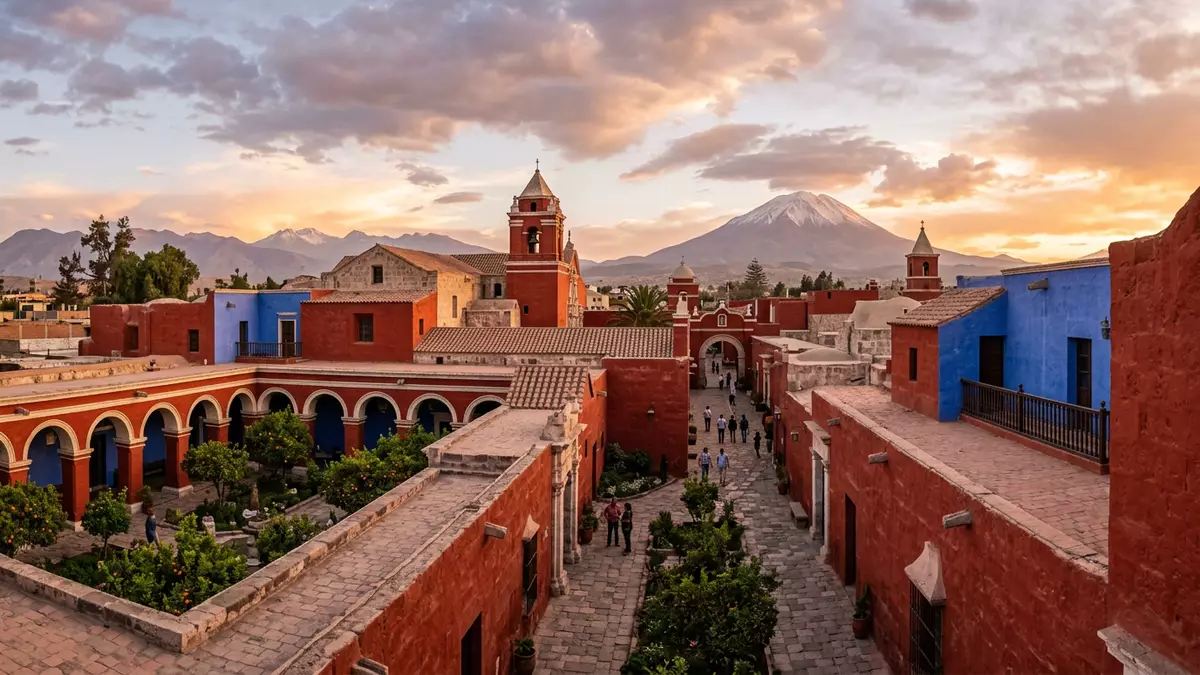
Monasterio de Santa Catalina in Arequipa is a Dominican convent that fills an entire city block with cloisters, chapels and vividly painted alleys, forming a self-contained city within the city shaped over several centuries.
A colonial convent carved from volcanic stone
Monasterio de Santa Catalina stands in the historic centre of Arequipa, a major city in southern Peru founded in the sixteenth century on a site known for its volcanic landscape and distinctive building stone.Arequipa was founded in 1540 on sillar stone This porous pale stone, formed from lava of nearby volcanoes, gives the monastery’s thick walls and arcades their characteristic light colour and texture.
The convent is traditionally dated to the late 1570s, when Dominican nuns established the community during the period of Spanish colonial rule in the Viceroyalty of Peru.The monastery was founded in the late sixteenth century It takes its full name, Monasterio de Santa Catalina de Siena, from Saint Catherine of Siena, a fourteenth-century Italian mystic associated with the Dominican tradition.The convent is named for Saint Catherine of Siena Over the centuries its buildings have been rebuilt and strengthened after earthquakes, while preserving the overall convent layout.
Streets, cloisters and cells: a city within walls
The most striking feature of Monasterio de Santa Catalina is its internal urban structure: paved lanes, small plazas and clusters of cells form a miniature city that was historically enclosed from the outside world.The monastery operated for centuries as a sealed city Within the walls, nuns followed a cloistered life with their own bakery, laundry and communal spaces, giving the complex the character of an autonomous neighbourhood.
Architecturally, the monastery combines Spanish colonial forms with local materials and Andean craftsmanship, including carved sillar, arcaded cloisters and decorative tiling.Its sillar architecture and Sevillian tiles show colonial and Andean influences Chapels and corridors display religious murals and artworks influenced by European styles such as Baroque, adapted to the local context.The complex is associated with colonial and Mestizo Baroque architecture
Cloisters and courtyards shaped by convent life
Inside the monastery, life was organised around cloisters and courtyards, each with its own character and role in the convent’s routines. The Novice Cloister is entered through an arch and centres on a courtyard marked by a rubber tree, reflecting its historical role as a space for women spending their first years under vows of silence, work and prayer.The Novice Cloister features a courtyard with a rubber tree Nearby, the Orange Cloister is named for the orange trees in its courtyard and gives access to the Profundis Room, where deceased nuns were traditionally mourned among paintings of the dead.The Orange Cloister and Profundis Room form part of the complex
In its heyday the monastery housed a substantial community of nuns and servants in cells arranged along narrow streets and around small plazas.Historical accounts describe several hundred residents in the seventeenth century Many cells were furnished as modest private apartments with their own kitchens and domestic spaces, illustrating the daily rhythm of convent life under Dominican discipline. Over time, parts of the complex have been opened to visitors while a smaller cloistered section continues to house a religious community.
Visiting Monasterio de Santa Catalina: what travellers from Western Europe should know
- Monasterio de Santa Catalina is located on Calle Santa Catalina in Arequipa’s historic centre, occupying a full city block a short walk north of the Plaza de Armas.
- The complex is built with thick sillar stone walls, arcaded cloisters and numerous internal streets and stairways, so a visit involves walking across uneven paving and navigating steps between levels.
- Arequipa lies in southern Peru; the official language is Spanish and the currency is the Peruvian sol.
- Entry requirements depend on your nationality; UK travellers can check the FCDO travel advice at gov.uk/foreign-travel-advice, Irish travellers the Department of Foreign Affairs at ireland.ie.
Searching for Monasterio de Santa Catalina on social platforms
These links open searches for Monasterio de Santa Catalina on each platform.
Frequently asked questions about Monasterio de Santa Catalina
Where is Monasterio de Santa Catalina located?
Monasterio de Santa Catalina stands on Calle Santa Catalina in the historic centre of Arequipa in southern Peru, occupying a single, walled city block.
What can visitors expect during a visit?
Visitors walk along narrow stone streets, explore cloisters and courtyards such as the Novice Cloister and Orange Cloister, and see chapels decorated with colonial religious art.
What makes Monasterio de Santa Catalina distinctive?
The convent combines sillar stone architecture, painted alleys and a self-contained urban layout that reflects centuries of cloistered Dominican life inside a single block of Arequipa’s historic centre.


