
Monserrate, Bogota’s mountain sanctuary above the city
Published on 09/05/2026 at 12:54 | Editorial responsibility: Rafael Müller, Editor-in-Chief AD HOC NEWS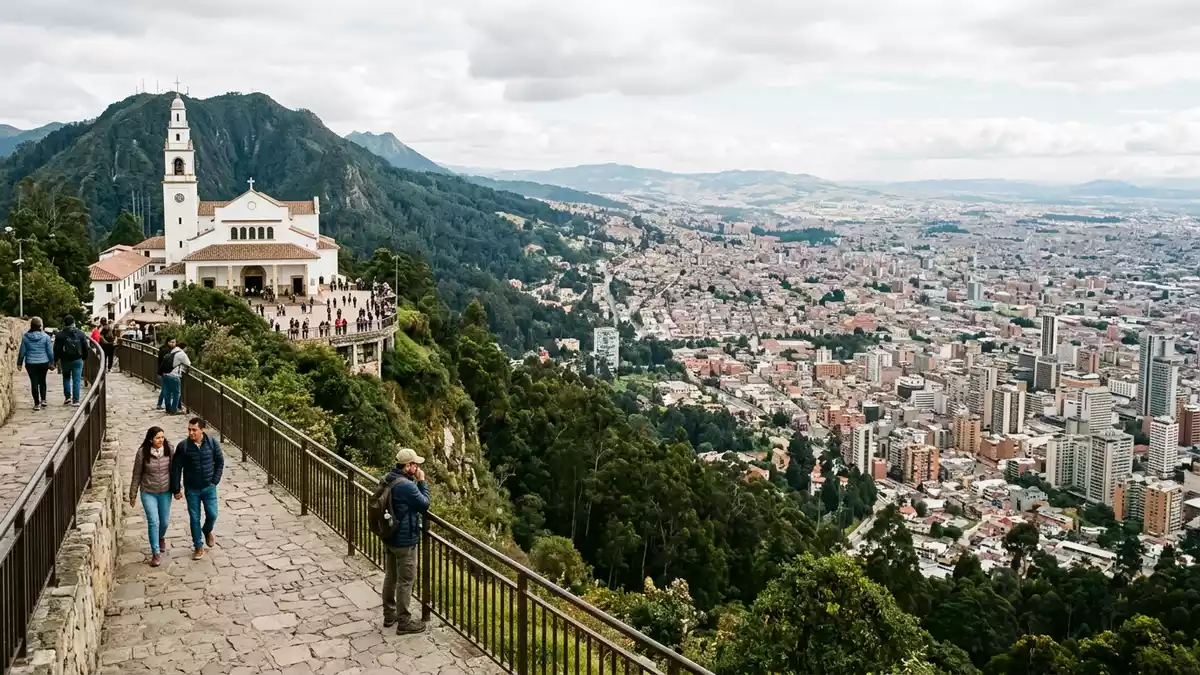
Monserrate is the steep Andean mountain that rises directly above central Bogota, crowned by a white Catholic sanctuary whose outlines are visible from large parts of the city. The summit lies more than 3,100 m (around 10,300 ft) above sea level in the Eastern Cordillera of the Andes, placing the church and its terraces high above the built-up plateau of the Colombian capital. From the sanctuary devoted to El Señor Caído, the mountain reads as a single composition: church, plazas and viewpoints strung along the crest.
An Andean peak turned city landmark
Monserrate forms part of the cerros orientales, the chain of eastern hills that frame Bogota’s urban basin and mark the transition from city to high Andean slopes.cerros orientales above Bogota Rising to about 3,152 m (10,341 ft), it stands noticeably higher than the city centre below, which lies on the Bogota savannah at roughly 2,600 m (8,530 ft).3,152 m above sea level The mountain crest carries the sanctuary complex as well as paved terraces and gardened paths that follow the ridge, setting built structures against steep green slopes.
The hill was known as Cerro de Las Nieves until the seventeenth century, when Christian pilgrimage consolidated around the summit and the name Monserrate took hold.earlier name Cerro de Las Nieves The broader landscape context reaches back further: the savannah at the foot of Monserrate formed part of the territory of the Muisca people, and the cerros of Monserrate and neighbouring Guadalupe stood above the area where Gonzalo Jiménez de Quesada founded the colonial town of Santa Fe de Bogotá in 1538.foundation of Santa Fe de Bogotá in 1538 Standing on the terraces, the relationship between high ground and city grid is clear: the straight streets of central Bogota run towards the foot of the mountain, while the sanctuary occupies the crest like a white marker above them.
Pilgrimage, sanctuary and the Fallen Lord
Christian devotion on Monserrate began in the seventeenth century, when Santafereño pilgrims walked up from the city to a small chapel dedicated to the Holy Cross of Monserrate on what was then Cerro de Las Nieves.early chapel dedicated to the Holy Cross Between about 1650 and 1657 a more substantial sanctuary was built on the summit, forming a recognised Catholic shrine above the town.sanctuary built between 1650 and 1657 The path from the Las Nieves church district up to the crest was laid out with chapels for pilgrims, fixing the upward route as part of the devotional practice.
At the heart of the sanctuary stands the image of El Señor Caído de Monserrate, a Christ figure associated with the crucifixion and placed near the main altar of the basilica.image of El Señor Caído de Monserrate The sculpture is attributed to Pedro de Lugo y Albarracín, a sixteenth-century sculptor whose work became central to religious devotion on the hill.Pedro de Lugo y Albarracín Over the following centuries Monserrate developed into an established site of pilgrimage from Bogota and other parts of Colombia, with walkers, worshippers and organised processions climbing the mountain to visit the shrine and attend services in the sanctuary.
Architecture, terraces and the neo-Gothic summit church
The present sanctuary building is a neo-Gothic structure completed in the early twentieth century, replacing earlier churches that had stood on the summit and suffered earthquake damage.neo-Gothic sanctuary on the summit Its whitewashed exterior and elongated nave line up along the ridge, with a tower rising above the main entrance and an adjoining convent-like wing. The building has been attributed to architect Arturo Jaramillo, whose design brought pointed arches and vertical emphasis to the hilltop silhouette.neo-Gothic design by Arturo Jaramillo Inside, the sanctuary is arranged around the altar and the statue of El Señor Caído, with side chapels, religious artworks and rows of pews for worshippers.
Outside the sanctuary, paved plazas extend along the summit, forming promenades and viewpoints that look across Bogota and towards other Andean ridges. On clear days the view takes in the central districts, the wider urban spread over the savannah and, further out, the patchwork of fields beyond the city edge. The summit complex also includes a series of smaller buildings housing restaurants and service spaces, and landscaped areas with planting and sculptures that line the approach to the church. Whether reached by the long walking path or by mechanical transport up the mountainside, Monserrate combines built religious architecture with the steep contours and vegetation of its Andean setting.
Visiting Monserrate: what travellers from Western Europe should know
- Monserrate rises directly above central Bogota on the eastern side of the city and is reached from the Las Nieves area near Carrera 2 and Paseo Bolívar.
- The approach on foot climbs a sustained mountain path with many steps and a significant change in altitude from the city to the summit, demanding steady legs and adaptation to thin air.
- Mechanical access follows dedicated lines up the mountainside, with a funicular railway and a cable car carrying passengers between the lower station and the hilltop complex.
- The summit terraces stand at more than 3,100 m (around 10,300 ft), so conditions reflect high-altitude weather on an exposed Andean crest above the city.
- The official language is Spanish and the currency is the Colombian peso; entry requirements depend on your nationality, UK travellers can check the FCDO travel advice at gov.uk/foreign-travel-advice, Irish travellers the Department of Foreign Affairs at ireland.ie.
Searching for Monserrate on social platforms
These links open searches for Monserrate on each platform.
Frequently asked questions about Monserrate
Where is Monserrate and what kind of place is it?
Monserrate is a mountain in the Eastern Cordillera of the Andes that rises above central Bogota, topped by a Catholic sanctuary and summit terraces.
What can visitors expect during a visit to Monserrate?
Visitors encounter a high-altitude Andean crest with a neo-Gothic church, pilgrimage path, plazas, viewpoints over Bogota and facilities arranged around the sanctuary.
What makes Monserrate distinctive among Bogota’s landmarks?
Its combination of steep mountain slopes, a seventeenth-century pilgrimage tradition and a white neo-Gothic sanctuary more than 3,100 m (around 10,300 ft) above the city gives Monserrate a particular character.


