
Monte Alban’s hilltop plazas above Oaxaca
Published on 08/22/2026 at 17:50 | Editorial responsibility: Rafael Müller, Editor-in-Chief AD HOC NEWS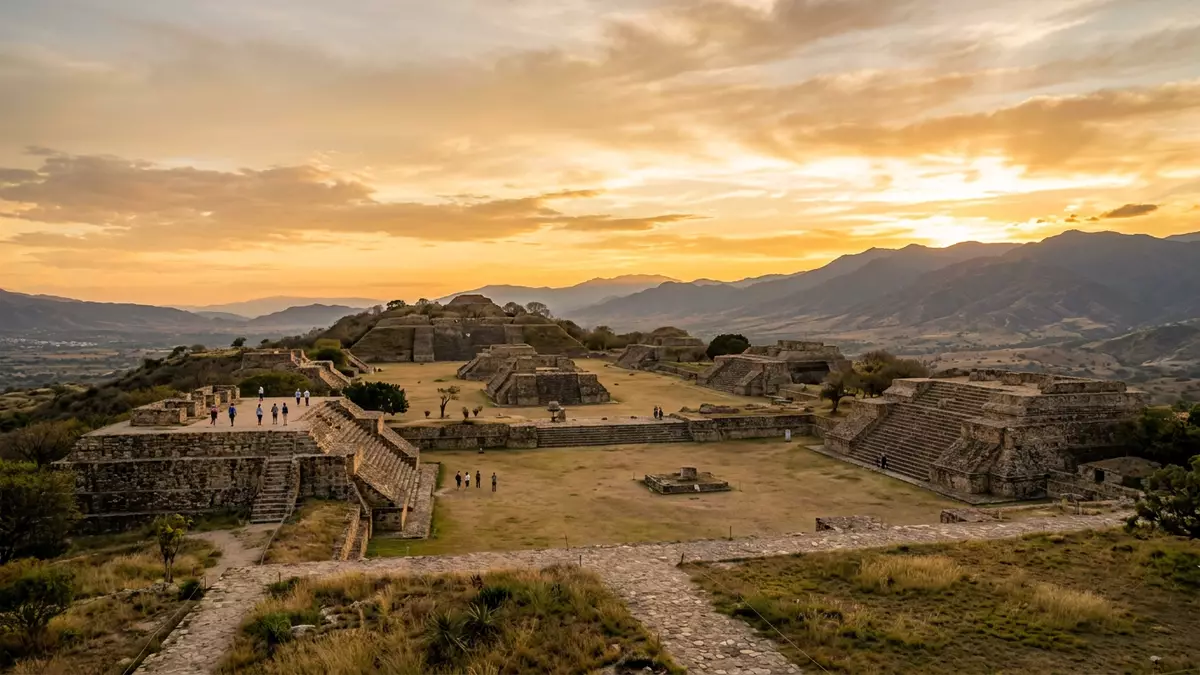
Monte Alban rises above the Valley of Oaxaca as a pre-Columbian city laid out across a flattened summit. Its terraces, plazas and tombs give the site a strong geometric presence, while the surrounding slopes remind visitors that this was once a hilltop capital, not a lowland town.
Stone platforms on a mountain summit
The archaeological zone belongs to the Historic Centre of Oaxaca and Archaeological Site of Monte Albán, a UNESCO World Heritage property inscribed in 1987. The place is linked to the Zapotec state of the first millennium BC, and later to Mixtec use of several tombs. World Heritage property
The visible remains include terraces, canals, artificial mounds, temples, a ball court and tombs. The central plaza and its surrounding platforms give the settlement a formal order that remains easy to read on the ground. ancient Zapotec centre
Zapotec capital and Mixtec burial place
The site is tied to the Zapotec capital that flourished from 500 BC to 850 AD, after a long sequence of occupation across about 1,500 years. That span places the main occupation in the Late Preclassic and Classic periods of Mesoamerican history. flourished from 500 BC to 850 AD
Its carved stones, bas-reliefs and hieroglyphic inscriptions belong to the wider artistic language of Oaxaca’s ancient cultures. Mixtec rulers later used some of the tombs, adding another historical layer to the same hilltop landscape. hieroglyphic inscriptions
Reading the plaza and the tombs
The main attraction is the broad ceremonial centre, where platforms frame open space and the remains of buildings stand in clear relation to one another. The site also preserves tomb architecture, stone carvings and the traces of formal urban planning across the summit.
Monte Alban is especially striking because the architecture is not hidden within dense streets or folded into a modern city. Its order is exposed across the hilltop, with the open plaza acting as the clearest single feature of the whole.
Visiting Monte Alban: what travellers from Western Europe should know
- The site lies west of Oaxaca city in Mexico’s Oaxaca state. It is reached from the valley by road, and the approach climbs to the hilltop archaeological zone.
- The terrain includes broad stone surfaces, steps and uneven ground. The summit setting also means that the site spreads across a large open plateau rather than a compact museum complex.
- The official language is Spanish and the currency is the Mexican peso.
- Entry requirements depend on your nationality; UK travellers can check the FCDO travel advice at gov.uk/foreign-travel-advice, Irish travellers the Department of Foreign Affairs at ireland.ie.
Searching for Monte Alban on social platforms
These links open searches for Monte Alban on each platform.
Frequently asked questions about Monte Alban
Where is Monte Alban?
It stands in Oaxaca state, above Oaxaca city in southern Mexico. The archaeological zone occupies a hilltop above the Valley of Oaxaca.
What does a visit involve?
The site is an outdoor archaeological landscape with plazas, platforms, tombs and stone remains. The ground is open and uneven, with steps and broad surfaces across the summit.
What makes Monte Alban distinctive?
Its hilltop layout is the defining feature, along with the long occupation by Zapotec and later Mixtec peoples. The formal plazas, carved stones and tombs make the ancient city easy to read across the landscape.


