
Montjuic, Barcelona’s layered hill of fortresses and culture
Published on 09/10/2026 at 21:07 | Editorial responsibility: Rafael Müller, Editor-in-Chief AD HOC NEWS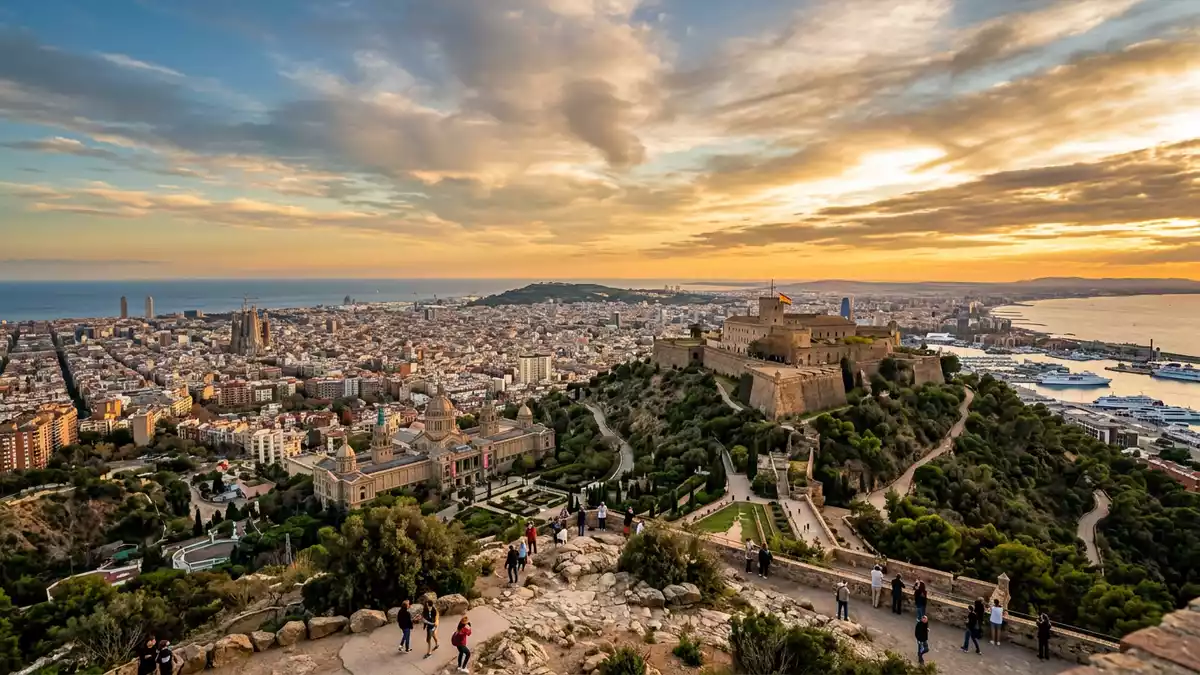
Montjuic is the broad hill that lifts away from Barcelona’s streets towards the Mediterranean, carrying defensive walls, museums, gardens and sports arenas on its terraces. Rising south-west of the central districts, it has long anchored the city’s edge, from the medieval Jewish burial ground that gave it its name to the fortified summit of Castell de Montjuic and the cultural institutions that line its slopes.Jewish burial ground
The hill above the port
Montjuic forms a low mountain beside Barcelona’s commercial port, running roughly between Plaça d’Espanya and the waterfront. The ridge stands a little over 170 m (558 ft) above sea level at its highest point, giving broad views over the city grid, the harbour and the coastal plain.a hill in Barcelona The slopes are mostly green, with parkland, woodland and landscaped gardens threaded by roads, paths and stairways, so the built structures sit among large expanses of planting rather than in dense streets.
The name Montjuic, often rendered as Montjuïc in Catalan, is widely explained as “mountain of the Jews”, linked to a medieval Jewish cemetery established on the hillside in the eleventh century.medieval Jewish necropolis Over time the hill became a strategic lookout above the port approaches and coastal plain, its height and position making it a natural place for watchtowers and fortifications.
Castell de Montjuic and the militarised summit
At the highest point of the hill stands Castell de Montjuic, an old military fortress whose origins lie in the mid seventeenth century.roots dating back from 1640 A small fort was first constructed around an earlier watchtower in 1640 during the Catalan Revolt, also known as the Guerra dels Segadors, marking the beginning of a long period in which the mountain was heavily militarised.origins of the castle date back to 1640 Subsequent centuries saw the fortress expanded and rebuilt, but the basic presence of a walled stronghold on the summit remained a defining feature.
Throughout the eighteenth and nineteenth centuries Montjuic Castle played a central role in the city’s military history, including bombardments of Barcelona during insurrectionary episodes in the 1840s and 1850s and its use as a prison for political opponents.bombarded from the fortress In the twentieth century it again functioned as a military prison during the Spanish Civil War and the subsequent Franco period, with the execution of Catalan president Lluís Companys in 1940 among the events most closely associated with the site.execution of Lluís Companys Ownership eventually passed to the city authorities in the early twenty-first century, and the castle now stands as a historic monument at the top of the hill.
Museums, sport and gardens on the slopes
Below the summit, Montjuic’s terraces carry an array of cultural and sporting venues dating mainly from the twentieth century. On one prominent platform stands the Palau Nacional, a grand building completed for the 1929 International Exposition and now home to the Museu Nacional d’Art de Catalunya (MNAC), which presents collections of Catalan art across multiple periods.Museu Nacional d’Art de Catalunya Nearby is the Fundació Joan Miró, housed in a building by architect Josep Lluís Sert and devoted to the work of Catalan artist Joan Miró, whose paintings, sculptures and drawings occupy bright, geometric galleries.Fundació Joan Miró
Montjuic also became one of Barcelona’s principal sporting centres in the late twentieth century. The Olympic Stadium on the hill, originally built for the 1929 exposition and later redeveloped, hosted events during the 1992 Summer Olympics, with other facilities such as swimming pools and sports halls grouped nearby.Olympic Stadium on Montjuïc Across the slopes lie theatres, including the Greek Theatre, and landscaped spaces such as the Jardins de Laribal and botanical gardens, which use the hillside’s gradients and views to frame terraces, pergolas and paths between trees and shrubs.
Visiting Montjuic: what travellers from Western Europe should know
- Montjuic stands south-west of Barcelona’s central districts, between Plaça d’Espanya and the commercial port, with metro, funicular and cable car links reaching different levels of the hill.
- The terrain includes sustained slopes and stairways between terraces; moving across the hill often involves walking on gradients and using long flights of outdoor steps.
- Several major institutions have their own buildings on Montjuic, including the Museu Nacional d’Art de Catalunya in the Palau Nacional and the Fundació Joan Miró in a dedicated museum structure.
- The official language is Catalan and Spanish, and the currency is the euro.
Searching for Montjuic on social platforms
These links open searches for Montjuic on each platform.Frequently asked questions about Montjuic
Where is Montjuic in relation to Barcelona’s centre?
Montjuic rises south-west of Barcelona’s central districts, forming a long hill between Plaça d’Espanya and the commercial port on the Mediterranean.
What can visitors expect when exploring Montjuic?
Visitors encounter a mix of historic fortifications, major museums, sports venues and gardens spread across terraces and slopes, with broad views over the city and harbour.
What makes Montjuic distinctive among Barcelona’s sights?
Montjuic is distinctive for combining a seventeenth-century fortress, twentieth-century cultural institutions and Olympic facilities on one hill, all integrated with extensive green spaces.


