
Mosquito Bay and the living blue light of Vieques
Published on 09/22/2026 at 07:05 | Editorial responsibility: Rafael Müller, Editor-in-Chief AD HOC NEWS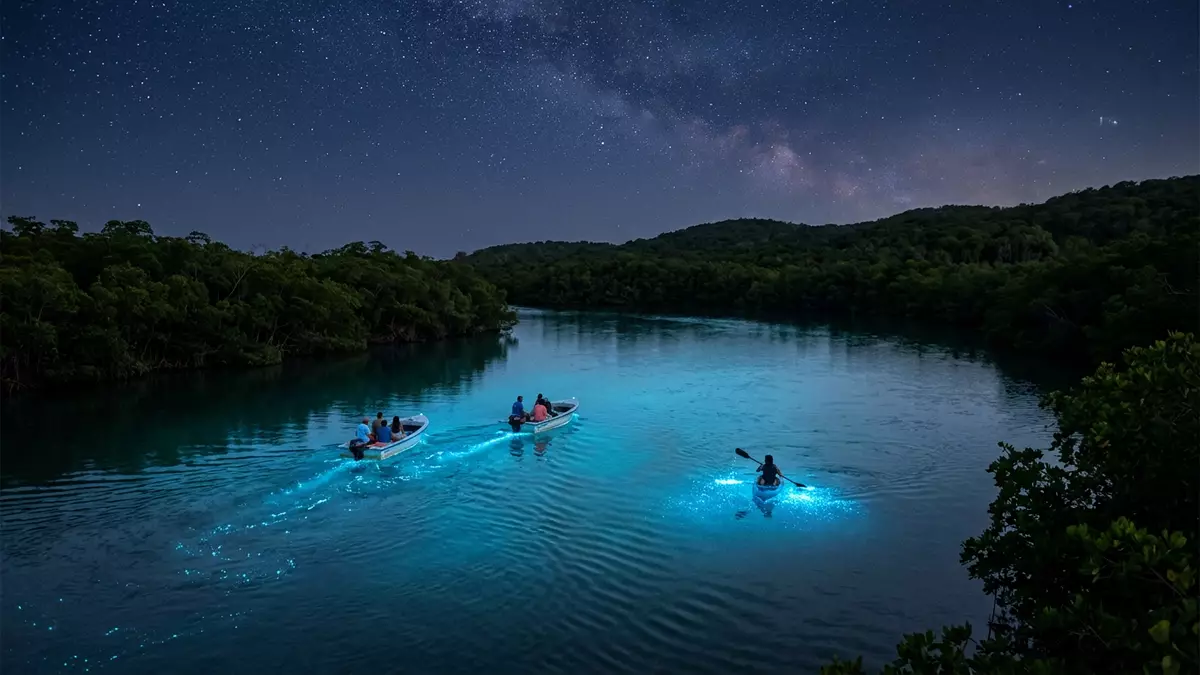
Mosquito Bay lies on the southern coast of Vieques, Puerto Rico, where shallow water, mangroves and microscopic organisms meet. At night, movement across the surface can produce brief blue-green flashes, turning the lagoon itself into the central subject of the landscape.
Mosquito Bay: a lagoon lit by microscopic life
The light comes from dinoflagellates, single-celled marine organisms that include Pyrodinium bahamense. When the water is disturbed, these organisms emit light through a chemical reaction. Each flash is tiny, yet the combined effect can appear as a glowing trail around a paddle or boat.
The bay is a shallow coastal lagoon with mangrove forest along its edges. Its sheltered water holds the organisms within a confined marine environment. Research at Puerto Mosquito has linked stronger measured bioluminescence with higher concentrations of Pyrodinium bahamense, giving the blue light a clear biological identity. light-producing dinoflagellates form part of a wider coastal system that includes mangroves, seagrass and coral habitat.
From Puerto Mosquito to National Natural Landmark
Mosquito Bay is also known as Puerto Mosquito and the Vieques Bioluminescent Bay. Its formal designation as a National Natural Landmark dates from 1980, placing the lagoon within Puerto Rico’s protected natural heritage.
The bay belongs to Vieques, an island east of Puerto Rico’s main island. Its southern setting places the lagoon near the coastal settlement of Esperanza and within a landscape of mangrove shorelines, shallow marine water and nearby Caribbean vegetation. The name Puerto Mosquito appears in scientific work on Puerto Rico’s bioluminescent bays, where the site is identified as one of the island’s principal examples. Puerto Mosquito research report records the bay’s position on the south-western coast of Vieques and examines its dinoflagellate population.
The title associated with Mosquito Bay is not based on architecture or an urban monument. It belongs to a living water system whose visible character changes when the surface is agitated. The National Natural Landmark designation therefore covers a lagoon, its surrounding habitats and the biological phenomenon within them.
Night water, mangrove edges and a protected ecosystem
A visit to Mosquito Bay centres on the water after dark. Guided kayak and boat outings are associated with the lagoon, where paddles, wakes and other movement can trigger small points of light. The experience depends on observing the water without treating it as an ordinary swimming area.
The mangroves are part of the bay’s ecological setting. Their roots border shallow water, while seagrass and coral habitats occur within the wider coastal environment. Restoration work in the Vieques Bioluminescent Bay Natural Reserve has included mangrove, seagrass and coral projects, connecting the glowing lagoon with a broader conservation landscape. Mosquito Bay’s luminous waters are associated with an exceptionally dense population of dinoflagellates.
Darkness gives the phenomenon its visual setting, but the light itself comes from biology. The water does not glow as a solid surface. Instead, disturbed patches produce separate flashes that appear and disappear across the lagoon. The contrast between dark surroundings, mangrove silhouettes and blue-green sparks defines Mosquito Bay’s character.
Visiting Mosquito Bay: what travellers from Western Europe should know
- Mosquito Bay lies on the southern coast of Vieques, near Esperanza. Vieques is reached from Puerto Rico’s main island by air or sea transport.
- The visit takes place on shallow lagoon water. Kayaks and small boats are used for observing the bioluminescence, while mangrove edges form the visible shoreline.
- The official language is Spanish and English, and the currency is the United States dollar.
- Entry requirements depend on your nationality; UK travellers can check the FCDO travel advice at gov.uk/foreign-travel-advice, Irish travellers the Department of Foreign Affairs at ireland.ie.
Searching for Mosquito Bay on social platforms
These links open searches for Mosquito Bay on each platform.Frequently asked questions about Mosquito Bay
Where is Mosquito Bay?
Mosquito Bay is on the southern coast of Vieques, an island belonging to Puerto Rico. The lagoon lies near Esperanza and is also known as Puerto Mosquito.
What happens during a visit?
Visitors observe the lagoon after dark from a kayak or small boat. Movement across the water can trigger blue-green flashes from dinoflagellates.
What makes Mosquito Bay distinctive?
Its visible light comes from living microscopic organisms rather than artificial lighting. Mangroves, shallow water and the protected coastal setting form the surrounding ecosystem.


