
Mosteiro dos Jeronimos and the stone lace of Portugal’s Age of Discoveries
Published on 08/22/2026 at 18:48 | Editorial responsibility: Rafael Müller, Editor-in-Chief AD HOC NEWS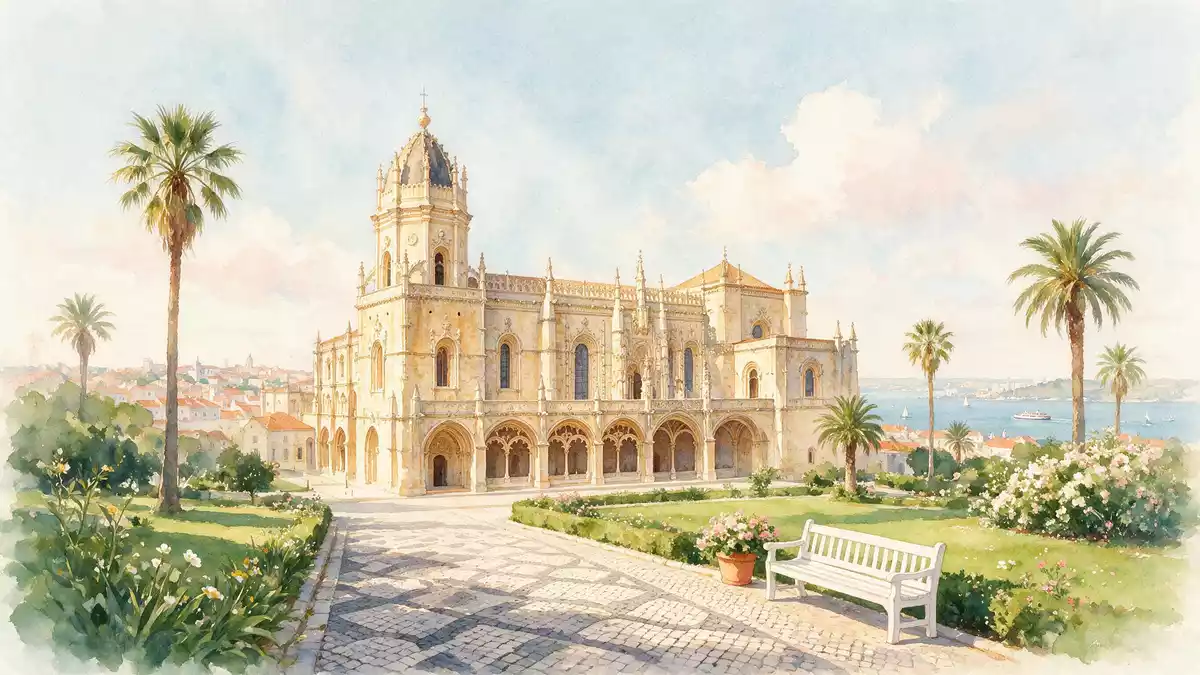
Mosteiro dos Jeronimos in Lissabon is a monastery complex where Portugal’s Age of Discoveries is written into limestone as elaborate tracery, maritime symbols and royal tombs. Built in the early sixteenth century under King Manuel I, it rises near the Tagus river in Belém, facing the waters from which Vasco da Gama sailed towards India.
Manueline stonework by the Tagus
The monastery stands in the Belém district of Lisbon, close to the wide estuary of the Tagus river where it opens towards the Atlantic. The long riverside façade forms a pale limestone front along Praça do Império, with towers, buttresses and arcades giving the complex an extended yet coherent outline.Praça do Império address Inside, the architecture belongs to the Manueline vocabulary, a Portuguese variant of late Gothic that blends structural forms with sculpted motifs drawn from navigation, heraldry and nature.Manueline Portuguese art
Many elements repeat along the façades and cloisters: ropes carved into stone, armillary spheres, crosses of the Order of Christ and botanical motifs recalling plants from distant shores. The building fabric is predominantly local limestone, cut and carved into traceried arches and balustrades that lend the monastery a filigree character despite its size.seafaring and oriental motifs From the riverside, the monastery and the nearby Belém Tower form a pair of stone landmarks marking Lisbon harbour and tying the urban landscape back to early modern seafaring.
From royal commission to UNESCO World Heritage
Mosteiro dos Jeronimos was commissioned by King Manuel I at the turn of the sixteenth century, during his reign between 1495 and 1521, as a major religious and dynastic foundation linked to maritime expansion.commissioned by King Manuel I Construction began in the early 1500s, with a first stone recorded in 1501 or 1502, and continued for around a century under successive master builders.primary dates of construction The monastery was given to the Hieronymite Order, whose monks prayed for sailors and for the royal family, turning the complex into both a spiritual harbour and a royal pantheon.
Over the following centuries, Mosteiro dos Jeronimos became closely associated with the dynasty of Aviz and later with the Portuguese crown more broadly, housing royal tombs and ceremonial functions. In the nineteenth century it was classified as a National Monument, recognising its artistic and historical weight within Portugal.National Monument and World Heritage In 1983 the monastery, together with the nearby tower of Belém, was inscribed on the UNESCO World Heritage List as an outstanding example of Portuguese art linked to the maritime discoveries of the fifteenth and sixteenth centuries.UNESCO inscription in 1983
Cloisters, church and tombs
Within the outer walls, the complex is organised around a large cloister and the church of Santa Maria de Belém. The cloister is two storeys high, each level lined with arcades whose arches and piers carry dense Manueline carving, from marine symbols to vegetal forms. This inner courtyard creates a calm geometric space with open sky above, framed on all sides by sculpted stone and corridors.
The adjoining church has a nave supported by slender columns and a vaulted ceiling, showing how late Gothic structure was adapted to Iberian needs and decorative traditions.late Gothic Manueline church Near the entrance, tombs of Vasco da Gama and other figures from Portuguese history occupy prominent positions, connecting the architecture directly with names from the voyages that reshaped trade routes.Vasco da Gama buried here Elsewhere in the complex, further chapels and burial spaces form a continuous link between the building and the country’s political and literary past, including monarchs and writers laid to rest within the same Manueline stone envelope.
Visiting Mosteiro dos Jeronimos: what travellers from Western Europe should know
- Mosteiro dos Jeronimos stands in Belém, west of central Lissabon, near the Tagus river and Praça do Império. It is reached by urban transport routes running along the riverside.
- The monastery interior includes staircases and cloister walks laid out around a large courtyard, with stone floors and steps that require steady footing.
- Belém contains several major landmarks within walking distance of the monastery, including the riverside Torre de Belém and the Padrão dos Descobrimentos monument.
- Portugal’s official language is Portuguese and the currency is the euro.
Searching for Mosteiro dos Jeronimos on social platforms
These links open searches for Mosteiro dos Jeronimos on each platform.
Frequently asked questions about Mosteiro dos Jeronimos
Where is Mosteiro dos Jeronimos located in Lissabon?
Mosteiro dos Jeronimos is in the Belém district of Lisbon, beside Praça do Império and near the northern bank of the Tagus river.
What can visitors expect inside the monastery complex?
Visitors encounter Manueline stonework in cloisters and church spaces, with carved maritime motifs, chapels, tombs of historical figures and quiet corridors around a central courtyard.
What makes Mosteiro dos Jeronimos distinctive among Portuguese monuments?
Its large-scale Manueline design, riverside position linked to the Age of Discoveries and role as both Hieronymite monastery and royal pantheon make it a distinctive landmark in Portugal.


