
Mount Kenya National Park and its glacier crown
Published on 09/10/2026 at 14:10 | Editorial responsibility: Rafael Müller, Editor-in-Chief AD HOC NEWS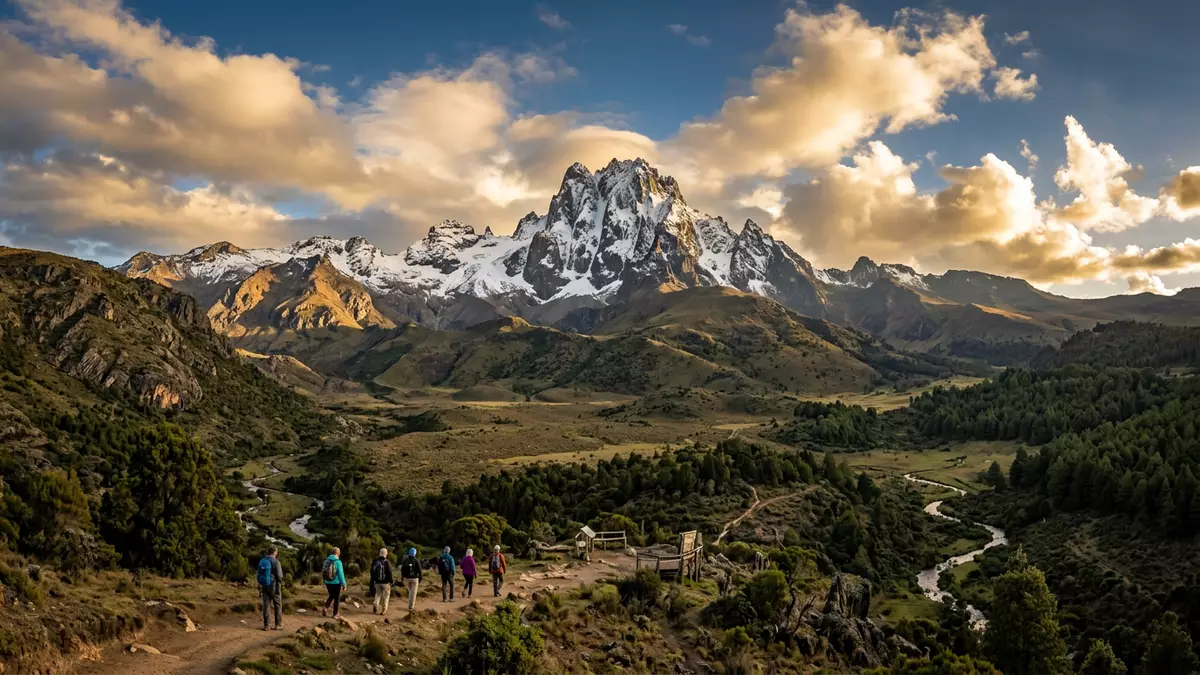
Mount Kenya National Park rises around Kenya’s highest mountain, with Batian at 5,199 m and a summit zone of glacier-clad rock. It lies near Nanyuki and forms part of a UNESCO-listed mountain landscape.
Glaciers, peaks and forest belts
The mountain is an ancient extinct volcano, and its upper slopes hold valleys cut back from the peaks. UNESCO describes 12 remnant glaciers on Mount Kenya, together with four secondary peaks at the heads of U-shaped valleys.12 remnant glaciers The forested middle slopes below the alpine zone give the mountain a layered profile rather than a single bare summit.
The park sits within a wider protected ecosystem that also includes forest reserve land and lower foothill habitats. Mount Kenya National Park was established in 1949, and the wider property was inscribed on the World Heritage List in 1997.established in 1949
World Heritage status and mountain setting
Mount Kenya straddles the equator and rises in central Kenya. The mountain is about 193 km north-east of Nairobi and about 480 km from the Kenyan coast, placing it far from the Indian Ocean yet close to the country’s interior highlands.straddles the equator
The World Heritage property is named Mount Kenya National Park/Natural Forest and combines the national park with forest reserve components. The listed area reflects the mountain’s ecological range, from upper forest to moorland and rock, with the park itself managed by the Kenya Wildlife Service and the reserve by the Kenya Forest Service.Mount Kenya National Park/Natural Forest
A landscape shaped by altitude
Mount Kenya is an alpine world of steep relief, valleys and exposed summit rock. Its highest peaks are Batian and Nelion, while Point Lenana is the best-known trekking summit in the massif.highest peaks are Batian
The mountain’s profile changes sharply with altitude. Lower slopes carry forest, then bamboo and moorland, before the ground opens into rock, ice and high alpine terrain around the summits.
Visiting Mount Kenya National Park: what travellers from Western Europe should know
- The park is reached from central Kenya, with Nanyuki serving as a northern base and Naro Moru, Chogoria and Sirimon linked to the mountain’s access routes.
- The upper mountain is high-altitude terrain with rock, glacier remnants and steep valleys. Conditions change quickly with elevation.
- The official language is English and Swahili, and the currency is the Kenyan shilling.
- Entry requirements depend on your nationality; UK travellers can check the FCDO travel advice at gov.uk/foreign-travel-advice, Irish travellers the Department of Foreign Affairs at ireland.ie.
Searching for Mount Kenya National Park on social platforms
These links open searches for Mount Kenya National Park on each platform.
Frequently asked questions about Mount Kenya National Park
Where is Mount Kenya National Park?
It lies in central Kenya around Mount Kenya, near Nanyuki and north-east of Nairobi. The mountain straddles the equator.
What does a visit involve?
The park is an alpine mountain landscape with forested lower slopes, high valleys and exposed summit terrain. Nanyuki, Sirimon, Chogoria and Naro Moru are common reference points for access.
What makes it distinctive?
Its combination of 1949 protection, 1997 World Heritage status, Batian at 5,199 m and the mountain’s glaciers gives it a strong identity. The place is both a national park and a mountain ecosystem.


