
Mount Kenya National Park and the high peaks above Nanyuki
Published on 08/24/2026 at 18:40 | Editorial responsibility: Rafael Müller, Editor-in-Chief AD HOC NEWS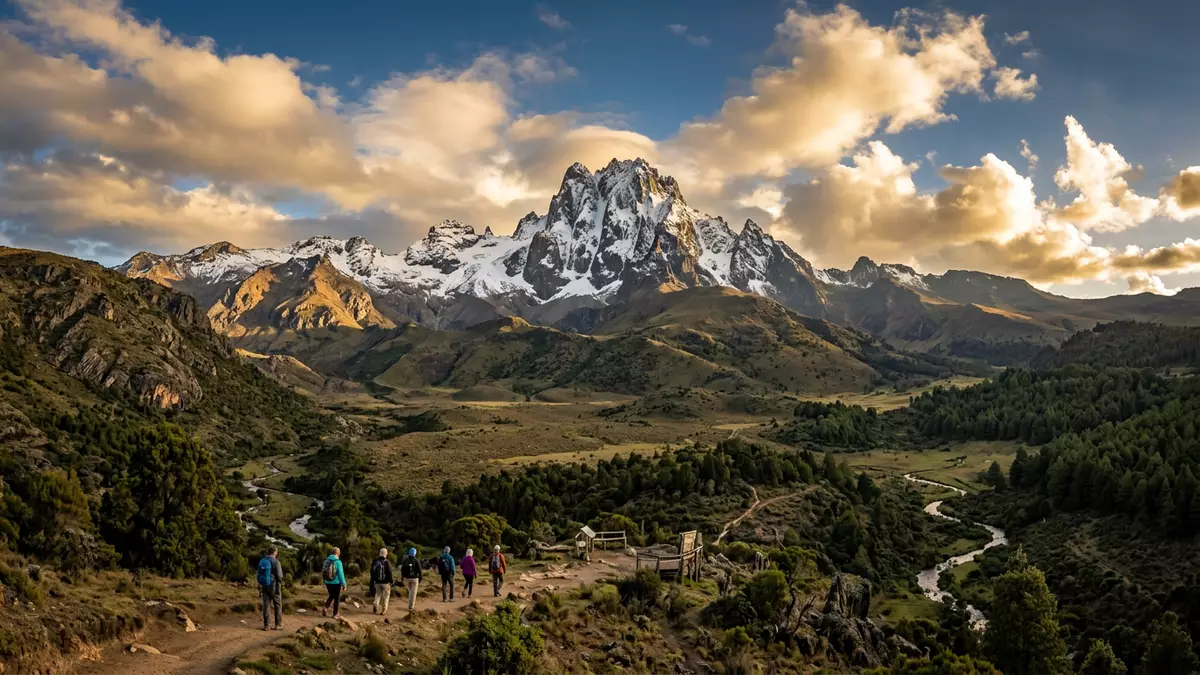
Mount Kenya National Park rises above the town of Nanyuki on the northern slopes of Mount Kenya, an ancient volcanic massif whose highest summit, Batian, reaches 5,199 m (17,058 ft). The protected area forms part of the Mount Kenya National Park / Natural Forest World Heritage site in Kenya, inscribed for its afro?alpine ecosystems and dramatic mountain scenery in 1997.
The high volcanic massif and its afro?alpine belt
Mount Kenya is an extinct stratovolcano that stands as the second?highest mountain in Africa, with the central massif ringed by steep ridges and glaciated valleys carved into volcanic rock. Its highest peak, Batian, reaches 5,199 m (17,058 ft), closely followed by Nelion at 5,188 m (17,022 ft) and the trekking summit Point Lenana at 4,985 m (16,355 ft).Batian, Nelion and Point Lenana dominate a summit area characterised by rock spires, buttresses and remnant glaciers hanging in sheltered hollows.
The national park protects the afro?alpine region surrounding this massif, where giant heathers, lobelias and groundsels grow above belts of montane forest and bamboo. The property combines the park with parts of the surrounding natural forest to form the Mount Kenya National Park / Natural Forest World Heritage site, which covers over 180,000 ha of mountain and forest landscapes.Mount Kenya National Park / Natural Forest lies astride the equator, so glaciers, tarns and high moorland share latitude with tea and coffee districts lower down the slopes.
World Heritage status and the water tower of central Kenya
Mount Kenya National Park / Natural Forest was inscribed on the UNESCO World Heritage List in 1997 under natural criteria (vii) and (ix), recognising its outstanding mountain scenery and the ecological processes shaping afro?alpine ecosystems.The World Heritage datasheet notes that the property was later extended to include the Lewa Wildlife Conservancy and Ngare Ndare Forest Reserve, linking the high mountain to wildlife corridors on its northern flanks. Within the serial site, Mount Kenya National Park is managed by the Kenya Wildlife Service, while adjacent forest reserves fall under the Kenya Forest Service.Management responsibilities reflect its dual role as wildlife habitat and water catchment.
The massif acts as a major “water tower” for central Kenya, feeding rivers that irrigate farms, supply towns and sustain wildlife areas downstream. The mountain’s glaciers, high?altitude bogs and small lakes form headwaters for the Tana and Ewaso Ng’iro North rivers, among others, with meltwater and rain filtered through forest to lower catchments.The site’s description emphasises this hydrological role alongside its scenic value, making the park central to regional water security as well as conservation.
Nanyuki and the main approaches into the park
On the north?western side of the mountain, Nanyuki has developed as a base town for access to Mount Kenya National Park, with roads leading towards Sirimon and Burguret gates. The Sirimon Route enters the park near Nanyuki and is widely used for treks to Point Lenana, following a gradual ascent through forest and moorland before reaching alpine zones close to the main peaks.The Sirimon entry gate lies at over 2,600 m (8,530 ft), already within the highlands above the town.
Other routes climb from different sides of the mountain, but many travellers approaching from Western Europe first encounter Mount Kenya through Nanyuki’s services and the park gates on this flank. Within the protected area, trekking paths rise towards the high cirques and ridges, with climbing routes on Batian and Nelion reserved for experienced mountaineers using technical equipment.Peak elevations and visitor profiles underline the difference between the trekking summit at Point Lenana and the technical nature of the highest rock peaks.
Visiting Mount Kenya National Park: what travellers from Western Europe should know
- Mount Kenya National Park lies north?east of Nairobi in central Kenya, with Nanyuki on its north?western side acting as the main base town linked to Sirimon Gate.
- Approaches into the park rise from agricultural highlands into belts of montane forest and bamboo before reaching open moorland, so visitors encounter increasing altitude and extended sections on foot on mountain paths.
- Within the massif, trekking routes towards Point Lenana reach over 4,800 m (15,750 ft), and any ascent into higher alpine zones requires preparation for thin air and rapidly changing mountain weather.
- The official language is Swahili and English is also widely used; the currency is the Kenyan shilling.
- Entry requirements depend on your nationality; UK travellers can check the FCDO travel advice at gov.uk/foreign-travel-advice, Irish travellers the Department of Foreign Affairs at ireland.ie.
Searching for Mount Kenya National Park on social platforms
These links open searches for Mount Kenya National Park on each platform.
Frequently asked questions about Mount Kenya National Park
Where is Mount Kenya National Park located?
Mount Kenya National Park surrounds the Mount Kenya massif in central Kenya, with the north?western approaches reached from the town of Nanyuki.
What can visitors expect inside the park?
Visitors encounter montane forest, bamboo and open moorland rising towards glaciated valleys, alpine lakes and the high peaks of Batian, Nelion and Point Lenana.
What makes Mount Kenya National Park distinctive?
The park combines afro?alpine ecosystems on an equatorial volcano, World Heritage status and a role as a major water catchment feeding rivers across central Kenya.


