
Mount Kenya National Park’s high-altitude world above Nanyuki
Published on 09/08/2026 at 08:03 | Editorial responsibility: Rafael Müller, Editor-in-Chief AD HOC NEWS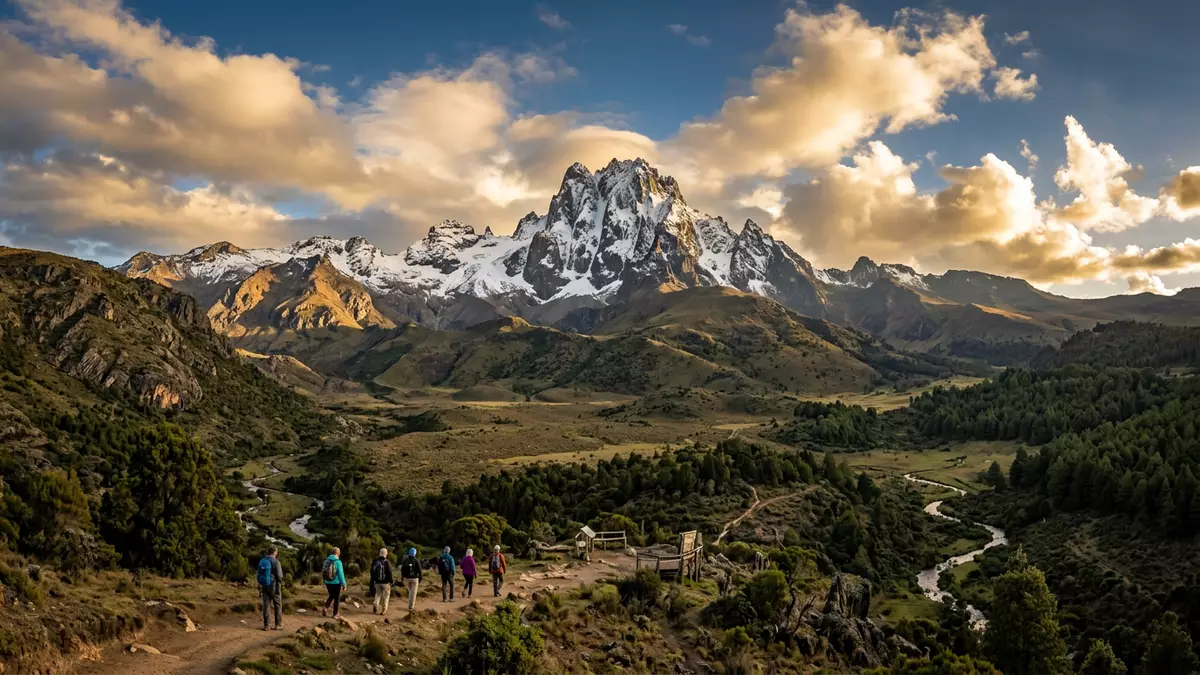
Mount Kenya National Park rises above Nanyuki in central Kenya as a protected mountain landscape centred on Mount Kenya, Africa’s second-highest peak. Established in 1949, it encloses a high-altitude world of forests, moorland and glaciated summits that later gained UNESCO World Heritage status for its scenery and ecology.
A stratovolcano turned protected mountain landscape
Mount Kenya is an ancient stratovolcano whose peak reaches about 5,199 m (17,057 ft), making it the second-highest mountain on the African continent after Kilimanjaro.second-highest mountain in Africa The national park surrounds the upper slopes of this solitary massif, shielding its glaciers, cliffs and high valleys from development and intensive land use.surrounds the upper slopes
The park lies close to the equator yet climbs through pronounced climatic bands, from montane forest into Afro-alpine moorland and eventually the bare rock and ice of the summit zone.Afro-alpine moorland and diverse forests Its designation as a national park came in the mid-twentieth century, reflecting the importance of Mount Kenya as a regional “water tower” and wildlife refuge.gazetted as a national park in 1949
UNESCO World Heritage and biosphere reserve status
Mount Kenya National Park forms the core of the Mount Kenya National Park / Natural Forest World Heritage property, which was inscribed on the UNESCO List in 1997 under natural criteria for its scenery and ecological processes.inscribed on the World Heritage List in 1997 The inscription later expanded to include the Lewa Wildlife Conservancy and Ngare Ndare Forest Reserve, linking the alpine zone to the wider foothill ecosystems used by migratory wildlife.
Well before its World Heritage recognition, the Mount Kenya area became a Biosphere Reserve under UNESCO’s Man and the Biosphere Programme in 1978.designated a Biosphere Reserve in 1978 Management of the park rests with the Kenya Wildlife Service, while the surrounding forest reserves fall under the Kenya Forest Service, together forming a large protected area whose total World Heritage extent exceeds 180,000 ha.World Heritage property extent
From forest belt to glaciated summits
Within Mount Kenya National Park, the lower zone is characterised by dense forest that merges into bamboo stands and hagenia groves, forming a dark green belt around the mountain.diverse forests around the mountain Above this, tree cover thins into heather and tussock grass, with giant lobelias and other Afro-alpine plants marking the transition to the open moorland. These bands are part of what earned the park its recognition for illustrating ecological processes along an altitudinal gradient.
Higher still, the terrain steepens into buttresses and ridges leading towards the main peaks of Batian and Nelion, which rise above 5,100 m (16,732 ft).Batian and Nelion peaks Glacial cirques, valleys and remnant glaciers occupy this upper zone, with U-shaped valleys that bear the imprint of past glaciation.U-shaped glacial valleys Point Lenana, a subsidiary summit, provides a non-technical high point for trekkers, while technical climbers focus on the steeper rocky faces of the higher summits.Point Lenana as a destination
Visiting Mount Kenya National Park: what travellers from Western Europe should know
- Mount Kenya National Park lies in central Kenya north-east of Nairobi, with access routes converging near Nanyuki on the Nanyuki–Isiolo and Nyeri–Nanyuki roads.
- The park’s terrain is mountainous, with long ascents on foot and sections of steep paths and high-altitude trails where the air becomes thin.
- Approach roads reach several official mountain gates, including Sirimon, Naro Moru and Chogoria, which serve as entry points into the park’s trail network.
- The official language is Swahili alongside English, and the national currency is the Kenyan shilling.
- Entry requirements depend on your nationality; UK travellers can check the FCDO travel advice at gov.uk/foreign-travel-advice, Irish travellers the Department of Foreign Affairs at ireland.ie.
Searching for Mount Kenya National Park on social platforms
These links open searches for Mount Kenya National Park on each platform.
Frequently asked questions about Mount Kenya National Park
Where is Mount Kenya National Park located?
Mount Kenya National Park is in central Kenya north-east of Nairobi, on the slopes of Mount Kenya near the town of Nanyuki.
What can visitors expect on a visit?
Visitors encounter a mountainous protected area with forest trails, high moorland routes and, for experienced parties, access towards glaciated summit terrain.
What makes Mount Kenya National Park distinctive?
The park is distinctive for combining a high equatorial mountain, Afro-alpine ecosystems and formal recognition as both a Biosphere Reserve and a UNESCO World Heritage site.


