
Musee du Bardo and Tunisia’s palace of mosaics
Published on 09/23/2026 at 10:17 | Editorial responsibility: Rafael Müller, Editor-in-Chief AD HOC NEWS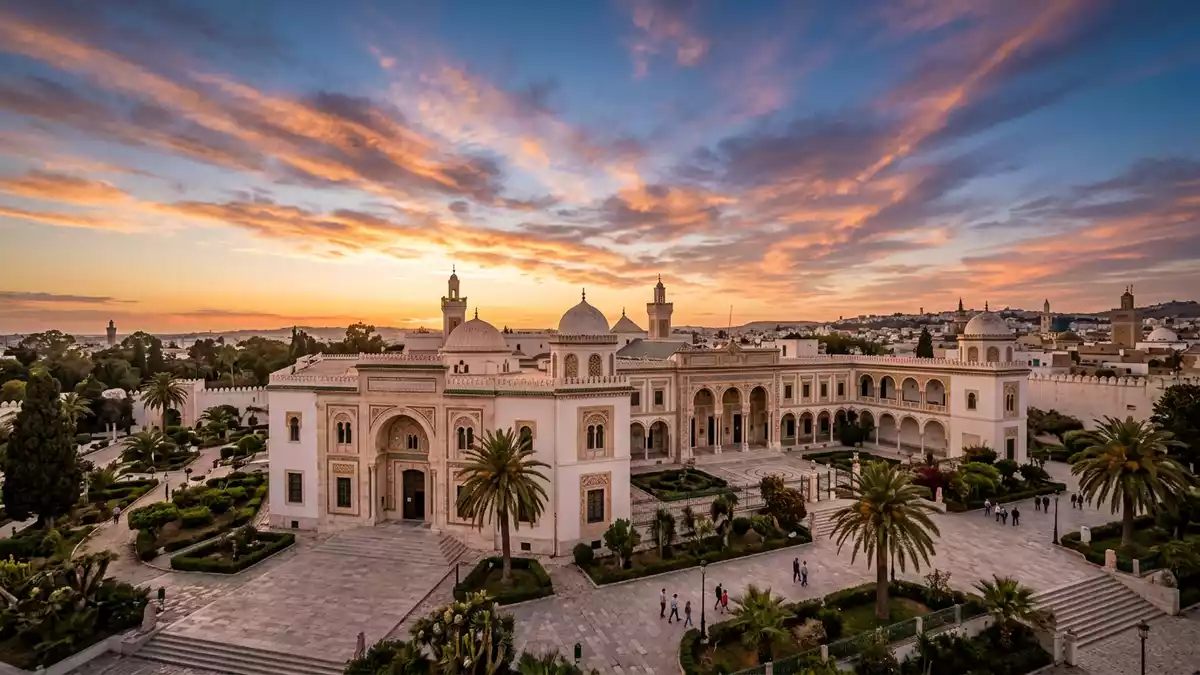
Musee du Bardo occupies a nineteenth-century beylical palace in Tunis, where painted ceilings, carved stucco and ceramic panels frame collections spanning Tunisia’s history. Roman mosaics form the museum’s visual centre, but the galleries also reach from prehistoric tools and Punic votive objects to Islamic manuscripts and ceramics.
Musee du Bardo: a palace shaped by many traditions
The museum stands in the Bardo district, west of the medina of Tunis. Its palace architecture combines Tunisian forms with Andalusian-Moorish, Ottoman and Italian influences, creating rooms whose decoration is part of the collection.
The principal palace was begun under Muhammad Bey and completed under Muhammad al-Sadok Bey during the second half of the nineteenth century. Its rooms include a covered patio, ceremonial spaces, private apartments and ceilings enriched with painted wood, gilding and finely cut plaster.
Glazed ceramic panels cover sections of the walls in blue, green, yellow and white. Marble columns, carved frames and geometric or vegetal stucco motifs appear throughout the palace. The result is not a neutral container for archaeology, but a historic residence with its own visual language.
From the Alaoui Museum to a national collection
The creation of the museum was decided by decree on 7 November 1882. The official inauguration followed on 7 May 1888, when the institution was named the Alaoui Museum after Ali Bey III. The museum’s founding dates mark the beginning of its public life.
In March 1956, after Tunisia gained independence, the institution became the Bardo National Museum. Its historic building is listed as a monument, and the palace remains central to the museum’s identity.
The collections are arranged across the palace and its museum extensions. They cover prehistory, Punic and Numidian cultures, the Greek and Roman periods, early Christianity, Jewish heritage and Islamic art. This range presents Tunisia through objects from many regions and historical communities.
Mosaics, shipwreck bronzes and the history of Tunisia
The Roman mosaic collection includes mythological scenes, marine imagery, rural estates, seasonal cycles and scenes from daily life. A celebrated mosaic represents the poet Virgil with two Muses, while another depicts Ulysses passing the Sirens.
The galleries also contain mosaics from Carthage, Thysdrus, Dougga and other ancient sites. Their subjects include Neptune, seasons, villas, gardens, animals, theatrical imagery and the occupations of agricultural life. The museum’s mosaic collection forms one of the clearest records of Roman North African visual culture.
A separate department presents objects recovered from the Mahdia shipwreck, including bronze sculptures, marble works and elements associated with Hellenistic art. The collection connects Tunisia with the movement of artworks across the Mediterranean during the ancient world.
Punic galleries display offerings linked with Baal Hammon and Tanit, along with inscriptions, jewellery and ceramics. Numidian rooms include stelae and evidence of Punic and Libyco-Berber writing. Islamic collections add Qallaline ceramics, decorative tiles and pages from the Blue Quran and Hadhina Quran.
Visiting Musee du Bardo: what travellers from Western Europe should know
- Musee du Bardo is in the Bardo district of Tunis, west of the medina. The museum is reached through the city’s urban transport network and lies near the parliamentary district.
- The visit combines palace interiors with museum galleries. Expect stairs, changes between historic rooms and modern exhibition spaces, and floors covered by archaeological displays.
- The palace rooms contain ceramic wall panels, painted timber ceilings, carved stucco and marble details. The architecture is part of the experience alongside the collections.
- The official language is Arabic and the currency is the Tunisian dinar.
- Entry requirements depend on your nationality; UK travellers can check the FCDO travel advice at gov.uk/foreign-travel-advice, Irish travellers the Department of Foreign Affairs at ireland.ie.
Searching for Musee du Bardo on social platforms
These links open searches for Musee du Bardo on each platform.
Frequently asked questions about Musee du Bardo
Where is Musee du Bardo?
Musee du Bardo is in the Bardo district of Tunis, west of the city’s historic medina. It occupies a former beylical palace.
What can visitors expect inside?
The museum combines decorated palace rooms with archaeological galleries. Displays include mosaics, Punic objects, Roman sculpture, Mahdia shipwreck finds and Islamic art.
What makes Musee du Bardo distinctive?
Its collections cover Tunisia from prehistory to the Islamic period, while the building preserves nineteenth-century palace architecture. The mosaics and royal interiors share the same museum setting.


