
Museo del Oro in Bogota and its world of pre?Hispanic gold
Published on 09/09/2026 at 12:06 | Editorial responsibility: Rafael Müller, Editor-in-Chief AD HOC NEWS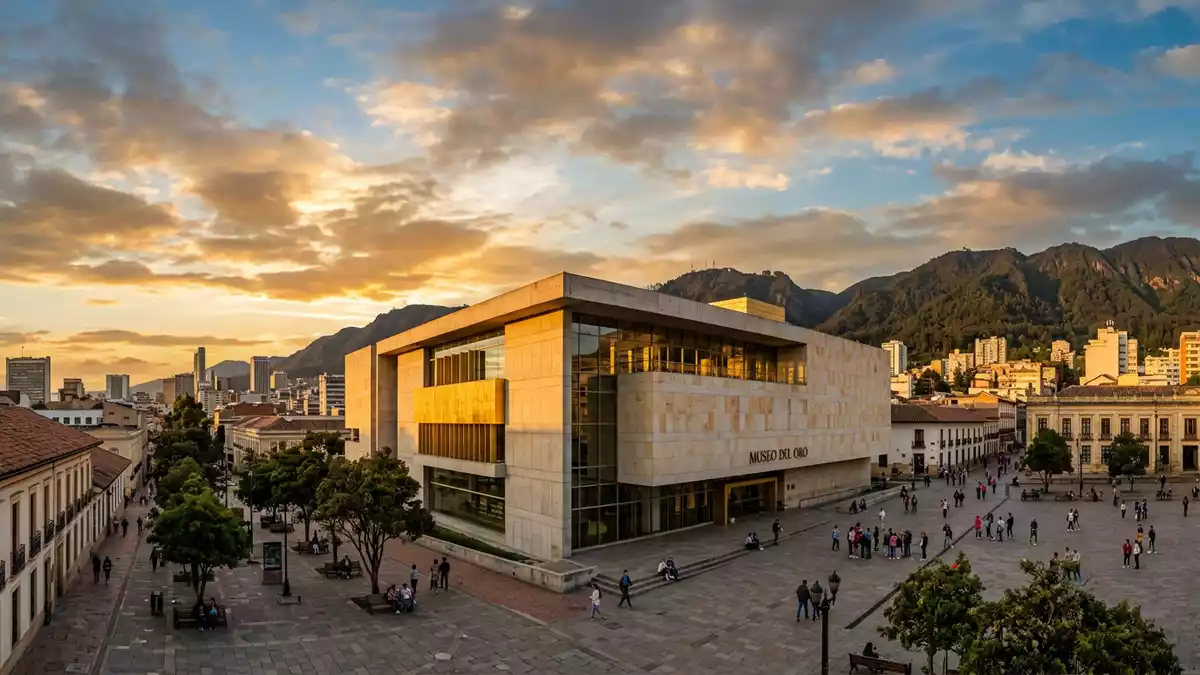
Museo del Oro in Bogota is Colombia’s national showcase of pre?Hispanic goldwork, bringing tens of thousands of metal and ceramic objects into a purpose?built museum beside Parque Santander in the historic centre. Opened in 1939 under the Banco de la República, it has grown into a four?storey institution where indigenous craftsmanship, ritual and cosmology are set out through carefully staged rooms and displays.
From bank collection to national gold museum
The story of Museo del Oro begins with the Banco de la República, Colombia’s central bank, which started assembling a collection of indigenous gold artefacts in the first half of the twentieth century and formalised it as a museum in 1939.opened in 1939 Over time that collection expanded into what is widely recognised as the world’s largest single assembly of pre?Hispanic gold pieces, bringing together objects from cultures such as the Muisca, Quimbaya, Calima, Tayrona, Zenú and Tolima.cultures including Muisca and Quimbaya
The museum occupies a modern building on Carrera 6 at the edge of Parque Santander in La Candelaria, Bogota’s historic core, a short walk from the traditional artery of Carrera 7 and the TransMilenio station that bears its name.location on Carrera 6 at Parque Santander Inside, exhibition floors rise above a ground level with services and reception, forming a compact vertical museum that contrasts sharply with the sprawling urban fabric outside.
Goldwork, tumbaga and the Muisca raft
The core of Museo del Oro is its collection of gold and gold?alloy artefacts, with more than 30,000 metal pieces alongside large numbers of stone, ceramic and textile objects from pre?Columbian societies across what is now Colombia.over 34,000 gold pieces and other materials Among these are ornaments for the body, ritual objects, figurines, nose rings, breastplates and small sculptures, many made from tumbaga, a copper?gold alloy that allowed fine casting and subtle surface finishes.
One of the most emblematic pieces on display is the Muisca raft, a detailed gold sculpture depicting a chieftain standing on a raft surrounded by attendants, linked in Colombian imagination to the El Dorado legend and the ceremonial lake offerings of the Muisca people.Muisca raft gold sculpture The galleries frame such works not as isolated treasures but as part of wider ensembles, showing how metallurgy connected with ceramics, textiles and stone carving in everyday life and sacred practice.
Exhibition rooms and sensory experience
Museo del Oro is arranged over several floors of permanent galleries, each devoted to a theme or region, with rooms that vary in scale from intimate alcoves to larger halls. Some spaces are kept deliberately dim, with controlled lighting that draws attention to the intricate surfaces of the gold artefacts, while others use brighter light to reveal ceramics, tools and models of settlements.
Towards the upper levels, a sequence of rooms introduces visitors to indigenous cosmologies and mythic narratives, combining objects with projections, sound and text to evoke pre?Hispanic understandings of the world. A final chamber, sometimes called a “gold room” in visitor descriptions, surrounds the viewer with suspended pieces and reflective surfaces, emphasising the density of the collection and the multiplicity of forms that goldwork took in different regions.
Visiting Museo del Oro: what travellers from Western Europe should know
- Museo del Oro stands on the north?eastern corner of Parque Santander in central Bogota, on Carrera 6 in the La Candelaria district, close to Carrera 7 and the TransMilenio station named Museo del Oro.
- The museum interior is spread across several floors connected by lifts and staircases; some gallery rooms are kept relatively dark to highlight the exhibits, and visitors often spend a substantial time on their feet moving between displays.
- The official language is Spanish and the currency is the Colombian peso.
- Entry requirements depend on your nationality; UK travellers can check the FCDO travel advice at gov.uk/foreign-travel-advice, Irish travellers the Department of Foreign Affairs at ireland.ie.
Searching for Museo del Oro on social platforms
These links open searches for Museo del Oro on each platform.
Frequently asked questions about Museo del Oro
Where is Museo del Oro located in Bogota?
Museo del Oro stands on Carrera 6 at the edge of Parque Santander in the La Candelaria district of central Bogota, close to the Museo del Oro TransMilenio station.
What can visitors expect to see inside Museo del Oro?
Visitors encounter extensive galleries of pre?Hispanic goldwork, including the Muisca raft sculpture, alongside ceramics, textiles and stone artefacts arranged by culture and theme.
What makes Museo del Oro distinctive among museums in Colombia?
Museo del Oro is distinctive for its scale as a national gold museum, its focus on pre?Hispanic metallurgy across multiple indigenous cultures, and its layered exhibition floors linking objects with cosmological interpretation.


