
Museo Nacional de Antropologia and its courtyard umbrella in Mexiko-Stadt
Published on 09/05/2026 at 07:08 | Editorial responsibility: Rafael Müller, Editor-in-Chief AD HOC NEWS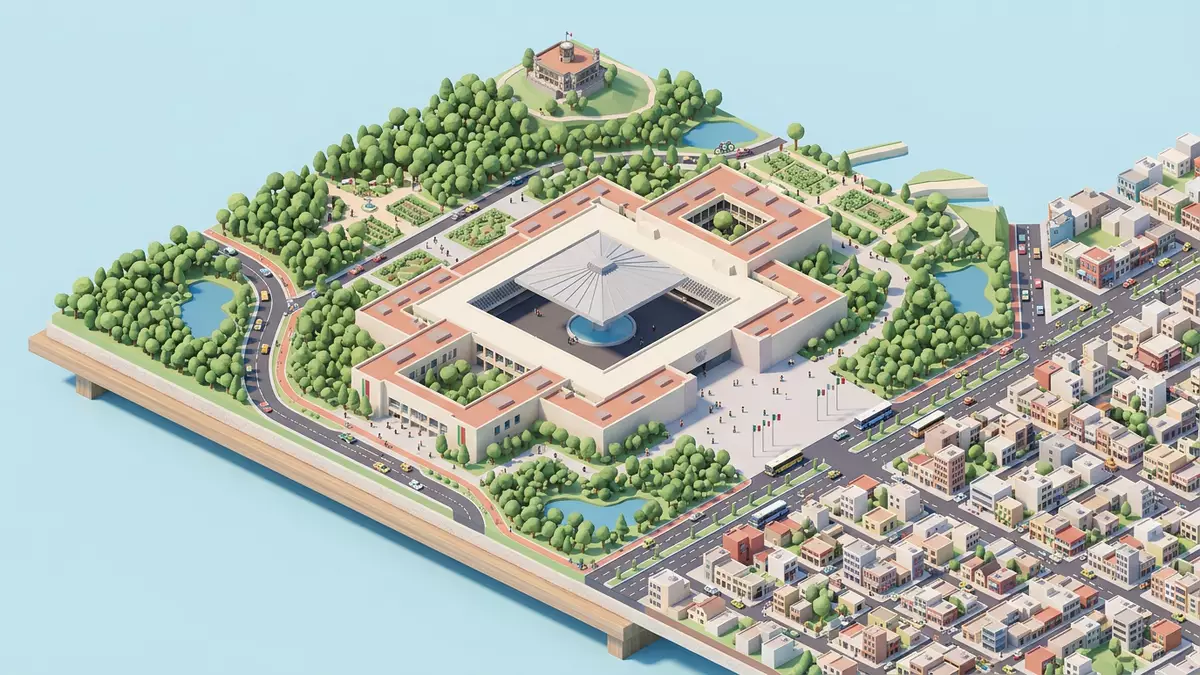
Museo Nacional de Antropologia in Mexiko-Stadt is Mexico’s principal museum of archaeology and ethnography, housed in a modernist complex where a vast concrete courtyard umbrella sends water down in a continuous curtain. Opened in 1964 in Chapultepec Park and directed by architect Pedro Ramírez Vázquez, it brings Mexico’s pre-Columbian heritage and living indigenous cultures together under one expansive roof.
A twentieth-century museum set in Chapultepec Park
Museo Nacional de Antropologia stands along Paseo de la Reforma at the edge of Bosque de Chapultepec, one of Mexico City’s major urban parks, with its main frontage set between the broad avenue and Mahatma Gandhi Street. The museum’s site within Chapultepec places it among a cluster of national cultural institutions and gives the complex a backdrop of mature trees and open parkland rather than dense city blocks.Located between Paseo de la Reforma and Mahatma Gandhi Street
The present building was inaugurated on 17 September 1964, when President Adolfo López Mateos opened the museum as part of a wider twentieth-century programme of state museums in Mexico.President Adolfo López Mateos opened the museum in 1964 The project was directed by architect Pedro Ramírez Vázquez with collaboration from Jorge Campuzano and Rafael Mijares, giving the museum an architectural language aligned with international modernism while rooted in Mexican materials and symbolism.The project was directed by Pedro Ramírez Vázquez
Architecture of concrete, stone, glass and a central patio
The museum complex occupies a built area of around 70,000 m² within Chapultepec, laid out as a broad rectangle broken into exhibition halls, service spaces and circulation areas that share a palette of marble, aluminium and glass.A built area of 70,000 square metres in Chapultepec Concrete frames and porticoes give the building a strong horizontal emphasis along Paseo de la Reforma, while recessed entrances and covered walkways mediate the transition between park and interior galleries. The form of the complex centres on a large open courtyard, with exhibition wings arranged around it so that visitors move repeatedly between enclosed halls and the central outdoor space.
Within this plan the materials carry much of the building’s character. Structural concrete supports the long roof spans and entrance canopy, stone cladding and paving give weight to walls and floors, and extensive glazing lets daylight reach deep into the galleries from the courtyard side.Concrete, stone and glass dominate the material palette The arrangement of the halls reflects the museum’s dual focus, with one sequence of spaces devoted to archaeological collections and another to ethnographic displays of Mexico’s contemporary indigenous communities.The museum contains archaeological and anthropological collections
El Paraguas: a courtyard umbrella of falling water
The defining feature of Museo Nacional de Antropologia’s architecture is El Paraguas, the “Umbrella”, in the central courtyard. This structure consists of a single tall concrete column rising from a shallow basin and supporting a broad roof plate that covers part of the patio.El Paraguas, a single concrete column supporting a wide roof plate Along the edges of this roof, water descends in a continuous curtain, defining the space beneath with a moving wall that separates the basin and column from the rest of the courtyard without enclosing it.
Viewed from the entrance portico, El Paraguas forms a visual centre to the entire complex, drawing sightlines from the exhibition wings and the covered walkways that open onto the patio. The column’s reinforced concrete and the geometry of the canopy have become a recognisable piece of post-war Mexican architecture, frequently appearing in visual representations of the museum and of Mexiko-Stadt’s modernist period.El Paraguas is a landmark of the central courtyard Beneath the falling water, the courtyard connects the surrounding halls, so that many routes through the museum pass close to the basin and column before returning indoors.
Visiting Museo Nacional de Antropologia: what travellers from Western Europe should know
- Museo Nacional de Antropologia stands in the first section of Bosque de Chapultepec in Mexico City, with its main address along Paseo de la Reforma at the junction with Calzada Gandhi.
- The complex is reached easily by public transport, with Metro stations Auditorio on Line 7 and Chapultepec on Line 1 and a Metrobús stop named Antropología on Line 7 nearby.
- The museum building has extensive interior circulation and a large open courtyard, with long, level walkways and sizeable galleries that invite extended exploration on foot.
- Spanish is the official language and the currency is the Mexican peso.
- Entry requirements depend on your nationality; UK travellers can check the FCDO travel advice at gov.uk/foreign-travel-advice, Irish travellers the Department of Foreign Affairs at ireland.ie.
Searching for Museo Nacional de Antropologia on social platforms
These links open searches for Museo Nacional de Antropologia on each platform.
Frequently asked questions about Museo Nacional de Antropologia
Where is Museo Nacional de Antropologia located in Mexiko-Stadt?
The museum is in Mexico City’s Bosque de Chapultepec, with its main frontage along Paseo de la Reforma near Calzada Gandhi in the Miguel Hidalgo district.
What can visitors expect inside the museum?
Visitors encounter archaeological collections such as pre-Columbian sculpture and artefacts alongside ethnographic galleries that present the cultures and daily life of Mexico’s indigenous peoples.
What makes Museo Nacional de Antropologia distinctive as a museum building?
Its combination of a large modernist complex, a central courtyard dominated by the El Paraguas waterfall umbrella and extensive collections of Mexico’s archaeological and anthropological heritage gives it a distinctive character.


