
Museum of Islamic Art in Doha and its geometric waterfront silhouette
Published on 08/24/2026 at 09:21 | Editorial responsibility: Rafael Müller, Editor-in-Chief AD HOC NEWS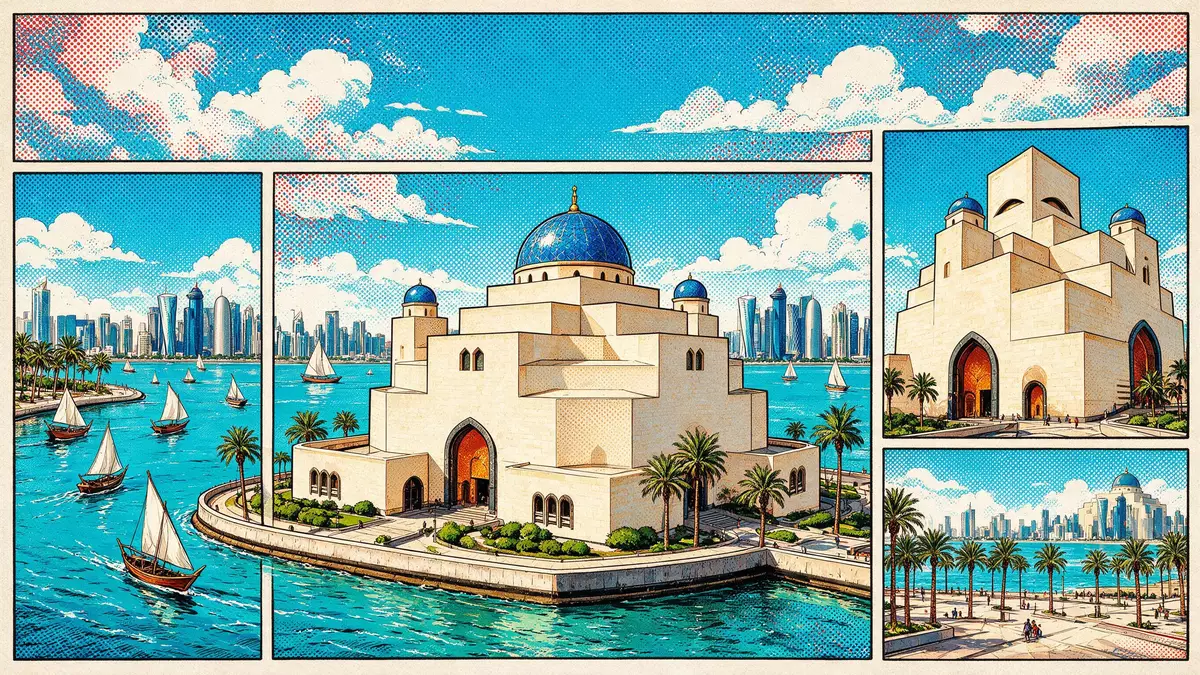
On the edge of Doha’s Corniche, the Museum of Islamic Art appears almost like a limestone sculpture rising from the water, its stacked volumes cut sharply against the Gulf light. Designed by architect I. M. Pei and founded in 2008, it brings centuries of Islamic art into a building whose form is as studied and deliberate as the collection it holds.Founded in 2008
A limestone island of pure geometry
The Museum of Islamic Art stands on a purpose-built island that projects from Doha’s Corniche into the waters of Doha Bay, set slightly apart from the main shoreline. The main building forms a compact mass of pale stone, its volumes stepping back in a sequence that emphasises edges, shadows and clean lines.On a purpose-built island The limestone cladding gives the museum a consistent, almost monolithic appearance, interrupted towards the north by broad expanses of glass that open towards the Arabian Gulf.Monolithic limestone apart from the glass
The architectural composition centres on a five-storey main building paired with an education wing, separated by a generous courtyard that connects the two parts.Five-storey main building with education wing Seen from the Corniche, the museum’s stepped profile reads as a sequence of geometric solids, culminating in a compact tower-like element that crowns the composition. Water surrounds much of the site, so that approaches along the causeway and bridge highlight the way the building rises from a low-lying platform just off the coast.
Light, atrium and galleries inside
Inside, visitors move from the bright waterfront into an atrium that extends through several levels, capped by a dome that sends daylight down into the space.Five-storey-high domed atrium A series of staircases and balconies ring this central volume, giving views back across the interior and out through the north-facing glass towards the bay. Stone surfaces and metal detailing echo patterns associated with Islamic geometry without copying any single historic building.
The galleries are arranged over several floors and are linked in a circuit that leads from early objects through to later works, with spaces for both permanent displays and temporary exhibitions.Exhibition space organised across five floors Interior design by Jean-Michel Wilmotte uses darker stone and wood in many of the galleries, setting the rooms apart from the lighter tones of the atrium.Interior design by Jean-Michel Wilmotte The result is a clear sequence: bright, expansive public spaces around the atrium and more controlled light levels in the exhibition rooms where objects take centre stage.
A collection spanning continents and centuries
The Museum of Islamic Art holds artworks and objects from across three continents, bringing together pieces from regions including Spain, Egypt, Iran, Iraq, Turkey, India and Central Asia.Objects from Spain to Central Asia The collection covers roughly 1,400 years of Islamic artistic production, from the early centuries of Islam through to works from the nineteenth and twentieth centuries.Collection spanning 1,300 years and three continents Manuscripts, ceramics, metalwork, glass, textiles and carved wood appear in themed galleries that draw links across regions and eras.
The museum forms part of the wider programme of Qatar Museums and includes not only exhibition spaces but also a heritage library and study facilities.Part of Qatar Museums and includes a heritage library For visitors from Western Europe, the building offers both a clear introduction to Islamic material culture and a case study in late twentieth- and early twenty-first-century museum architecture, where an architect such as I. M. Pei translates historical references into a contemporary waterfront landmark.
Visiting Museum of Islamic Art: what travellers from Western Europe should know
- The Museum of Islamic Art stands on an offshore site along the Doha Corniche, with access by road from central Doha and views across Doha Bay.
- The building rises several storeys above the waterline, and visiting the galleries involves using lifts or staircases between the exhibition levels.
- The museum lies in Doha, the capital of Qatar, on the eastern coast of the Qatar Peninsula facing the waters of the Arabian Gulf.
- The official language is Arabic and the currency is the Qatari riyal.
- Entry requirements depend on your nationality; UK travellers can check the FCDO travel advice at gov.uk/foreign-travel-advice, Irish travellers the Department of Foreign Affairs at ireland.ie.
Searching for Museum of Islamic Art on social platforms
These links open searches for Museum of Islamic Art on each platform.
Frequently asked questions about Museum of Islamic Art
Where is the Museum of Islamic Art in Doha?
The Museum of Islamic Art is located on a man-made island off the Doha Corniche in Doha, Qatar, projecting into Doha Bay.
What can visitors expect inside the museum?
Visitors encounter a tall central atrium, several floors of galleries displaying Islamic art from across regions and centuries, and views out over the water and city skyline.
What makes the museum distinctive among Doha’s cultural sites?
Its combination of I. M. Pei’s geometric limestone architecture, its waterfront island setting and a collection spanning around 1,400 years of Islamic art gives it a distinct presence.


