
Museum of Islamic Art rises above Doha Bay
Published on 09/22/2026 at 06:58 | Editorial responsibility: Rafael Müller, Editor-in-Chief AD HOC NEWS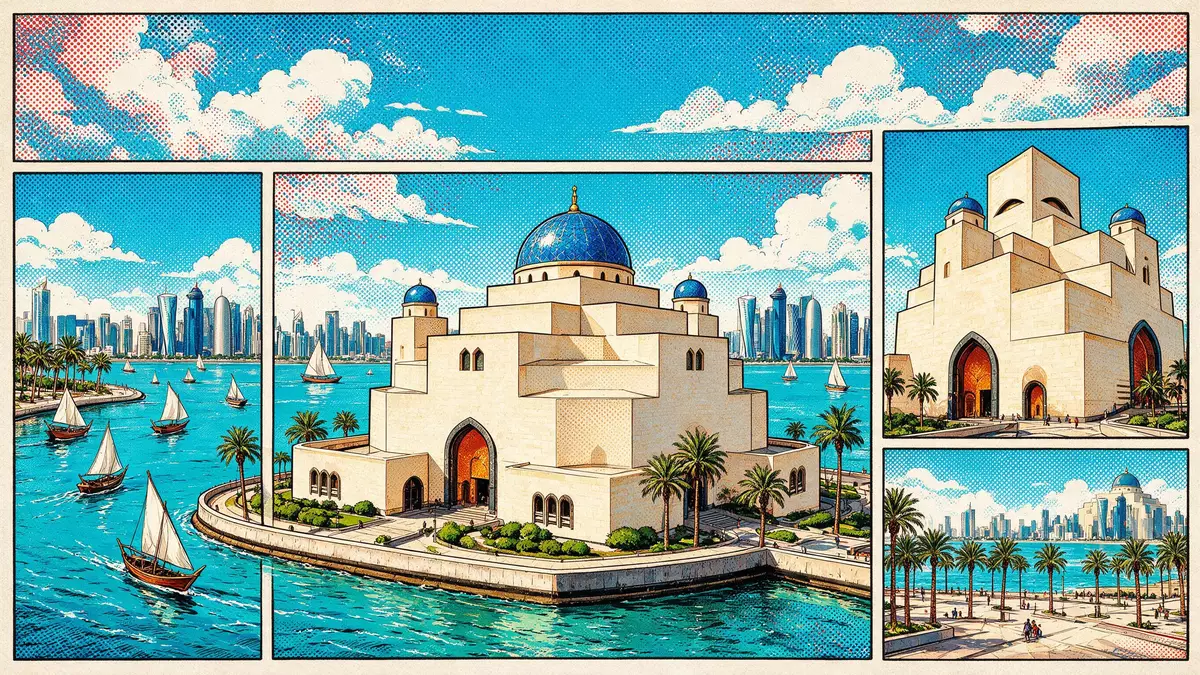
Museum of Islamic Art stands on Doha’s Corniche, its pale geometric mass surrounded by water and open sky. Designed by I. M. Pei and opened in 2008, the building places Islamic art inside a modern architectural composition.
Pei’s geometric composition beside Doha Bay
The museum is set on a purpose-built island at the southern end of the Corniche. Its broad stone volumes rise in stepped layers, with a central tower-like form and a large opening beneath the upper structure.
Pei’s design draws on geometric forms associated with Islamic architecture, while using a restrained modern vocabulary. Pale limestone covers the exterior, and the building’s angular profile is visible from the waterfront promenade and across Doha Bay.
From the seventh century to the twentieth
The collection spans Islamic art from the seventh to the twentieth centuries. It includes metalwork, ceramics, jewellery, woodwork, textiles, glass and manuscripts from regions across three continents.
The galleries bring together objects connected with major artistic traditions of the Islamic world. Persian, Ottoman, Mughal, Egyptian, Syrian, Spanish and Central Asian works appear within a collection that crosses political borders and historical periods.
The museum’s history is linked with Sheikh Hamad bin Khalifa Al Thani, who commissioned I. M. Pei in 1999. Pei, born in 1917, had designed major museums and civic buildings before creating the Doha project.
A modern museum for historic objects
Museum of Islamic Art opened in December 2008. Its interior is organised around a high central atrium, with galleries arranged around the main volume.
Stone, glass and metal appear throughout the building. The architecture uses strong edges, repeated geometry and carefully framed views, while the objects introduce intricate surfaces, calligraphy, colour and fine workmanship.
The setting combines the museum with MIA Park and the Corniche waterfront. Palm-lined paths, open lawns and views towards Doha’s skyline form part of the wider museum landscape.
Visiting Museum of Islamic Art: what travellers from Western Europe should know
- Museum of Islamic Art is on the Doha Corniche, on an island beside MIA Park. It can be reached by car, taxi or Doha Metro connections followed by a road transfer.
- The approach crosses the waterfront setting before reaching the museum’s entrance. Inside, galleries extend around the central atrium and include stairs between levels.
- The museum faces Doha Bay and the West Bay skyline. Souq Waqif lies near the eastern end of the Corniche.
- The official language is Arabic and the currency is the Qatari riyal.
- Entry requirements depend on your nationality; UK travellers can check the FCDO travel advice at gov.uk/foreign-travel-advice, Irish travellers the Department of Foreign Affairs at ireland.ie.
Searching for Museum of Islamic Art on social platforms
These links open searches for Museum of Islamic Art on each platform.Frequently asked questions about Museum of Islamic Art
Where is Museum of Islamic Art?
It stands on Doha’s Corniche, on an island beside MIA Park and the waters of Doha Bay.
What can visitors see inside?
The collection includes Islamic art from the seventh to the twentieth centuries, including ceramics, metalwork, textiles, glass, jewellery and manuscripts.
What makes the museum distinctive?
I. M. Pei’s pale geometric building combines modern architectural forms with references to Islamic design and a prominent waterfront setting.


