
Myeongdong, where Seoul’s shopping streets meet a Gothic cathedral
Published on 09/24/2026 at 03:39 | Editorial responsibility: Rafael Müller, Editor-in-Chief AD HOC NEWS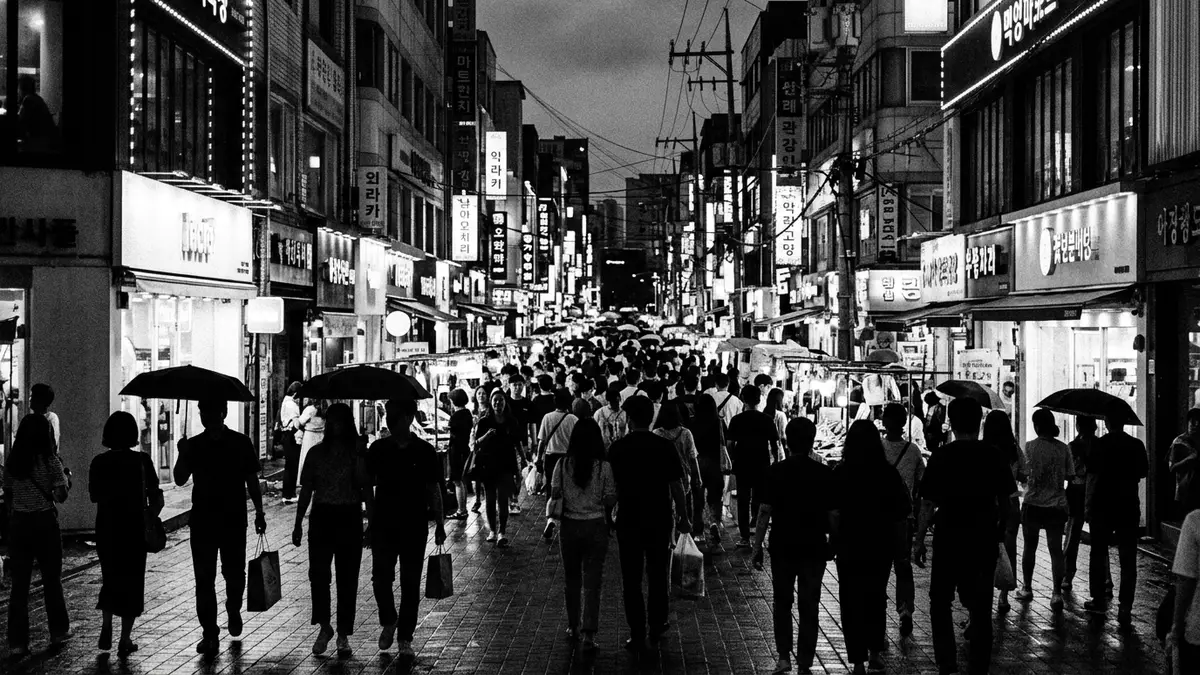
Myeongdong is a dense central Seoul district where retail lanes, food stalls and cultural buildings gather around a red-brick Catholic cathedral. The neighbourhood’s most distinctive view is the contrast between its close-packed commercial streets and Myeongdong Cathedral, completed in 1898 during the late Joseon period.
Myeongdong’s streets around a nineteenth-century cathedral
The district lies in Jung-gu, between Namdaemun-ro, Eulji-ro and Chungmu-ro. Its lanes contain cosmetics shops, fashion retailers, cafés, restaurants and street-food stands, while larger commercial buildings occupy the surrounding avenues. The urban fabric is compact, with shopfronts and signs forming a continuous streetscape.
Above this commercial setting stands Myeongdong Cathedral, formally the Cathedral Church of Our Lady of the Immaculate Conception. Its red brick, pointed arches, towers and stained-glass windows mark it as a Gothic Revival building. Construction began in 1892, and the completed church became the first brick church built in Korea in the Gothic style.
From Joseon residential quarter to commercial district
During the Joseon Dynasty, the area formed part of southern Hanseong, the walled capital that occupied the centre of present-day Seoul. It carried names including Myeongnyebang and Chonghyeon, and its streets belonged to a residential section of the historic city.
The neighbourhood’s commercial character developed during the late nineteenth and early twentieth centuries. Chinese merchants settled in the area after 1882, establishing shops and contributing to the growth of modern commerce. Chinese merchant history remains part of Myeongdong’s cultural landscape, alongside the Overseas Chinese Primary School, founded in 1909. Under Japanese colonial rule the district was called Meiji-cho. After liberation, the name Myeongdong entered official use in 1946.
Shopping, theatre and Catholic heritage
Myeongdong’s identity rests on several layers rather than a single attraction. The shopping streets are closely associated with Korean cosmetics, skincare, fashion and prepared food. Department stores and large retail buildings sit beside narrow lanes where smaller businesses occupy ground-floor units.
The district also contains Myeongdong Theater, a cultural landmark with roots in the colonial period, and buildings connected with international and civic institutions. The cathedral has a religious role as the seat of the Archdiocese of Seoul. Its grounds and surrounding streets also became associated with democratic movements during South Korea’s political struggles in the late twentieth century. The building’s formal heritage status as Myeongdong Cathedral reflects its place in Korea’s architectural and religious history.
Visiting Myeongdong: what travellers from Western Europe should know
- Myeongdong is in Jung-gu, central Seoul. Myeongdong Station on Seoul Subway Line 4 serves the shopping district, while Euljiro 1-ga Station on Line 2 is another approach.
- The cathedral stands at 74 Myeongdong-gil on a slight rise. Streets around the retail lanes are paved and busy, with stairways and sloping approaches near the cathedral grounds.
- The district lies near Namdaemun Market, Namsan and Namsan Seoul Tower. These landmarks connect Myeongdong with Seoul’s central shopping, historic and mountain areas.
- The official language is Korean and the currency is the South Korean won.
Searching for Myeongdong on social platforms
These links open searches for Myeongdong on each platform.Frequently asked questions about Myeongdong
Where is Myeongdong?
Myeongdong is a central Seoul neighbourhood in Jung-gu. It lies near Namdaemun-ro, Eulji-ro, Chungmu-ro, Namsan and Namdaemun Market.
What can visitors expect in Myeongdong?
The district combines dense shopping lanes, cosmetics retailers, restaurants, street food, cafés, department stores and cultural buildings. Myeongdong Cathedral occupies a prominent rise within the neighbourhood.
What makes Myeongdong distinctive?
Its defining contrast is the meeting of an intensely commercial streetscape with Myeongdong Cathedral, a red-brick Gothic Revival church completed in 1898.


