
Mystras and the layered Byzantine hillside above Sparta
Published on 08/25/2026 at 11:32 | Editorial responsibility: Rafael Müller, Editor-in-Chief AD HOC NEWS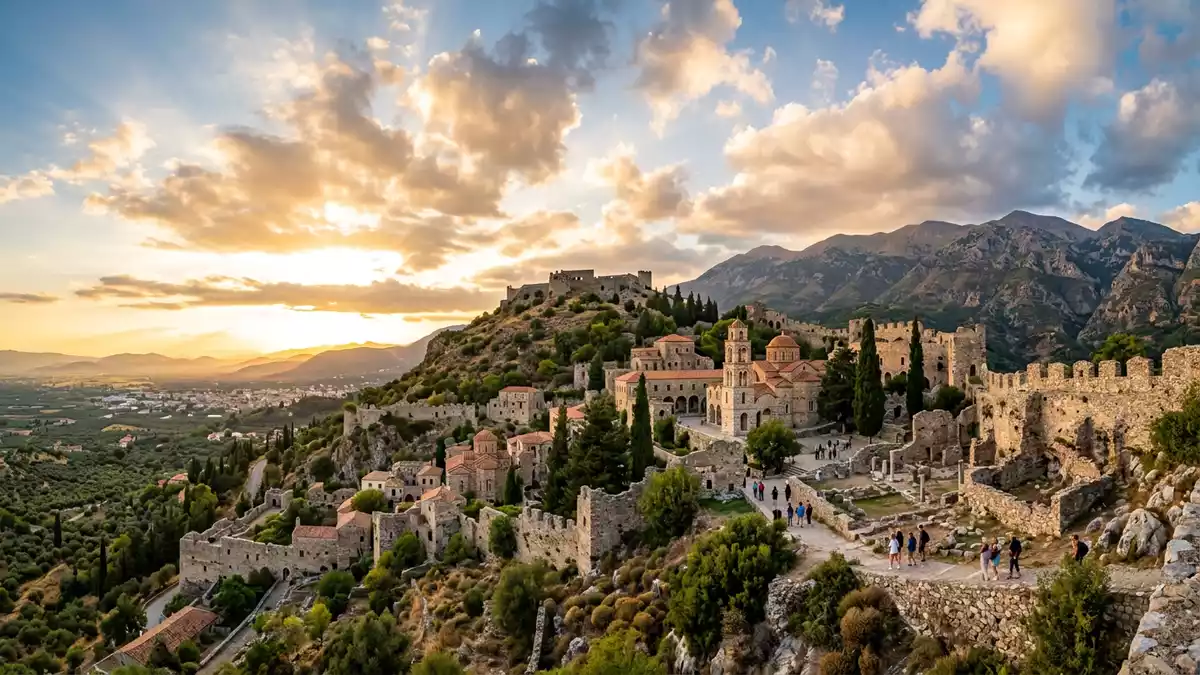
Mystras rises above Sparta as a hillside archaeological site where castles, churches and monasteries step down the slope. Its profile comes from the Archaeological Site of Mystras, a UNESCO World Heritage site on the southeastern edge of the Peloponnese.
Mystras on the Taygetos slope
The settlement grew around the fortress associated with William of Villehardouin, and its ruins still stretch across the slope in layers. The surviving complex includes fortified walls, monastic buildings and churches, with stonework that belongs to the Byzantine world.
Mystras became closely tied to the late Byzantine Despotate of the Morea, and the site remained important for centuries. The name also carries the memory of a medieval urban landscape rather than a single monument.
Churches, palaces and monastic quarters
The upper fortress sits above a lower town of narrow lanes, churches and domestic remains. The Byzantine city is read through these fragments, which still show how religious, civic and military functions sat close together.
Among the best-known elements are the palace quarter, the metropoleis and the monasteries on the hillside. The place is especially valuable because the architectural layers remain legible across the slope, from the summit to the lower terraces.
From medieval capital to archaeological landscape
Mystras is associated with the Palaiologan period, when late Byzantine culture left a strong mark on architecture and painting. Its formal inscription in 1989 placed it among Greece’s recognised World Heritage landscapes.
The site also belongs to the history of Sparta, which lies below it in Laconia. The contrast between the modern town on the plain and the abandoned medieval settlement above gives Mystras its particular form.
Visiting Mystras: what travellers from Western Europe should know
- The site lies above Sparta in Laconia, on the southeastern side of the Peloponnese. Access is by road from the valley and then on foot through the hillside settlement.
- The terrain is steep and broken by stone paths, steps and level changes. Comfortable shoes matter because the route moves through uneven ground and long climbs.
- The official language is Greek and the currency is the euro.
- Entry requirements depend on your nationality; UK travellers can check the FCDO travel advice at gov.uk/foreign-travel-advice, Irish travellers the Department of Foreign Affairs at ireland.ie.
Searching for Mystras on social platforms
These links open searches for Mystras on each platform.
Frequently asked questions about Mystras
Where is Mystras?
Mystras lies above Sparta in the Peloponnese, in the region of Laconia. It is a hillside site rather than a flat urban centre.
What does a visit involve?
The route moves through stone paths, steps and surviving buildings spread across the slope. The upper fortress and the lower settlement form the main framework.
What makes Mystras distinctive?
Its layered Byzantine landscape, with fortifications, churches and monastic ruins, gives it a strong historical profile. The 1989 World Heritage inscription reflects that preserved medieval fabric.


