
Namib Desert and the long edge of the Atlantic
Published on 08/15/2026 at 14:16 | Editorial responsibility: Rafael Müller, Editor-in-Chief AD HOC NEWS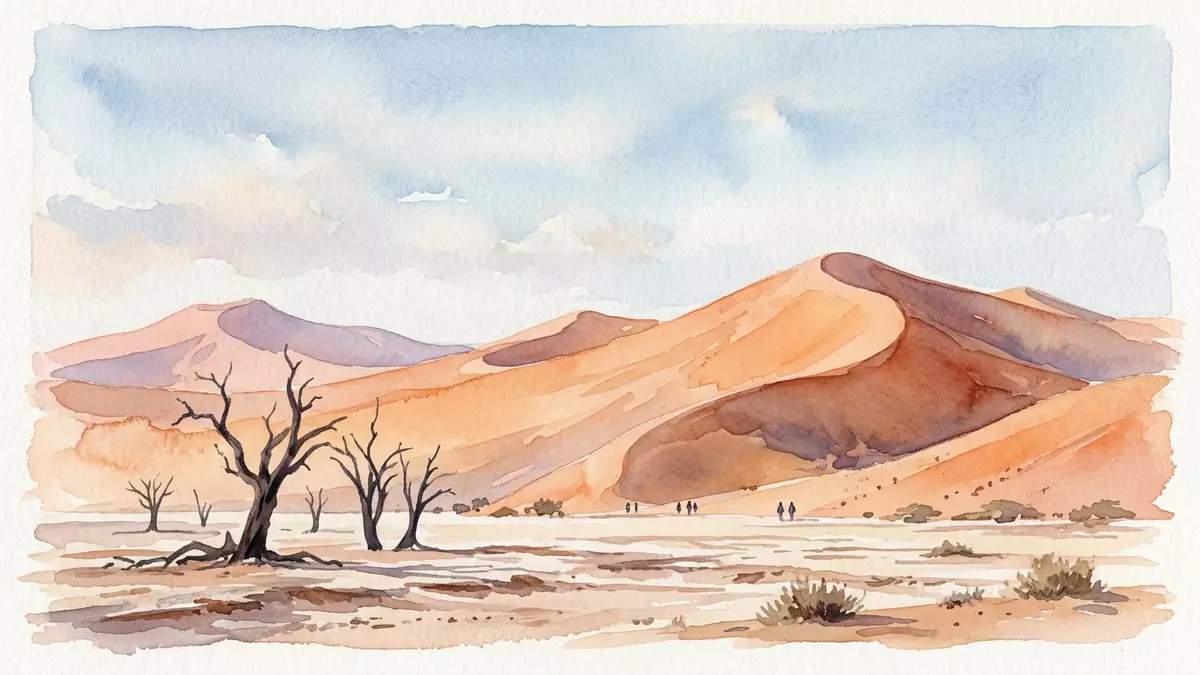
Namib Desert runs along the south-western edge of Africa and reaches deep into Namibia, where Sossusvlei sits among its sand seas. Britannica places it as a coastal desert stretching for about 1,900 km (1,200 miles), a scale that gives the land its spare, horizon-wide character.
The coast, the dunes and the dry interior
At its broadest, the desert reads as a sequence of gravel plains, dune fields and a hard coastal margin beside the Atlantic. The southern half includes the Namib Sand Sea, a World Heritage landscape of younger active dunes over an older dune system.
Sossusvlei belongs to that dune world, where sand forms long ridges and broad sweeps rather than a single enclosed basin. The wider Namib also contains bedrock surfaces and inland reaches that meet the foot of the Great Escarpment, giving the desert more than one visible layer of terrain.
A desert shaped by sand and fog
The name Namib is linked to the Nama language, and the word carries the sense of emptiness. That meaning suits the open scale of the place, but the land itself is not blank: it holds sand, gravel, marine margins and sparse life adapted to extreme aridity.
The UNESCO-listed Namib Sand Sea is described as the world’s only coastal desert with extensive dune fields influenced by fog, and that formal distinction captures an important part of the region’s identity. Its dune systems are the most legible sign of the desert’s character, with old forms partly stabilised and younger dunes shifting above them.
Sossusvlei within the Namib landscape
Sossusvlei sits in the Namib-Naukluft area, where sand, hard ground and empty drainage lines meet. The place is part of a desert system that extends from the coast inland for many tens of kilometres, so its setting is continental as well as maritime.
That mix matters because the Namib is not only dunes. It also includes coastal stretches, inland plains and a band of terrain where the desert meets higher ground, and those contrasts are central to its identity.
Visiting Namib Desert: what travellers from Western Europe should know
- The desert lies in Namibia on the Atlantic side of southern Africa. Access is usually by road towards Sossusvlei, with the dune areas reached from the Namib-Naukluft side of the region.
- The terrain is open, sandy and exposed, with hard surfaces in some stretches and deep sand in others. Distances look short on a map but can feel much larger on foot.
- The broader region includes gravel plains, dunes and the coast, so the landscape changes in clear bands. Inland, the desert reaches towards the Great Escarpment.
- The official language is English and the currency is the Namibian dollar.
Searching for Namib Desert on social platforms
These links open searches for Namib Desert on each platform.
Frequently asked questions about Namib Desert
Where is Namib Desert?
Namib Desert runs along the south-west coast of Africa, with most of it in Namibia and the southern reaches extending towards South Africa. Sossusvlei lies within that Namibian desert landscape.
What does a visit involve?
The place is defined by open desert ground, dune fields and long sightlines. Around Sossusvlei, the terrain is sandy and exposed, with changes from hard ground to loose sand.
What makes Namib Desert distinctive?
The Namib Sand Sea is a World Heritage landscape of fog-influenced dunes. The broader desert also combines coastal margins, gravel plains and inland reaches towards the escarpment.


