
Namib Desert at Sossusvlei and its red dune sea
Published on 09/12/2026 at 07:46 | Editorial responsibility: Rafael Müller, Editor-in-Chief AD HOC NEWS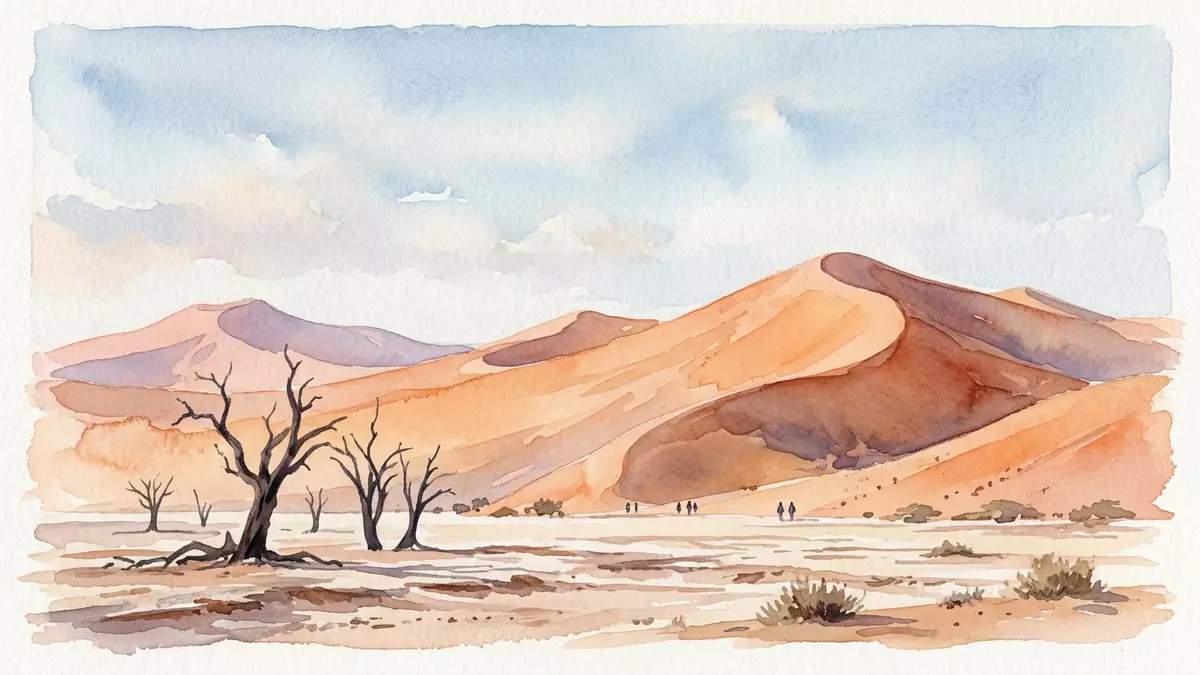
Namib Desert at Sossusvlei in Namibia presents a striking meeting of towering red dunes and pale clay pans that reveals the structure of one of Earth’s oldest deserts. Evidence for persistent desert conditions in the Namib reaches back into the Eocene Epoch around 55 million years ago, giving the region a deep geological timescale that frames any visit.Evidence for desert conditions
Red dunes and clay pans of the Namib Sand Sea
Namib Desert around Sossusvlei forms part of the Namib Sand Sea, a dune field that covers tens of thousands of square kilometres in south-western Namibia.Namib Sand Sea dune field Within this sand sea, Sossusvlei itself is a salt and clay pan surrounded by a dense belt of high sand dunes whose orange-red colour reflects coatings of iron oxide on the grains of sand.Salt and clay pan
The pan stands at the terminus of the Tsauchab River, an ephemeral river that flows from the Naukluft Mountains to the east and ends where its course is blocked by dunes, creating an endorheic basin without outflow.Endorheic basin for the Tsauchab River When seasonal water reaches Sossusvlei, a shallow sheet spreads across the clay before evaporating, leaving behind salt and mud that contrast sharply with the surrounding sand slopes.Clay and salt deposits
Ancient foundations beneath a young dune sea
Though the dunes visitors see around Sossusvlei are geologically young, the foundations beneath them reach far deeper into time. Fossil dune deposits known as the Tsondab Sandstone Formation record ancient sand seas beneath the modern Namib Sand Sea and provide unequivocal evidence of desert conditions in the Namib from roughly 55 million years ago.Tsondab Sandstone Formation Above this fossil desert, a younger sand sea developed during the Plio-Pleistocene, building the dunes that form the modern landscape.
Studies using cosmogenic nuclides and other dating methods indicate that sand within the Namib Sand Sea has a residence time of at least one million years, with major episodes of dune formation associated with climatic changes during the Pleistocene and Holocene.Residence time of sand The dunes of central Namib Sand Sea, including those at Sossusvlei, are therefore part of a layered desert system in which older cemented sands underpin younger mobile dunes.Two dune seas
Sossusvlei in the wider desert landscape
Geographically, Namib Desert stretches along the Atlantic coast of Namibia, and Sossusvlei lies in its southern part, inland from the coast yet still within the influence of oceanic and continental processes that move sediment into the dunes.Namib Desert geography The broader sand sea around Sossusvlei is characterised by long linear dunes and more complex star dunes where winds from different directions intersect, creating a varied topography that includes pans such as Deadvlei along with other clay basins.Network of clay pans
Northwards from Sossusvlei, the landscape gradually shifts from extensive sand dunes to a more rocky desert where gravel plains and canyons appear, demonstrating how the Namib transitions between sand seas and other desert forms.Transition to rocky desert Beneath all these surface forms lies bedrock composed of ancient metamorphic rocks belonging to the African craton, some of which date back more than a billion years and support later sedimentary units from the Palaeozoic and Mesozoic eras.Ancient metamorphic bedrock
Visiting Namib Desert: what travellers from Western Europe should know
- Namib Desert at Sossusvlei lies in southern Namibia, inland from the Atlantic coast, and is reached by road from towns on the central plateau and coastal settlements.
- The terrain around Sossusvlei consists of loose sand, steep dune slopes and hardened clay pans, so walking involves ascents on yielding sand and sections across firm but uneven ground.
- Sossusvlei sits within a protected area in Namibia where official language is English and the currency is the Namibian dollar.
- Entry requirements depend on your nationality; UK travellers can check the FCDO travel advice at gov.uk/foreign-travel-advice, Irish travellers the Department of Foreign Affairs at ireland.ie.
Searching for Namib Desert on social platforms
These links open searches for Namib Desert on each platform.Frequently asked questions about Namib Desert
Where is Namib Desert at Sossusvlei located?
Namib Desert at Sossusvlei lies in southern Namibia within the Namib Sand Sea, inland from the Atlantic coast and south of the Swakop River region.
What should travellers expect when visiting Sossusvlei?
Travellers encounter high red sand dunes, pale salt and clay pans and an arid desert climate, with approaches across loose sand and climbs on steep dune slopes.
What makes Namib Desert at Sossusvlei distinctive?
Sossusvlei combines a young dune sea with fossil desert foundations, an endorheic clay pan at the end of the Tsauchab River and evidence of desert conditions dating back many millions of years.


