
Naqsh-e Jahan: Safavid grandeur at the heart of Isfahan
Published on 08/20/2026 at 11:51 | Editorial responsibility: Rafael Müller, Editor-in-Chief AD HOC NEWS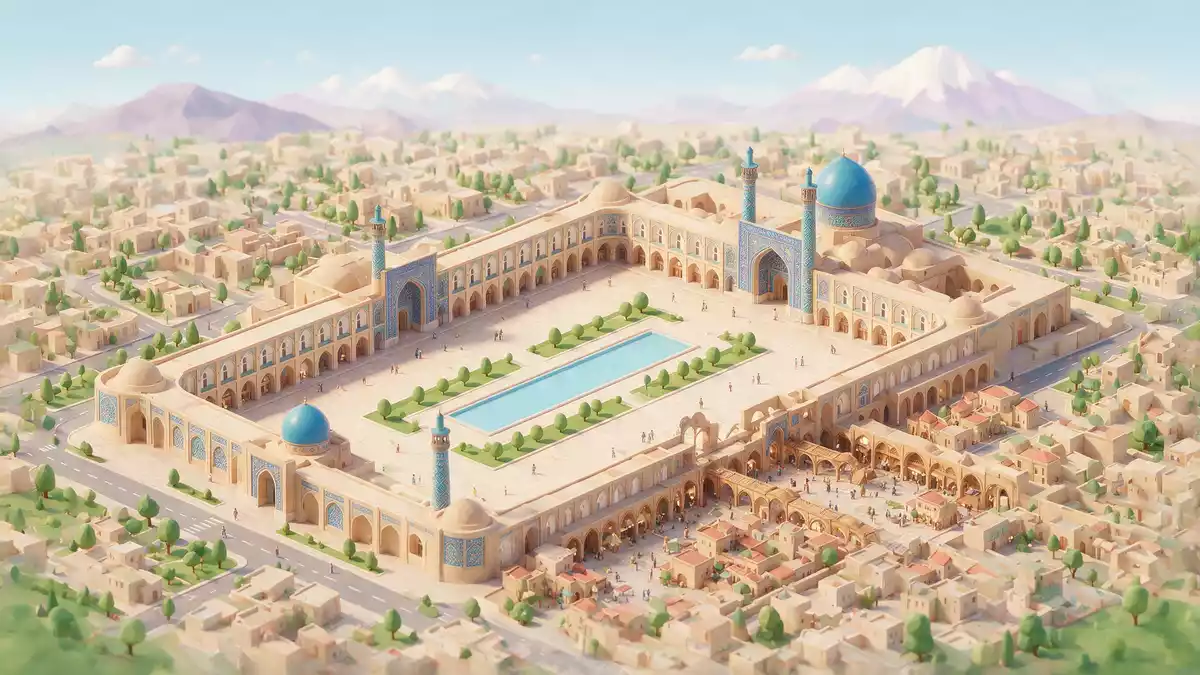
Naqsh-e Jahan in Isfahan is a monumental city square where Safavid power, religion and commerce were gathered into a single urban space. Commissioned by Shah Abbas I in the early seventeenth century, it set out a new ceremonial centre for the Safavid capital, framed by mosques, a palace and the main bazaar gate.Safavid era square
A rectangle of power and ceremony
Naqsh-e Jahan is a vast oblong rectangle, measuring about 560 m (1,837 ft) in length and 160 m (525 ft) in width, which gives it close to nine hectares of open space enclosed by built fabric.Dimensions of the square Unlike older Iranian cities with tightly woven streets, the Safavid planners inserted this single, elongated void into the urban core of Isfahan as a stage for imperial display.Meidan Emam urban ensemble
The long sides of the square are lined with continuous two-storey arcades, their repeated arches forming a rhythm of shopfronts and recessed chambers. Behind these arcades the city’s commercial life flows towards the Qeysariyeh Gate at the northern end, where the covered bazaar system branches away from the open square into narrower alleys.Arcades and bazaar gate
Mosques, palace and bazaar around the square
Each side of Naqsh-e Jahan is anchored by a major Safavid monument. To the south stands the Royal Mosque, also known as the Masjed-e Shah and later Imam Mosque, a congregational mosque whose lofty entrance portal and tiled minarets form a dominant presence on the square’s axis.Royal Mosque on the south side Its facade is faced with glazed tiles in deep blues and turquoise, carrying Quranic inscriptions and vegetal motifs characteristic of Safavid religious architecture.
On the east side, the Sheikh Lotfolah Mosque presents a more intimate scale, with a finely proportioned dome and a portal set directly into the arcade rather than a large courtyard front.Sheikh Lotfolah Mosque Opposite it to the west, the Ali Qapu Palace rises above the arcades with a multi-storey pavilion and an elevated terrace overlooking the square, from which the Safavid court could watch ceremonies and polo matches laid out on the great rectangle below.Ali Qapu Palace terrace
Safavid urban vision and UNESCO recognition
Naqsh-e Jahan was laid out between 1598 and 1629, during the reign of Shah Abbas I, when Isfahan became the Safavid capital and a programme of monumental construction reshaped its urban form.Construction between 1598 and 1629 The square gathered religious, political and commercial functions in a single composition: Friday prayers in the Royal Mosque, court receptions in Ali Qapu, scholarly worship in Sheikh Lotfolah and mercantile activity through the Qeysariyeh bazaar portal.
Under its official designation “Meidan Emam, Esfahan”, Naqsh-e Jahan was inscribed on the UNESCO World Heritage List in 1979, recognised as a major example of Iranian-Islamic urban design from the Safavid period.UNESCO listing in 1979 The ensemble of square, arcades, mosques, palace and bazaar illustrates the social and cultural life of Persia in the seventeenth century, when Isfahan served as the political and ceremonial heart of the empire.Safavid socio-cultural life
Visiting Naqsh-e Jahan: what travellers from Western Europe should know
- Naqsh-e Jahan lies in the historic centre of Isfahan, in central Iran, with the square forming a focal point for main streets and the Qeysariyeh bazaar at its northern end.
- The interior of the square is a broad paved and landscaped space, with a central water feature and long edges defined by arcades; moving between monuments involves walking across open ground and climbing staircases within the mosques and Ali Qapu Palace.
- The surrounding district is urban and level, but the palace terrace and mosque galleries are reached via narrow stairways inside the historic structures, which can feel confined when ascending or descending.
- The official language is Persian and the currency is the Iranian rial.
- Entry requirements depend on your nationality; UK travellers can check the FCDO travel advice at gov.uk/foreign-travel-advice, Irish travellers the Department of Foreign Affairs at ireland.ie.
Searching for Naqsh-e Jahan on social platforms
These links open searches for Naqsh-e Jahan on each platform.
Frequently asked questions about Naqsh-e Jahan
Where is Naqsh-e Jahan and what kind of place is it?
Naqsh-e Jahan is a large historic city square in the centre of Isfahan in central Iran, laid out as an elongated rectangle framed by Safavid monuments.
What can visitors expect when they enter the square?
Visitors step into a wide open space edged by continuous arcades, with mosques, a palace and the main bazaar gate occupying its sides and a central water feature marking the middle.
What makes Naqsh-e Jahan distinctive among Iranian historic sites?
Its scale, rectangular form and combination of religious, royal and commercial buildings in a single seventeenth-century composition give Naqsh-e Jahan a distinctive place in Iranian urban history.


