
Naqsh-e Jahan, the Safavid masterpiece at the heart of Isfahan
Published on 09/09/2026 at 09:08 | Editorial responsibility: Rafael Müller, Editor-in-Chief AD HOC NEWS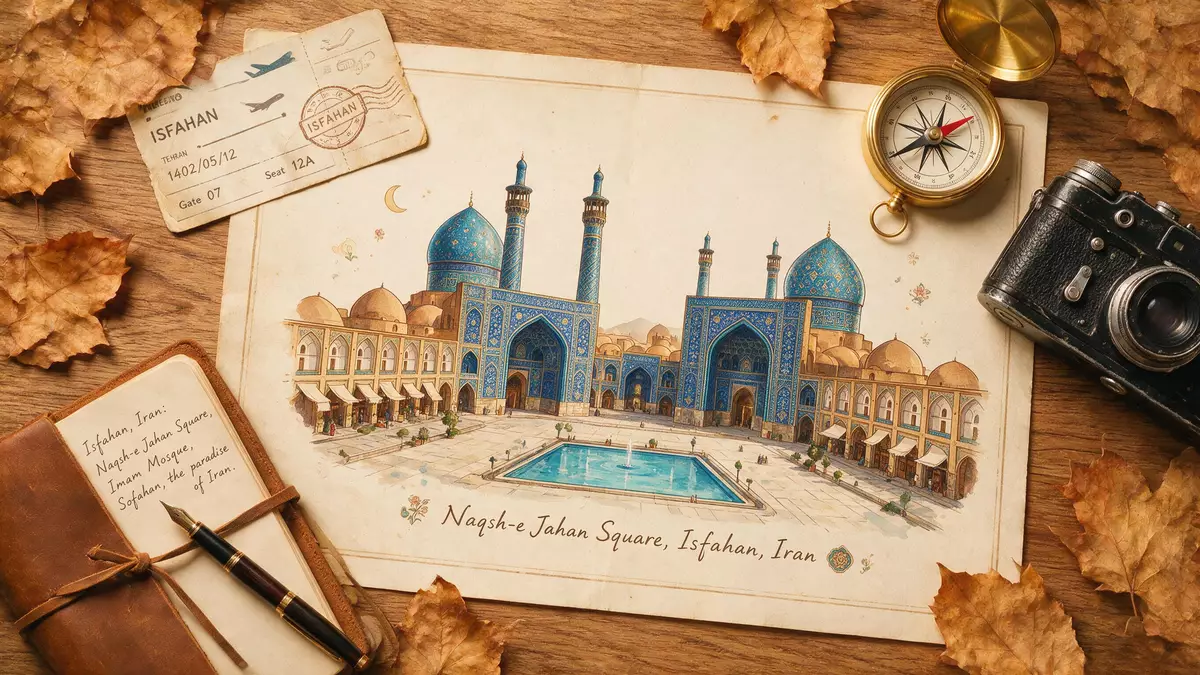
Naqsh-e Jahan Square in Isfahan is a vast Safavid-era rectangle of stone, brick and tile that turned a city crossroads into an immense ceremonial space. Laid out under Shah Abbas I in the early seventeenth century, it anchors one of Iran’s most important historic centres and holds UNESCO World Heritage status as Meidan Emam.
A rectangle that became an “image of the world”
Naqsh-e Jahan is a huge urban square in central Isfahan, measuring about 160 m (525 ft) across and 560 m (1,837 ft) along its longer side, with an area near 90,000 square metres.The square’s dimensions give it the scale of a shallow canyon of architecture, with continuous two-storey arcades running around all four sides and enclosing an open floor of paving, pools and lawns. The name “Naqsh-e Jahan”, meaning “image of the world”, reflects the way the ensemble gathers the main functions of Safavid Isfahan around a single space.
The square was laid out between 1598 and 1629 during the Safavid dynasty, when Isfahan became the capital and grew into one of the largest cities in Iran.Safavid-period Isfahan Shah Abbas I placed Naqsh-e Jahan at the centre of this new urban order, turning it into a ceremonial ground framed by religious, commercial and residential structures that still define its character.The square’s Safavid context is visible in its proportions, its axial layout and the hierarchy of buildings around it.
Mosques, palace and bazaar around the edges
Four major monuments line the inner edges of Naqsh-e Jahan and turn its expanse into an outdoor hall. On the south side stands the historical Emam Mosque, known in many sources as the Shah Mosque, a congregational mosque whose main entrance opens directly to the square behind a tall portal and tiled half-dome.The Emam Mosque on the south side supplies the religious weight of the ensemble. On the east side, the more intimate Sheikh Lotfollah Mosque presents a refined façade and a domed prayer hall aligned with the square but entered from beneath the surrounding arcade.
The western edge is marked by the Ali Qapu Palace, a multi-storey pavilion whose main porch rises above the arcades and looks across the entire square.Ali Qapu on the west represents the secular and dynastic side of Safavid power, with upper levels that once housed reception rooms and a music hall. To the north, the Qeysarieh Gate forms the monumental entrance to the Grand Bazaar of Isfahan, its tiled portal opening into a long market spine that leads away from the square.The bazaar gateway ties Naqsh-e Jahan directly into the city’s commercial network.
UNESCO status and the life of the square
Naqsh-e Jahan Square, inscribed on the UNESCO World Heritage List in 1979 under the name Meidan Emam, is recognised as a historic urban ensemble where architecture and open space form a coherent whole.Its World Heritage inscription reflects both the individual monuments and the way they are arranged around the rectangle. The square’s layout, with its arcaded edges and axial alignment of mosques, palace and bazaar gate, sets it apart from the denser traditional fabric of many Iranian cities where large open squares are rare.
On the ground, the space is layered. Beneath the arcades, rows of small shops line the inner perimeter, their doors opening to the square and their back walls forming part of the structural ring around it.The arcaded perimeter creates long shaded walkways with repeated arches and columns. The floor of the square itself alternates between paved paths, planted lawns and pools, divided into large rectangles that echo the overall form. Together, these elements make Naqsh-e Jahan both a formal composition and a lived-in civic ground.
Visiting Naqsh-e Jahan: what travellers from Western Europe should know
- Naqsh-e Jahan lies in the centre of Isfahan, in central Iran, on the main north–south and east–west routes that cross the region. It is reached along city streets from Isfahan’s modern districts and sits between the Grand Bazaar and the historic riverfront.
- The square’s central area is flat and open, but reaching the monuments involves flights of stone steps, especially at the Emam Mosque and Ali Qapu Palace.
- Isfahan’s climate brings marked seasonal changes, with hot summers and cooler winters; the arcades provide shade while the open square exposes visitors to sun and wind.
- The official language is Persian (Farsi) and the currency is the Iranian rial.
- Entry requirements depend on your nationality; UK travellers can check the FCDO travel advice at gov.uk/foreign-travel-advice, Irish travellers the Department of Foreign Affairs at ireland.ie.
Searching for Naqsh-e Jahan on social platforms
These links open searches for Naqsh-e Jahan on each platform.
Frequently asked questions about Naqsh-e Jahan
Where is Naqsh-e Jahan Square located?
Naqsh-e Jahan Square stands in the centre of Isfahan in central Iran, on major historic routes that cross the country’s plateau.
What can visitors expect when they arrive?
Visitors encounter a huge rectangular square framed by continuous arcades, with major mosques, a palace and the entrance to the Grand Bazaar lining its edges.
What makes Naqsh-e Jahan distinctive among historic squares?
Its Safavid-era layout combines religious, royal and commercial buildings around a single space of exceptional size, recognised internationally through its UNESCO World Heritage status.


