
National Museum of Cambodia and its red pavilions of Khmer art
Published on 08/18/2026 at 14:28 | Editorial responsibility: Rafael Müller, Editor-in-Chief AD HOC NEWS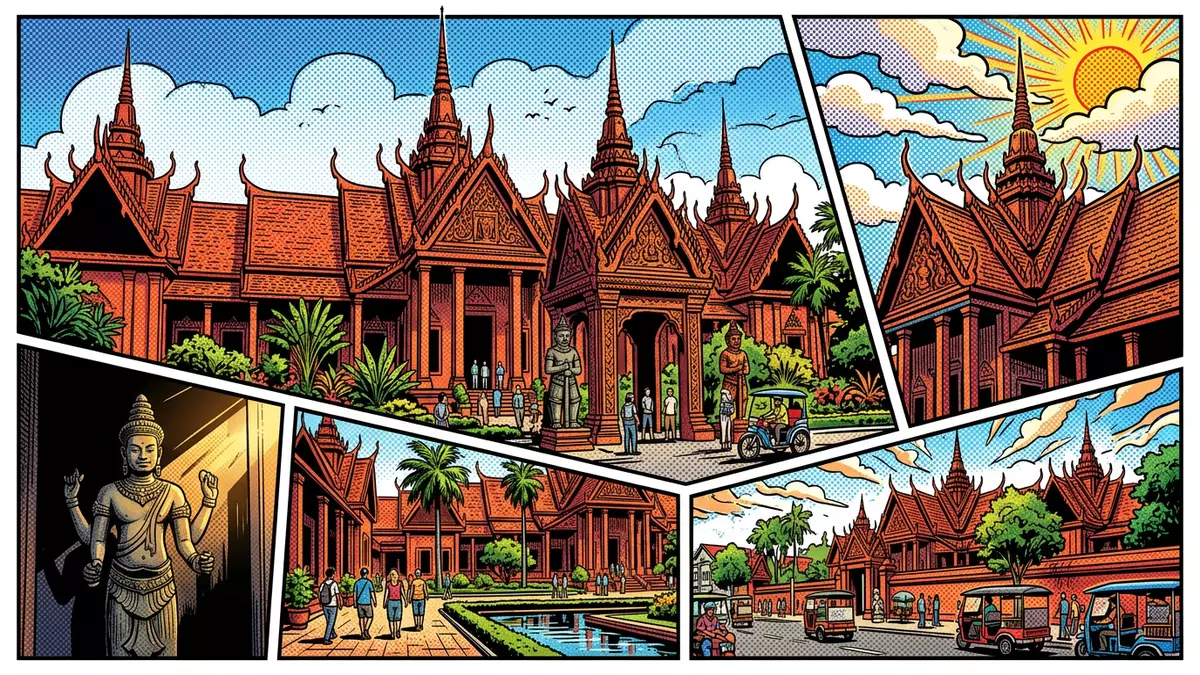
National Museum of Cambodia in Phnom Penh is a museum of red pavilions, steep roofs and shaded galleries wrapped around a central courtyard garden, bringing Khmer sculpture together in one coherent setting. Conceived in the early twentieth century and inaugurated on 13 April 1920 during Khmer New Year, it anchors the story of Cambodian art in a single complex of purpose-built halls.Inaugurated on 13 April 1920
Red pavilions and Khmer-inspired architecture
The museum stands just north of the Royal Palace in central Phnom Penh, set back from the surrounding streets behind a formal entrance gate and perimeter walls.Located immediately north of the Royal Palace Its buildings adopt a version of traditional Khmer architecture filtered through early twentieth century design, with high tiered roofs, elaborate ridge lines and richly carved pediments.
French historian and architect George Groslier designed the complex in the late 1910s, drawing on motifs from classical temples to create a museum that itself feels like a piece of heritage.George Groslier designed the museum The foundation stone was laid on 15 August 1917, and the initial construction phase between 1917 and 1920 produced a set of pavilions linked by covered galleries and oriented around a planted courtyard.Foundation stone laid on 15 August 1917
A collection spanning the Khmer world
Inside these pavilions, the museum holds a large collection of Cambodian artefacts that trace the development of Khmer civilisation from early periods through the Angkorian era and beyond.Collection covers prehistoric times to recent centuries Galleries are arranged broadly by period and theme, so stone sculptures, bronzes and wooden objects from different regions can be understood in relation to each other.
Visitors encounter sandstone statues from Angkor and other temple sites, intricate lintels, Buddha images and Hindu deities, many of them removed from archaeological locations for conservation.Finest collection of Khmer sculpture Later rooms introduce post-Angkorian pieces, royal regalia and everyday objects that show how artistic traditions continued after the great temple complexes were built.
Colonial beginnings, independence and survival
The museum grew out of the French administration in Indochina, with Governor General Albert Sarraut supporting the creation of a dedicated institution for Khmer antiquities and George Groslier serving as its first director.Albert Sarraut backed the project King Sisowath attended the inauguration on 13 April 1920, when the institution was still known as Musée Albert Sarraut, reflecting its colonial origins.Inauguration attended by King Sisowath
Control of the museum shifted from French to Cambodian hands in the early 1950s, and in 1968 Cambodian architect Vann Molyvann oversaw a renovation that refreshed the buildings while retaining their characteristic form.Renovation supervised by Vann Molyvann in 1968 The museum closed between 1975 and 1979 during the Khmer Rouge period, and it reopened on 13 April 1979, once again on Khmer New Year, with damaged structures repaired and surviving collections reorganised.Reopened on 13 April 1979
Visiting National Museum of Cambodia: what travellers from Western Europe should know
- National Museum of Cambodia stands on Preah Ang Eng Street (Street 13) in central Phnom Penh, immediately north of the Royal Palace and close to the riverside area.
- The complex consists of several interconnected pavilions around a courtyard garden, and visiting involves walking along shaded galleries and across open paving.
- The official language is Khmer and the currency is the Cambodian riel.
- Entry requirements depend on your nationality; UK travellers can check the FCDO travel advice at gov.uk/foreign-travel-advice, Irish travellers the Department of Foreign Affairs at ireland.ie.
Searching for National Museum of Cambodia on social platforms
These links open searches for National Museum of Cambodia on each platform.
Frequently asked questions about National Museum of Cambodia
Where is National Museum of Cambodia located?
National Museum of Cambodia stands in central Phnom Penh on Preah Ang Eng Street (Street 13), immediately north of the Royal Palace and close to the riverside district.
What can visitors expect inside the museum?
Visitors walk through red-roofed pavilions and a central courtyard garden, passing galleries of Khmer sculpture, bronzes and other artefacts from early periods through the Angkorian era and later centuries.
What makes National Museum of Cambodia distinctive among museums in Cambodia?
It combines Khmer-inspired architecture by George Groslier with a large, chronologically arranged collection of artefacts, and it has served as the principal national museum of fine arts and archaeology since its inauguration in 1920.


