
National Museum of Cambodia and its terracotta Khmer courtyards
Published on 08/14/2026 at 14:44 | Editorial responsibility: Rafael Müller, Editor-in-Chief AD HOC NEWS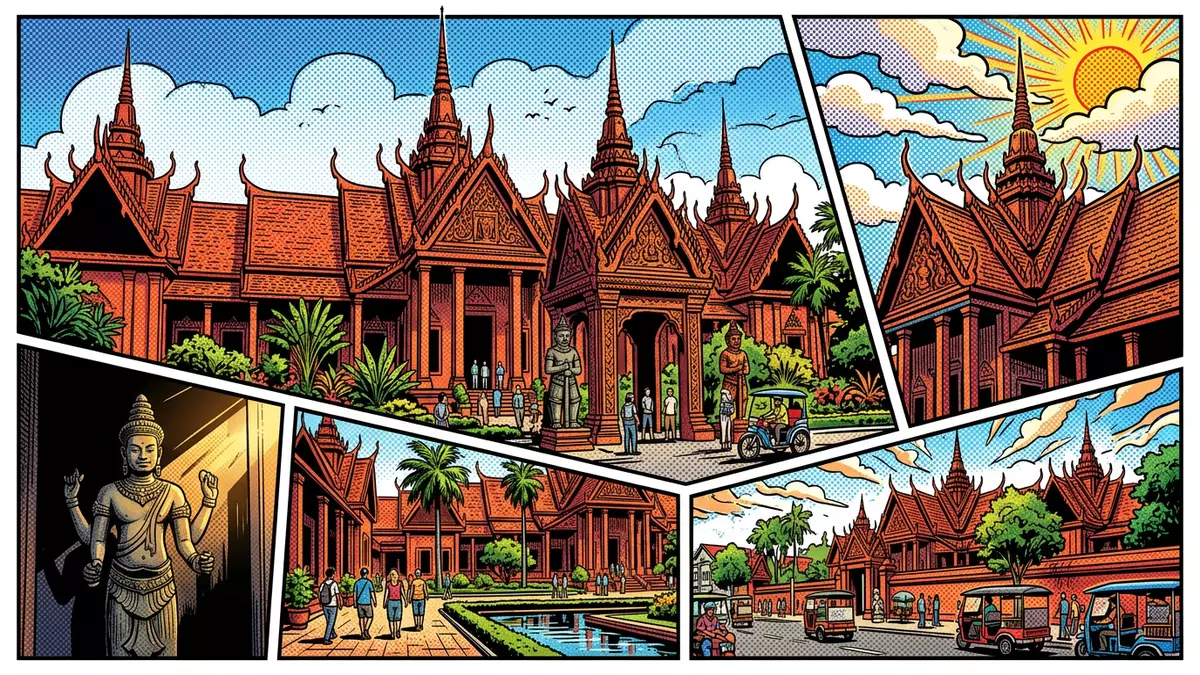
The National Museum of Cambodia in Phnom Penh brings centuries of Khmer art together inside a terracotta-red complex inspired by temple architecture, with galleries opening onto planted courtyards. Conceived under French colonial administration and inaugurated in 1920, it was designed by George Groslier as a museum for Cambodia’s royal capital.
Terracotta roofs and temple-inspired architecture
The National Museum of Cambodia stands just north of Phnom Penh’s Royal Palace, its terracotta-coloured buildings arranged around courtyards that recall the organisation of temple compounds. The complex was built between 1917 and the early 1920s, during the period when Cambodia formed part of French Indochina, and its inauguration took place on 13 April 1920 in the presence of King Sisowath.Built between 1917 and 1924 The museum building was originally named Musée Albert Sarraut in honour of Albert Sarraut, then Governor General of Indochina, reflecting its colonial-era origins.Inaugurated on 13 April 1920
George Groslier, a French historian and curator born in Phnom Penh in 1887, directed the creation of the museum and designed its architecture in a style that draws from classical Khmer forms.George Groslier designed the museum The building combines tiered roofs and prominent spires with ornamental “V”-shaped roof lines and carved details derived from ancient temple prototypes, reinterpreted at the scale of a museum.Tiered roofs and spires Its red brick and terracotta surfaces, colonnetted window frames and sculpted pediments give the complex a distinctive profile against the streets of central Phnom Penh.
Courtyards, galleries and the layout of the museum
The plan of the National Museum of Cambodia consists of galleries that frame interior courtyards, creating alternation between enclosed exhibition spaces and open-air gardens. Four principal gallery ranges surround a central courtyard planted with lotus ponds and tropical species, providing a transition zone between the interior halls and the sky above.Four galleries around a courtyard Additional wings added to the façade in 1924 expanded the museum’s capacity while maintaining the same vocabulary of curved roofs and ornamental gables.Wings added in 1924
Visitors move through a sequence of halls that showcase stone sculpture, ceramics and smaller artefacts, with doorways often opening directly onto planted spaces. The arrangement around courtyards allows sightlines from one side of the complex to another, with roofs rising in tiers above the gardens and spires marking the centre. Architectural elements such as naga finials on roof ridges, carved lintels and decorated eaves echo the motifs found at Angkorian temples, while the overall organisation reflects early twentieth-century museum practice, with clear circulation routes and display cases aligned along the walls.
Khmer collections from pre-Angkor to post-Angkor
The National Museum of Cambodia serves as Cambodia’s principal museum of cultural history, housing extensive collections of Khmer sculpture and related material from multiple historical periods.Foremost collection of Khmer cultural material The holdings encompass artefacts from prehistoric contexts, pre-Angkorian kingdoms, the Angkorian era and post-Angkorian developments, bringing material from across the country into a single institution. Many of the objects once formed part of the decoration of temple complexes and royal buildings, such as lintels, pediments and freestanding statues carved in sandstone.
Among the sculptures are examples dating from the fourth century through to the fourteenth century, representing deities and rulers associated with Khmer civilisation.Sculptures from pre-Angkor to post-Angkor Highlights described in guides to the museum include a multi-armed statue of Vishnu from the sixth or seventh century, a representation of Shiva from the late ninth century, and a seated image of King Jayavarman VII from the late twelfth or early thirteenth century, his head inclined slightly in a meditative pose. Together, the works illustrate changes in style and religious practice across more than a millennium of Cambodian history, with shifts in iconography, proportions and surface treatment visible in the galleries.
Visiting National Museum of Cambodia: what travellers from Western Europe should know
- The National Museum of Cambodia stands in central Phnom Penh on Street 13 near Street 178 in the Chey Chumneas quarter, immediately north of the Royal Palace, reached easily by road vehicles and local transport.
- Inside the museum, movement between galleries involves covered walkways and passageways opening onto courtyards; surfaces are paved and some routes include steps and thresholds between interior halls and garden areas.
- The official language is Khmer and the currency is the Cambodian riel.
- Entry requirements depend on your nationality; UK travellers can check the FCDO travel advice at gov.uk/foreign-travel-advice, Irish travellers the Department of Foreign Affairs at ireland.ie.
Searching for National Museum of Cambodia on social platforms
These links open searches for National Museum of Cambodia on each platform.
Frequently asked questions about National Museum of Cambodia
Where is the National Museum of Cambodia located?
The National Museum of Cambodia is located in central Phnom Penh on Street 13 near Street 178 in the Chey Chumneas quarter, just north of the Royal Palace.
What can visitors expect on a visit?
Visitors encounter terracotta-red galleries arranged around planted courtyards, with exhibitions of Khmer sculpture, ceramics and cultural artefacts from prehistoric, pre-Angkorian, Angkorian and later periods.
What makes the National Museum of Cambodia distinctive?
Its combination of traditional Khmer architectural forms designed by George Groslier and its role as Cambodia’s main museum of Khmer cultural material make the National Museum of Cambodia a distinctive institution in Phnom Penh.


