
Nemrut Dagi and the stone crown of Commagene
Published on 08/23/2026 at 13:03 | Editorial responsibility: Rafael Müller, Editor-in-Chief AD HOC NEWS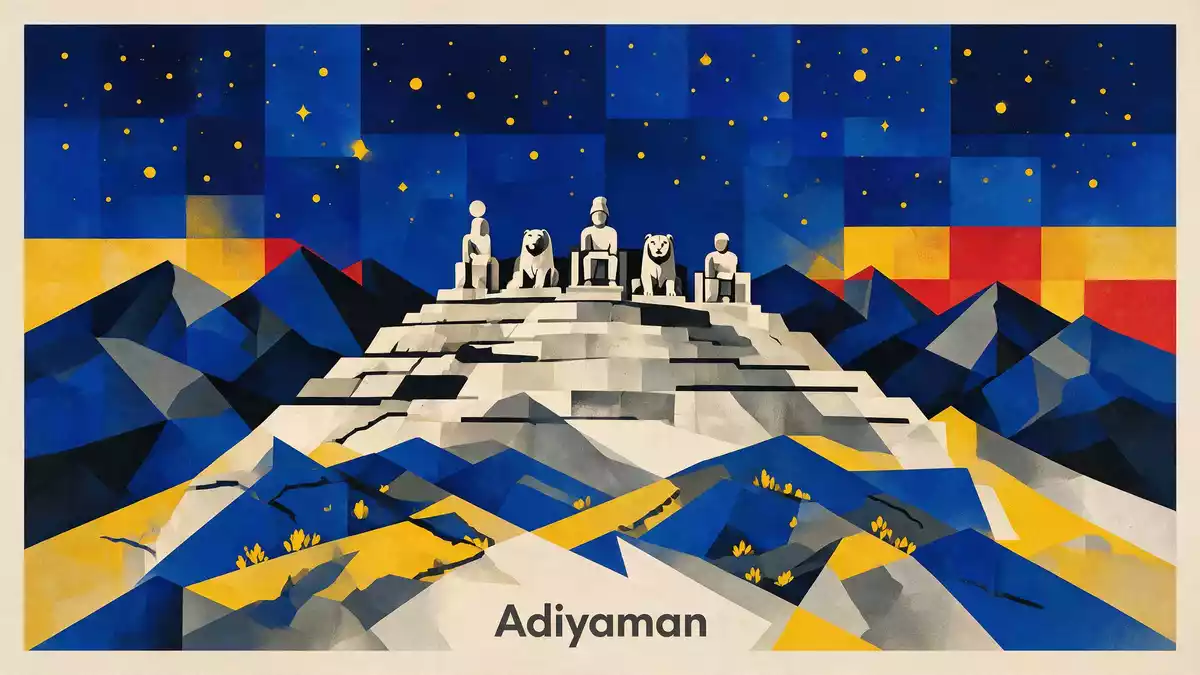
Nemrut Dagi rises above Adiyaman as a mountain summit arranged around an ancient royal sanctuary. Stone figures, inscribed blocks and a burial mound create a landscape that is as architectural as it is mountainous.
A summit sanctuary above Adiyaman
The site belongs to the kingdom of Commagene and is tied to King Antiochos I, who ruled in the late Hellenistic period. The sanctuary is part monument, part tomb, and part high mountain setting, with the summit carrying the most visible remains. late Hellenistic King Antiochos I UNESCO World Heritage
Its formal setting is a hierotheseion, a sanctuary complex that combines cult space and royal commemoration. The mountain stands in south-east Turkey, and the summit is linked with the Eastern Taurus range; its altitude is recorded at about 2,150 m (7,054 ft). hierotheseion 2,150 m
Antiochos I and the Commagene setting
Commagene sat between larger powers, and Nemrut Dagi reflects that position in its mixture of Greek, Persian and local royal imagery. The monument belongs to the first century BC, and the name Antiochos I gives it a fixed historical anchor that many mountain sites lack. first century BC Kommagene
The summit mound, statues and reliefs form the core of the place. Their scale is startling on a mountain top, where stone heads, seated figures and carved inscriptions occupy separate terraces around the mound. stone heads carved inscriptions
What remains visible on the summit
The material character of Nemrut Dagi is part of its appeal: rough mountain rock below, carved limestone above, and a planned ceremonial ensemble at the summit. The remains are fragmentary, but the arrangement is still legible as a royal mountain sanctuary rather than a conventional temple in a town or valley. carved limestone royal mountain sanctuary
Because the site sits high on the mountain, the summit element is the point where landscape and monument meet most directly. The statues and mound do not read as decoration alone; they define the place as a ceremonial landscape with a single dominant focus.
Visiting Nemrut Dagi: what travellers from Western Europe should know
- The site lies in Adiyaman province, in the Kahta district, and access runs through the mountain roads leading towards the summit. The final approach is on foot across exposed high ground.
- The terrain is steep and rocky, and the summit is at high altitude. The monument area is spread across terraces rather than a flat platform.
- The official language is Turkish and the currency is the Turkish lira.
- Entry requirements depend on your nationality; UK travellers can check the FCDO travel advice at gov.uk/foreign-travel-advice, Irish travellers the Department of Foreign Affairs at ireland.ie.
Searching for Nemrut Dagi on social platforms
These links open searches for Nemrut Dagi on each platform.
Frequently asked questions about Nemrut Dagi
Where is Nemrut Dagi?
Nemrut Dagi is in Adiyaman province in south-east Turkey, within the Kahta district. It rises in the Eastern Taurus mountain range.
What does a visit involve?
The site is a mountain sanctuary with terraces, carved blocks and a summit mound. The setting is open and high, with the monument spread across exposed ground.
What makes Nemrut Dagi distinctive?
It combines a royal tomb complex, monumental sculpture and a mountain summit in one planned ensemble. The link to Antiochos I and Commagene gives it a clear historical identity.


