
Nine Arch Bridge in Ella and its brick arches above the jungle
Published on 08/18/2026 at 13:11 | Editorial responsibility: Rafael Müller, Editor-in-Chief AD HOC NEWS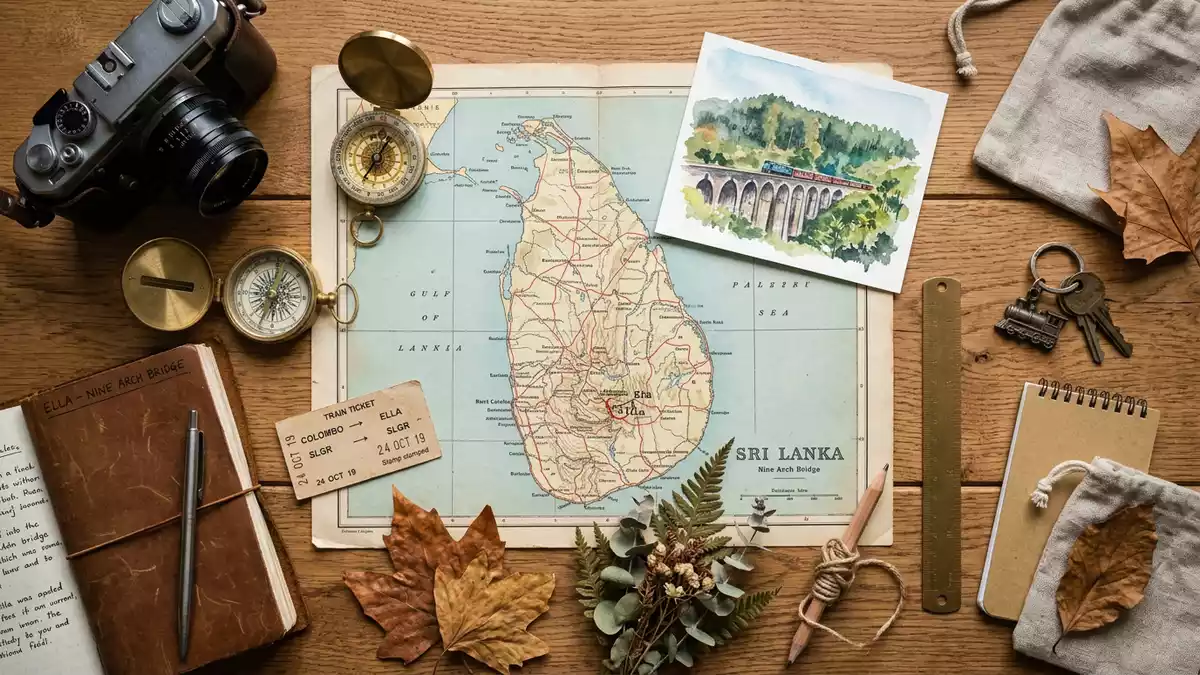
In the hills above Ella in Sri Lanka, Nine Arch Bridge carries the country’s upcountry railway across a forested ravine on a sweep of brick arches that rise from the jungle floor. Completed in the early 1920s, the stone and brick viaduct belongs to the colonial period of Ceylon’s railway building and still serves the line between Ella and Demodara. The scene of trains crossing its nine arches against tea-covered slopes has become one of the defining images of Sri Lanka’s hill country.
Brick arches over a steep valley
Nine Arch Bridge is a masonry railway viaduct on the line between Ella and Demodara, set at an elevation of more than 1,000 m (3,281 ft) in Sri Lanka’s central highlands.The bridge carries the Colombo–Badulla hill-country railway through dense jungle and cultivated slopes, linking the tracks across a gap between two ridges. Its nine masonry arches form a regular rhythm along a total length of about 91 m (300 ft), with the deck standing roughly 24 m (80 ft) above the valley floor.The bridge’s measured dimensions are widely reported.
The structure is built from stone blocks and brickwork, finished with cement rather than metal girders, and rests on solid piers that rise from the ground to support the arch ring. Travel accounts and engineering descriptions agree that the viaduct was constructed without structural steel, apart from the rails and their fastenings, making its long brick and stone arches the defining feature of the crossing.Contemporary guides describe the bridge as built only with stone blocks and cement. From track level, trains pass over a simple ballast deck, but viewed from below the arches frame strips of sky and forest between massive masonry supports.
Colonial-era railway engineering in Sri Lanka’s hill country
Nine Arch Bridge belongs to the early twentieth-century expansion of the upcountry railway in what was then British Ceylon, a programme that extended the line from Bandarawela towards Badulla.Historical notes place its construction in the years around 1919, with the bridge brought into service in 1921 under the colonial railway administration.Descriptions of the site record a 1921 completion date. The viaduct is therefore a product of the period when railway engineers were threading tracks through the island’s mountainous interior to reach tea estates and towns.
Several sources credit both British engineers and local builders for the bridge’s design and execution. Harold Cuthbert Marwood of the Ceylon Government Railway’s construction department is named as the designer of the viaduct, working under chief construction engineer M. Cole Bowen.Railway records identify Marwood and Bowen among the key engineers. Accounts from Sri Lanka give particular prominence to P. K. Appuhami, a Ceylonese builder associated with the site, reflecting the contribution of local labour and contractors to the masonry work.Travel information frequently attributes the bridge’s construction to Appuhami and local workers under colonial supervision. Together they produced a stone and brick viaduct that has carried trains across the valley for more than a century.
The bridge in the landscape around Ella
Nine Arch Bridge stands in a pocket of forest and cultivated land near the village of Gotuwala, between the stations of Ella and Demodara on the main hill-country line.Descriptions of the route place the viaduct between these two stops. The ravine beneath the bridge is lined with trees and undergrowth, while tea plantations climb the surrounding slopes, giving the arches a backdrop of green terraces and misty hills. When a train crosses, the coaches curve gently with the alignment of the structure, emphasising the sweep of the arches above the valley.
Locally the bridge is known by the Sinhala name “Ahas Namaye Palama”, often rendered as “Bridge in the Sky”, a reference to the way the open arches frame patches of sky as the railway passes high above the ground.Local usage records this alternative name. The setting combines engineered masonry, railway infrastructure and the agricultural landscape of Sri Lanka’s Uva Province, which together explain why images of Nine Arch Bridge crossing its valley are widely used to represent the region’s hill scenery.
Visiting Nine Arch Bridge: what travellers from Western Europe should know
- Nine Arch Bridge lies near the village of Gotuwala close to Ella in Sri Lanka’s Uva Province, on the railway line between Ella and Demodara stations. It is reached by local roads and footpaths from Ella or nearby accommodation.
- Approaches to the viewing points around the bridge involve walking on uneven paths and slopes, including sections on earth tracks beside tea fields and short climbs to vantage spots overlooking the arches.
- The site sits in Sri Lanka’s hill country at over 1,000 m (3,281 ft) above sea level, so weather can change quickly and low cloud or mist may affect visibility across the valley.
- The official languages of Sri Lanka are Sinhala and Tamil, and the currency is the Sri Lankan rupee.
- Entry requirements depend on your nationality; UK travellers can check the FCDO travel advice at gov.uk/foreign-travel-advice, Irish travellers the Department of Foreign Affairs at ireland.ie.
Searching for Nine Arch Bridge on social platforms
These links open searches for Nine Arch Bridge on each platform.
Frequently asked questions about Nine Arch Bridge
Where is Nine Arch Bridge located?
Nine Arch Bridge stands near the village of Gotuwala close to Ella in Sri Lanka’s Uva Province, between the railway stations of Ella and Demodara.
What should visitors expect at Nine Arch Bridge?
Visitors encounter a masonry railway bridge of nine arches spanning a forested valley, with views of trains crossing, surrounding tea plantations and hill-country scenery.
What makes Nine Arch Bridge distinctive?
The bridge combines early twentieth-century railway engineering with a stone and brick viaduct built without structural steel, set high above a ravine in Sri Lanka’s hill country.


