
Odaiba’s island cityscape in Tokyo Bay
Published on 09/07/2026 at 17:29 | Editorial responsibility: Rafael Müller, Editor-in-Chief AD HOC NEWS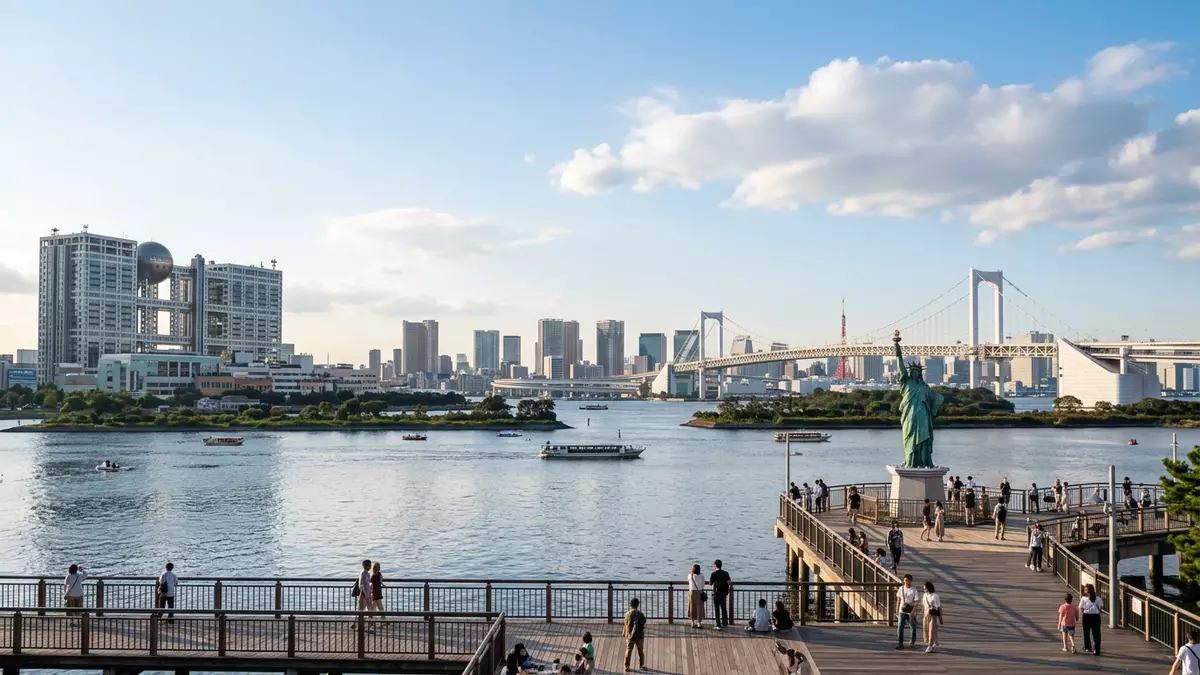
Odaiba is a large artificial island in Tokyo Bay, linked to central Tokyo by the Rainbow Bridge and developed into a waterfront district of leisure, business and housing from the late twentieth century onwards.artificial island in Tokyo Bay The area lies mainly within K?t? ward, with parts in Minato and Shinagawa, and has grown from nineteenth-century defensive earthworks into a modern urban quarter of wide promenades, landmark structures and expansive views across the bay.
A manufactured island with a changing role
Odaiba originated as a set of man-made fort islands created in the late Edo period, when the Tokugawa shogunate ordered coastal batteries to guard the approaches to Edo against attack from the sea.fort islands built in the late Edo period The name “daiba” itself refers to these gun emplacements, whose construction dates to the 1850s, and fragments of that older defensive landscape survive as historic sites alongside sweeping new land reclamation.
Extensive infill and urban planning in the late twentieth century turned the original batteries into part of a continuous island, now covered by offices, residential towers, parks and large-scale commercial complexes.late twentieth-century development Seen from the water, Odaiba reads as a man-made extension of Tokyo, its straight embankments and engineered shorelines contrasting with the more irregular coast of the older city.
Bridges, promenades and waterfront landmarks
The most recognisable link between Odaiba and central Tokyo is the Rainbow Bridge, a suspension bridge carrying road and rail traffic across the northern part of Tokyo Bay.Rainbow Bridge From Odaiba’s waterfront promenades the bridge frames views towards the towers of Shimbashi and Shiodome, while ferries and other vessels pass underneath on routes across the harbour.
Along the island’s edges, wide pedestrian routes run beside the water, lined with planting, public art and open plazas that connect directly to shopping and entertainment complexes.shopping and entertainment district Artificial beaches and lawns provide spaces where the city meets the bay, and elevated roads and rail lines curve above, giving Odaiba a layered urban profile of shoreline, podiums and decks.
Museums and technology on the bay
One of Odaiba’s signature cultural institutions is Miraikan – The National Museum of Emerging Science and Innovation, housed in a purpose-built building in the Aomi district on the island.Miraikan – The National Museum of Emerging Science and Innovation Established by Japan’s Science and Technology Agency and inaugurated in 2001, the museum focuses on themes such as robotics, space exploration and information technology, using large-scale displays and interactive exhibits to explore scientific questions.inaugurated in 2001
Miraikan stands at 2-3-6 Aomi in K?t? City, a short walk from several stations on the automated Yurikamome transit line and near Tokyo Teleport Station on the Rinkai Line.address in Aomi Its glass and metal volumes, set close to the waterfront, form part of a wider cluster of attractions that use Odaiba’s reclaimed land for large-scale cultural and leisure facilities.
Visiting Odaiba: what travellers from Western Europe should know
- Odaiba occupies reclaimed land in Tokyo Bay to the south-east of central Tokyo and is linked to the city by the Rainbow Bridge and other road and rail connections.
- The district is largely flat, with broad pavements and long waterfront promenades; some viewpoints and museum spaces are reached by escalators and stairs inside large buildings.
- The automated Yurikamome line runs from Shimbashi over the Rainbow Bridge to several stations on the island, and the Rinkai Line serves Tokyo Teleport Station inland from the waterfront.
- The official language is Japanese and the currency is the yen.
Searching for Odaiba on social platforms
These links open searches for Odaiba on each platform.
Frequently asked questions about Odaiba
Where is Odaiba in relation to central Tokyo?
Odaiba lies on reclaimed land in Tokyo Bay, facing districts such as Shimbashi and Shiodome across the water and connected to them by the Rainbow Bridge.
What can visitors expect on a visit to Odaiba?
Visitors encounter a manufactured island landscape of waterfront promenades, shopping and entertainment complexes, cultural venues and broad views across Tokyo Bay.
What makes Odaiba distinctive within Tokyo?
Its origin as Edo-period fort islands and its later transformation into a single large artificial island give Odaiba a layered character that contrasts with older parts of Tokyo.


