
Ogbunike Caves and the sandstone tunnels of Anambra
Published on 09/24/2026 at 04:32 | Editorial responsibility: Rafael Müller, Editor-in-Chief AD HOC NEWS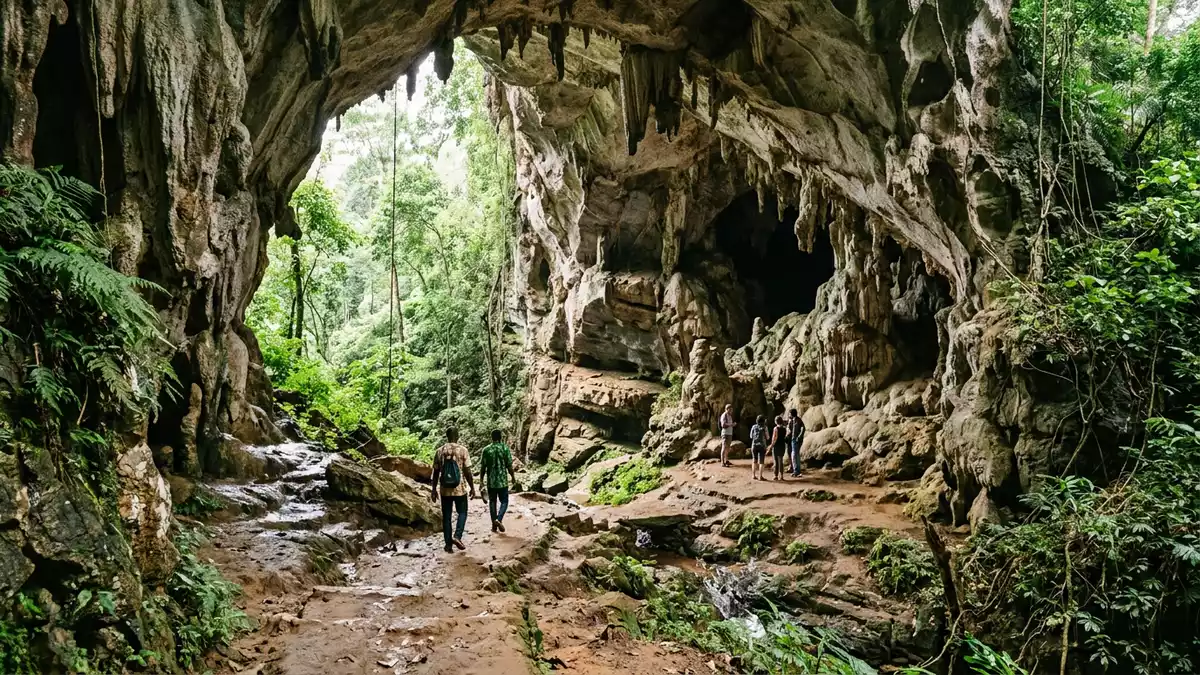
Ogbunike Caves descend beneath the Ogba hills near Ogbunike in Anambra State, south-eastern Nigeria. A forested valley leads to a sandstone cave system of chambers, streams and branching passages, with the rock forming the defining feature of the place.
Sandstone chambers beneath the Ogba hills
The caves lie in a valley behind the Ogba hills, within tropical rainforest near the town of Ogbunike. Their geological setting is lateritic sandstone of Campanian–Miocene age, a sedimentary formation associated with the Cretaceous and Miocene periods. lateritic sandstone formation
The main entrance chamber measures about 30 metres long, 10 metres wide and 5 metres high. Ten tunnels lead from the chamber towards different parts of the hillside, with further chambers, passages and watercourses inside the system. The cave is not a single hollow space, but a connected underground landscape with levels, bends and dark recesses.
Streams flow through parts of the caves, and water emerges from one passage before meeting the Nkissa River. The immediate landscape includes forest, undulating hills and the river valley. Bats occupy the cave chambers, while the surrounding habitat includes birds, frogs, fish, crabs and other forest species.
Living Igbo traditions and historical refuge
Ogbunike Caves have a sacred place in Igbo traditions. Living customs are associated with the site, and the annual Ime Ogbe festival commemorates the discovery of the caves. The name Ogbunike also belongs to the nearby town, linking the geological site with the community around it.
Oral traditions connect the caves with Ogba, a spiritual figure associated with justice and the underground chambers. Such traditions form part of the cultural meaning of the site, alongside its physical character as a sandstone cave system.
The caves are also associated with refuge during periods of violence. Historical accounts connect their chambers with people escaping slave raiding parties, while memories of the Nigerian Civil War from 1967 to 1970 add another layer to the site's history.
Nigeria submitted Ogbunike Caves to UNESCO's Tentative List on 8 October 2007 as a mixed natural and cultural site. The listing records both the cave landscape and the living traditions connected with it. UNESCO Tentative List entry
Steps, water and a cave network
The descent from the surrounding hills follows a long walkway of about 317 steps. At the end of the stairs, an open area marks the approach to the cave entrance. The route connects the forested upper landscape with the chamber below.
Tradition requires visitors to remove their shoes before entering the main cave areas. This practice reflects the sacred character of the place and distinguishes the entrance experience from a visit to a geological attraction without cultural rules.
Inside, the cave combines broad spaces with narrower tunnels and passages. Some routes connect with other chambers, while streams occupy sections of the lower cave. The darkness, uneven rock and underground water form permanent features of the setting.
The cave landscape extends beyond the entrance chamber. The Nkissa River runs beside the site, and water from the cave joins the river. The forest around the valley contains the natural context recorded for the caves, while the underground passages provide the central physical focus.
Visiting Ogbunike Caves: what travellers from Western Europe should know
- Ogbunike Caves are in Anambra State near Ogbunike and Onitsha. The approach follows Ifite Road, close to the Nkissa River.
- The descent uses a walkway of about 317 steps. Returning from the valley requires the same uphill route.
- The cave contains dark passages, uneven sandstone surfaces, streams and underground chambers. Footwear is removed before entering under local tradition.
- The official language is English and the currency is the Nigerian naira.
- Entry requirements depend on your nationality; UK travellers can check the FCDO travel advice at gov.uk/foreign-travel-advice, Irish travellers the Department of Foreign Affairs at ireland.ie.
Searching for Ogbunike Caves on social platforms
These links open searches for Ogbunike Caves on each platform.
Frequently asked questions about Ogbunike Caves
Where are Ogbunike Caves?
Ogbunike Caves are in Anambra State, south-eastern Nigeria, near the town of Ogbunike and the city of Onitsha. The caves lie in a forested valley behind the Ogba hills.
What can visitors expect inside?
The cave contains a large entrance chamber, branching tunnels, streams, bats and further underground chambers. The approach includes a long stairway with about 317 steps.
What makes the caves distinctive?
Ogbunike combines lateritic sandstone geology with Igbo spiritual traditions and memories of refuge. Nigeria placed the site on UNESCO's Tentative List in 2007 as a mixed natural and cultural property.


