
Oia's cliffside houses and caldera paths
Published on 08/22/2026 at 06:40 | Editorial responsibility: Rafael Müller, Editor-in-Chief AD HOC NEWS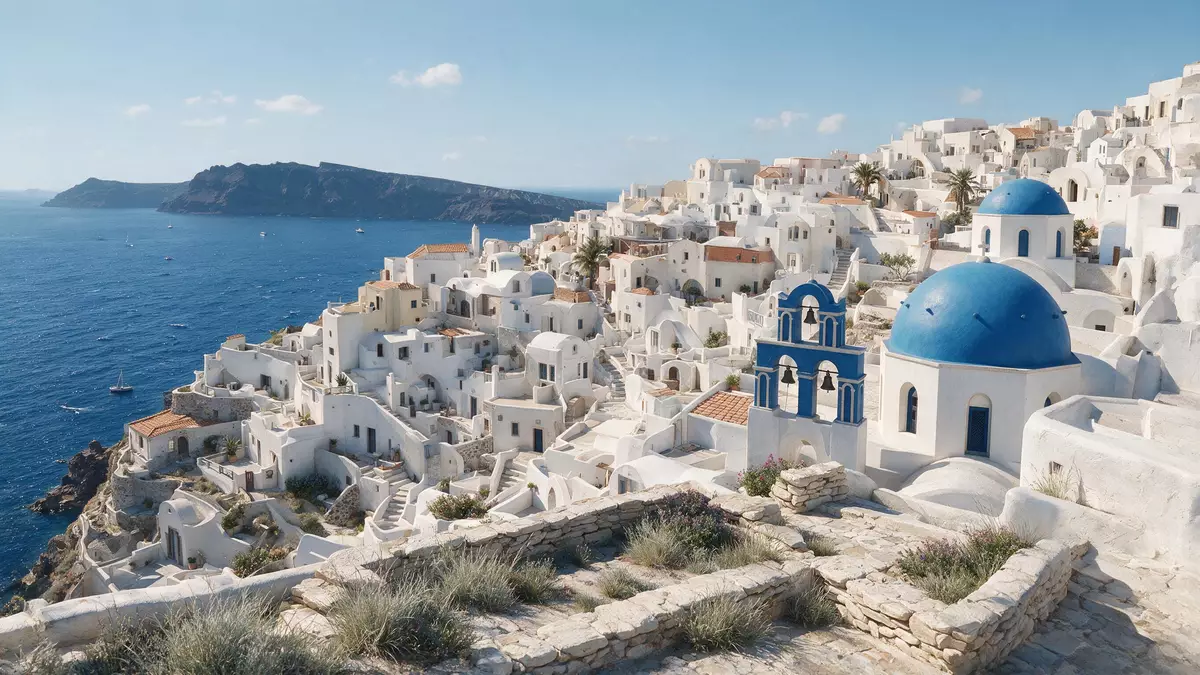
Oia, also called Ia, is a village on Santorin’s north-western edge, where whitewashed houses, cave dwellings and old captains’ homes step along the caldera. Its identity is tied to the settlement of Apano Meria, the Venetian period and the name change to Oia in the nineteenth century.
Oia along the caldera rim
The village extends for almost two kilometres along the rim, with steep drops on one side and lanes, terraces and church domes clustered above the bay. The caldera edge gives Oia its most recognisable profile, and the built fabric follows the slope rather than flattening it.
Oia sits within the municipality of Santorini in the Cyclades, and its older harbour landscape lies below at Ammoudi Bay. The village’s maritime past is visible in the captains’ houses on the higher ground and in the older working quarters below.
Venetian roots and maritime wealth
The settlement is linked to Marco Sanudo’s Duchy of Naxos and to the Venetian system that spread across Santorin after 1207. Under Venetian rule, Agios Nikolaos Kastell, also known as Apanomeria, formed one of the island’s local citadels.
That defensive layer survived in the place-name memory of Oia and in the ruined keep known as Goulas. The later settlement grew around a seafaring economy, and the merchant houses that remain speak to the era when shipowners and sailors shaped local life.
Stone, stairs and cliff houses
Architecture is Oia’s clearest feature. White façades, blue domes, narrow alleys and carved cave houses create a dense front to the caldera, while the stone-built houses of wealthier captains stand apart in scale and detail.
The village’s streets are tight, and the descent to Ammoudi and the lower harbour involves steps rather than level ground. The Goulas tower and the remaining fragments of the old fortress keep the medieval layer visible beside the Cycladic houses.
Visiting Oia: what travellers from Western Europe should know
- Oia lies on Santorin in Greece, on the island’s north-western edge above the caldera. From Fira, the route follows the island road north, and Ammoudi Bay lies below the settlement.
- The village is built on a slope and includes stairs, narrow passages and uneven levels. The descent to the lower harbour is by steps.
- The official language is Greek and the currency is the euro.
- Conditions on the mountain change with the seasons; the local cable-car operators and alpine clubs provide information.
- Entry requirements depend on your nationality; UK travellers can check the FCDO travel advice at gov.uk/foreign-travel-advice, Irish travellers the Department of Foreign Affairs at ireland.ie.
Searching for Oia on social platforms
These links open searches for Oia on each platform.
Frequently asked questions about Oia
Where is Oia?
Oia is a village on Santorin, in Greece, on the island’s north-western edge. It overlooks the caldera and faces the bay below.
What should a visit to Oia expect?
Oia has narrow lanes, steps, cave houses and whitewashed buildings on a steep slope. The lower harbour is reached by stairs.
What makes Oia distinctive?
Its distinctive character comes from the caldera setting, the Venetian fortress remains and the cluster of Cycladic houses and captains’ mansions. The layered history is visible in the built form.


