
Old San Juan, the walled colonial heart of San Juan
Published on 08/24/2026 at 13:13 | Editorial responsibility: Rafael Müller, Editor-in-Chief AD HOC NEWS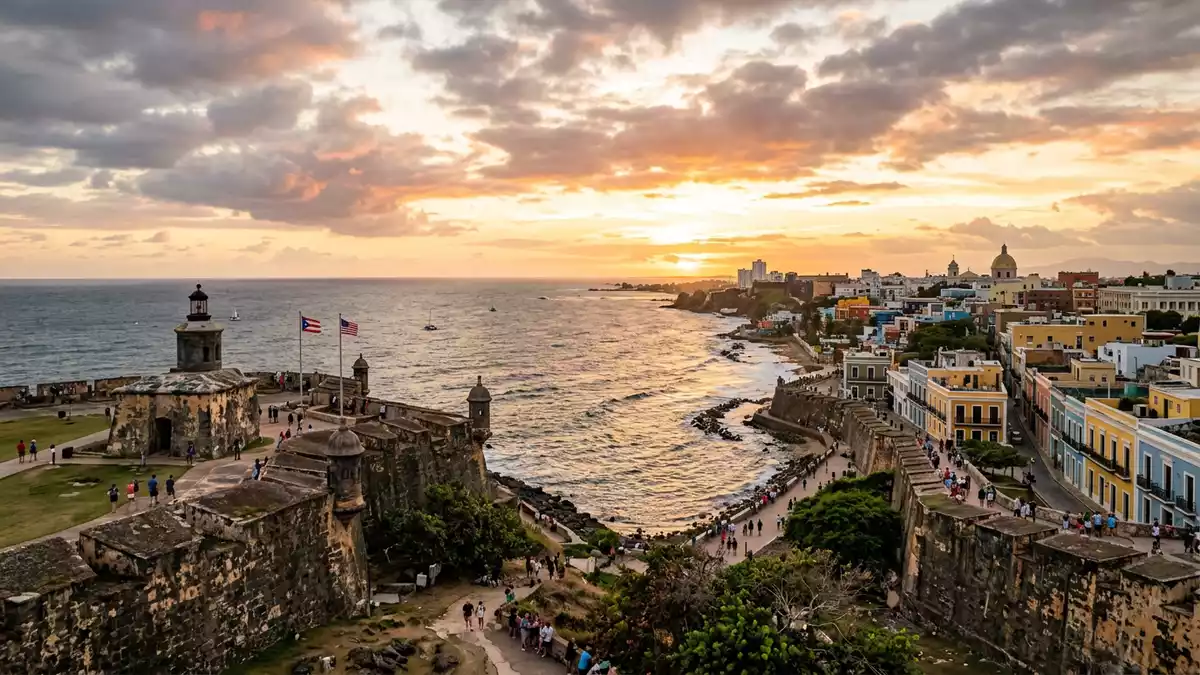
Old San Juan is the historic walled quarter of San Juan in Puerto Rico, occupying the northwest triangle of the small San Juan Islet where Atlantic surf meets a sheltered bay. The district was formally established as a town in 1521 and grew into the island’s oldest urban centre, laid out with plazas, churches and streets that still shape the city’s fabric.
The walled city on a narrow islet
Old San Juan stands on a narrow island off Puerto Rico’s north coast, bounded by the Atlantic Ocean to the north and by San Juan Bay to the south. Three bridges cross the San Antonio Channel to link the islet to the mainland districts of San Juan, tying the historic quarter into the wider metropolis.north coast location Within the old defensive perimeter, the streets are compact and often narrow, many paved with blue-toned cobblestones laid in the sixteenth and seventeenth centuries.
The urban layout reflects its early Spanish foundation. In 1521 the settlement was formally named “Ciudad de Puerto Rico de San Juan Bautista”, and key spaces such as Calle del Cristo and Plaza de Armas were already being set out.formal naming in 1521 Old San Juan’s land area today roughly corresponds to several historic subdistricts, including Ballajá, Catedral, Marina, Mercado, San Cristóbal and San Francisco, each carrying its share of civic buildings, houses and fortifications behind the walls.
From early stronghold to historic landmark district
The origins of Old San Juan lie in the first decades of Spanish expansion into the Caribbean. Juan Ponce de León founded an initial settlement called Caparra in 1508 inland from the bay, but within a year the focus shifted to the harbour site that evolved into San Juan, anchored by an early cathedral and fortified residence known as Casa Blanca.Juan Ponce de León and Caparra The fortified town developed as Spain consolidated its trade routes, with Old San Juan serving as a key Atlantic gateway.
Between the sixteenth and eighteenth centuries, a continuous programme of defensive building transformed the islet into a major stronghold. City walls were erected between about 1530 and 1560, enclosing the town and its harbour-facing slopes.construction of city walls Fortresses followed: La Fortaleza in the 1530s, early batteries at the headland of San Felipe del Morro later in the century, and the great Castillo San Cristóbal completed in the eighteenth century. By the late eighteenth century the fortified town housed thousands of residents and extensive military installations, with cannon-lined ramparts guarding the approaches by sea and land.
Fortresses, plazas and churches in the old quarter
Fortifications remain central to the experience of Old San Juan. At the northwestern tip rises Castillo San Felipe del Morro, a multi-level stone citadel standing on a promontory above the entrance to San Juan Bay. Construction on its first defences began in 1539 under the Spanish Crown, and work continued for roughly two centuries to produce the complex visitors see today.construction beginning in 1539 Across the eastern side of the old city lies Castillo San Cristóbal, the largest fortress built by Spain in the Americas, designed to shield the landward approach to the town.
The walls themselves, which give Old San Juan its nickname “La ciudad amurallada”, still encircle much of the district.La ciudad amurallada Only one main gate survives, the San Juan Gate beside the waterfront promenade of Paseo de La Princesa. Within the walls, plazas mark out civic life: Plaza de Armas with its historic city hall, Plaza Colón near the eastern ramparts and Tapia Theatre, and smaller squares such as Plaza de San José and Plaza de la Catedral, each framed by houses, government buildings or former convents.
Religious and domestic heritage
Old San Juan preserves a concentrated group of historic churches and domestic buildings that trace the city’s spiritual and everyday life. The Cathedral of San Juan Bautista, whose earliest version dates to the early sixteenth century, stands as one of the oldest churches in continuous use in the Americas and contains the tomb of Juan Ponce de León.Cathedral of San Juan Bautista Nearby, the gothic-arched San José Church is among the earliest surviving examples of Spanish Gothic architecture in the region.
Domestic and civic buildings now house museums and cultural institutions. Casa Blanca, begun in the 1520s as the residence of Ponce de León’s family, stands near El Morro with gardens stepping down towards the sea.Casa Blanca residence The former Ballajá Barracks contain the Museo de Las Américas and other cultural spaces, while the old city marketplace hosts the Museum of San Juan. Convents and town houses along streets such as Calle del Cristo have been adapted into hotels, galleries and small museums, preserving façades while carrying new interior uses.
Old San Juan as a protected historic district
Old San Juan’s fortified ensemble and civic core have been formally recognised for their heritage value. In 1949 the United States established San Juan National Historic Site to preserve major fortifications such as El Morro and San Cristóbal.San Juan National Historic Site In 1983, La Fortaleza and the San Juan National Historic Site together were inscribed as a cultural World Heritage Site, acknowledging the strategic and architectural significance of these defences in the history of the Americas.
The broader old town within the walls entered the Puerto Rico Register of Historic Sites in 1951 and was listed on the United States National Register of Historic Places in 1972 under the name San Juan Historic Zone.Old San Juan Historic District listing Boundary extensions and a renaming in 2012 defined the Old San Juan Historic District, and in 2013 it was designated a National Historic Landmark District. These layers of protection have helped maintain the colonial streetscapes, plazas and defensive works that characterise the quarter.
Visiting Old San Juan: what travellers from Western Europe should know
- Old San Juan occupies the northwest corner of the San Juan Islet on Puerto Rico’s north coast, linked to mainland San Juan by bridges across the San Antonio Channel. It is reached by road from the wider metropolitan area and lies beside San Juan’s port facilities.
- The historic quarter is compact and largely walkable, with cobbled streets, uneven paving and occasional steep stretches along the ramparts and towards fortresses such as El Morro.
- La Fortaleza, El Morro and San Cristóbal form part of a continuous fortified circuit, with some routes involving staircases within bastions or along sections of the preserved city walls.
- The official language is Spanish and the currency is the United States dollar.
- Entry requirements depend on your nationality; UK travellers can check the FCDO travel advice at gov.uk/foreign-travel-advice, Irish travellers the Department of Foreign Affairs at ireland.ie.
Searching for Old San Juan on social platforms
These links open searches for Old San Juan on each platform.
Frequently asked questions about Old San Juan
Where is Old San Juan and what kind of place is it?
Old San Juan is the historic walled district of San Juan on a small islet off Puerto Rico’s north coast, facing both the Atlantic Ocean and San Juan Bay.
What should visitors expect on a first walk through Old San Juan?
Visitors encounter cobbled streets, colourful façades, plazas framed by civic buildings and churches, and extensive stone fortifications including El Morro, San Cristóbal and sections of the city walls.
What makes Old San Juan distinctive among Caribbean historic centres?
Old San Juan combines a dense colonial street grid, major sixteenth- to eighteenth-century fortresses and largely preserved city walls, recognised collectively through its World Heritage listing and National Historic Landmark District status.


