
Old San Juan, where stone walls frame Caribbean colour
Published on 08/25/2026 at 07:43 | Editorial responsibility: Rafael Müller, Editor-in-Chief AD HOC NEWS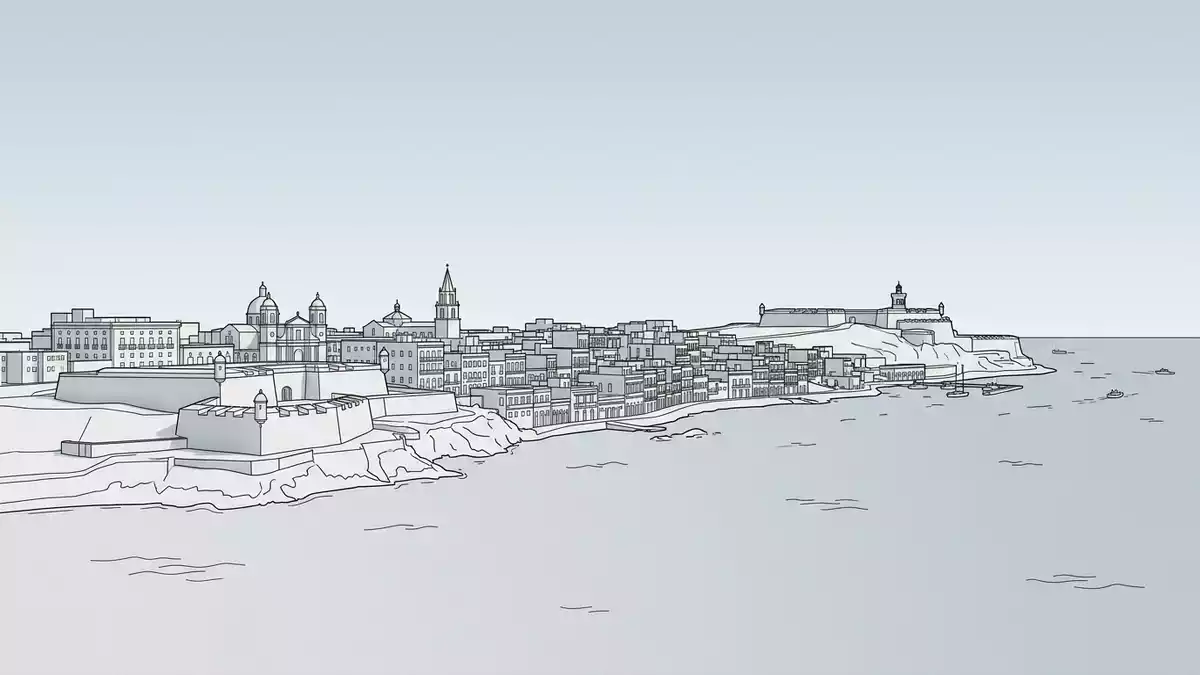
Old San Juan is the historic fortified district of San Juan, Puerto Rico, a compact headland where Caribbean light meets centuries of Spanish stonework and vividly painted houses. Founded in the early sixteenth century as a colonial stronghold, it grew into the island’s earliest urban centre and still retains its dense fabric of churches, plazas, town houses and military defences behind thick city walls.
Stone walls, Atlantic headland and a Spanish colonial plan
Old San Juan occupies the north-western tip of the San Juan Islet, projecting into the Atlantic Ocean and guarding the entrance to San Juan Bay. The district forms a roughly triangular plateau enclosed by substantial masonry walls that follow the contours of the headland and separate the historic streets from the water and the rest of the city.northwest triangle of San Juan Islet Within this stone envelope a tight grid of cobbled streets and small squares reflects early Spanish colonial town planning, with civic buildings, churches and residences arranged around several plazas.
The settlement was founded in 1521 under the leadership of Juan Ponce de León, who had established an earlier town at Caparra and shifted the main urban focus to the islet for better access to the harbour and Atlantic seaways.Juan Ponce de León founded the city in 1521 Over the following centuries the town became the capital of Puerto Rico and one of the oldest continuously inhabited European-founded urban districts in the wider Caribbean region, with a layered streetscape that now mixes early colonial fabric with later nineteenth- and twentieth-century structures.oldest urban centre on the island
Fortresses, city walls and the World Heritage inscription
The most immediately striking elements of Old San Juan are its fortifications, a linked system of bastions, forts and curtain walls that encircle the historic core and command wide views over the ocean and bay. At the north-western tip stands Castillo San Felipe del Morro, commonly called El Morro, a multi-level stone citadel whose ramparts and batteries overlook the harbour entrance and the Atlantic swells beyond the headland.Castillo San Felipe del Morro fortress On the eastern side of the district, Castillo San Cristóbal spreads across a broad area of ground, forming a landward defensive complex of ramparts, tunnels and outworks that once protected the city from attacks by land.Castillo San Cristóbal guarding the eastern gate
Together with La Fortaleza, the governor’s residence near the western end of the old town, these fortifications and large portions of the city wall form part of the UNESCO World Heritage Site known as “La Fortaleza and San Juan National Historic Site in Puerto Rico”, inscribed in 1983.World Heritage designation for San Juan fortifications The designation reflects the importance of this extensive Spanish colonial military architecture, which was developed between the sixteenth and nineteenth centuries to defend a key Caribbean harbour for Spain and later preserved as a historic ensemble.La Fortaleza and San Juan National Historic Site Sections of the wall run along the waterfront and beside the old town’s lower streets, giving clear physical form to the historic boundary between the fortified city and the sea.
Churches, plazas and cobbled streets in the historic quarter
Within the line of the walls, Old San Juan contains a dense ensemble of religious, civic and residential buildings that illustrate successive phases of colonial and later architecture. The Cathedral of San Juan Bautista, located near Plaza de la Catedral, is one of the earliest major churches in the district and serves as the seat of the Roman Catholic Archdiocese of San Juan.historic cathedral and plazas Nearby stands the Church of San José and the historic mansion Casa Blanca, while smaller chapels such as Capilla del Cristo overlook narrow streets and small squares.La Casa Blanca and Church of San José
Residential streets are characterised by rows of two- and three-storey town houses with balconies, shutters and strongly coloured façades, many dating to the sixteenth and seventeenth centuries and later carefully restored. Their doors and windows open directly to the cobbled pavements, while small corner shops, cafes and museums occupy ground floors around plazas such as Plaza de Armas and Plaza San José.restored Spanish colonial buildings The combination of tight street widths, stone paving and close-packed façades creates short vistas that terminate in churches, public buildings or glimpses of the sea beyond the defensive walls.
Visiting Old San Juan: what travellers from Western Europe should know
- Old San Juan stands on a small islet off the northern coast of Puerto Rico, linked to the mainland districts of San Juan by road bridges and reached over the harbour from the wider metropolitan area.
- The historic quarter is compact but built on a slope, with long cobbled streets, sections of steep pavement and stairways within the fortresses that involve sustained walking on stone surfaces.
- Along the waterfront, stretches of the old city wall stand above rocky shorelines and lawns, with open promenades that run below the fortifications and offer clear views of the Atlantic and the harbour mouth.
- Within the district, plazas, churches and major civic buildings sit close together, so moving between the fortifications, the cathedral area and residential streets usually involves short walks rather than long cross-town journeys.
- The official languages are Spanish and English and the currency is the United States dollar (USD). Entry requirements depend on your nationality; UK travellers can check the FCDO travel advice at gov.uk/foreign-travel-advice, Irish travellers the Department of Foreign Affairs at ireland.ie.
Searching for Old San Juan on social platforms
These links open searches for Old San Juan on each platform.
Frequently asked questions about Old San Juan
Where is Old San Juan and what kind of place is it?
Old San Juan is the historic district of San Juan, on a small islet off the northern coast of Puerto Rico, enclosed by substantial stone fortifications and city walls.
What should visitors expect when walking through Old San Juan?
Visitors encounter cobbled streets, plazas, churches, town houses and large forts, arranged within a compact triangular headland where short walks link dense residential areas with open ramparts above the sea.
What makes Old San Juan distinctive among Caribbean historic quarters?
Its combination of extensive Spanish colonial fortifications, the UNESCO-listed ensemble of La Fortaleza and the San Juan National Historic Site, and a long-inhabited grid of colourful streets gives Old San Juan a rare concentration of military and civic architecture in one walkable district.


